
Use the party total
I would record the amount for everyone in the cabin before comparing offers. A per-person amount only helps when the occupancy basis and included charges are clear.

I judge cruise quotes by the complete trip cost. Start with the total for everyone traveling, add compulsory charges not included, then budget your chosen extras and transportation. A current written quote must establish the actual price, inclusions and payment conditions.
I compare adult-only cruise vacations by separating accommodation, required charges and optional spending. For Long Island travelers, adult-only cruise vacations also need a budget for reaching the ship and returning home. The advertised fare alone cannot establish whether the complete trip fits.
I want adult-only cruise vacations to reflect your priorities, not just an appealing headline amount. Through our Long Island travel agency, I help frame cruise planning inquiries. My worksheet below supports a practical comparison before you decide whether to make a payment.
I would record the amount for everyone in the cabin before comparing offers. A per-person amount only helps when the occupancy basis and included charges are clear.
I would mark each required charge as included or additional. If it is already inside the quoted total, I would not add it again in the worksheet.
I would keep an onboard credit separate from cash savings. Its value depends on whether you can use it for something you otherwise intended to buy.
I would reserve room for the experiences that matter most before choosing an upgrade. An attractive cabin is a poor trade if it leaves no budget for your main reason to travel.
I would track the deposit and remaining balance separately from the total. A smaller initial payment does not make the vacation less expensive.

Cruise ship sailing through a mountainous fjord beside waterfalls Client photo (media library)
I first identify whether the displayed amount is per person or per cabin and covers the full sailing. I match it to your party size. For solo travel, I would request the single-occupancy total rather than use a shared-cabin advertisement as the amount payable.
I keep the sailing date, duration, cabin category and fare conditions together. Different accommodation or cancellation terms can make seemingly similar offers unsuitable for a direct price comparison. A lower total is useful only if you accept those differences.
I separate eligibility from price. An adults-only ship and an adult-oriented sailing are not interchangeable descriptions. The applicable age policy for your actual sailing determines whether it meets your requirement, regardless of the label used in advertising.
My starting point is the complete-party total for accommodation you would genuinely accept. I identify what changed between quotes, such as dates or cabin category, rather than assume the difference represents a discount.
I keep deposits in the payment schedule and the full fare in the cost worksheet. An attractive amount due today does not establish the size of your full financial commitment.
I organize the quote into fare, compulsory additions, transportation and optional-spending rows. For each, record the amount, whether it applies per traveler or cabin, whether it is included, and when payment is due. If an amount is not yet available, I mark it as unknown, not zero.
I start with your sailing dates, cabin category and party size. A per-person figure establishes the party total only when its occupancy terms match your booking. I then list taxes, port charges and other required amounts, adding only those outside the quoted fare.
I classify gratuities and service charges according to written supplier terms. I do not assume they are included, compulsory or adjustable. Separating predeparture payments from onboard charges shows both total cost and payment timing without counting anything twice.
I keep flights, transfers, parking and necessary hotel stays outside the cruise subtotal unless expressly included. My optional allowance covers dining, drinks and activities you want beyond fare inclusions. If the complete total exceeds your budget, I compare another cabin or sailing date before cutting priority experiences.
I consider cruise travel insurance separately and include the premium if you choose coverage. The worksheet tracks spending; the policy establishes covered losses, exclusions and conditions. I also keep your personal reserve distinct from supplier charges. With required amounts still unknown, I cannot use the worksheet as a reliable booking budget.
| Budget line | Record | Count |
|---|---|---|
| Fare | Party total; cabin basis | Quoted amount |
| Required charges | Supplier terms | Excluded amounts only |
| Optional spending | Intended purchases | Beyond inclusions |
| Transportation | Travel; necessary overnight stay | Outside quote |
| Protection and reserve | Chosen premium; personal buffer | Separately |
I budget dining, drinks and activities around your habits, starting with what you would buy beyond fare inclusions. A package can suit someone who uses its benefits but offer little value when preferred meals or drinks are already covered.
I compare its price with purchases it would actually replace. Limits, exclusions and additional service charges come from the applicable terms. I keep promotional credit separate from cash savings unless its permitted uses match your intended purchases. Unused benefits do not improve your budget.
Inclusions may belong to a specific fare product. Virgin Voyages' dated Annual Pass promotion described pass-specific extras including laundry service and priority boarding. I would not transfer those benefits to an ordinary sailing quote. The product you book needs its own inclusion list, even when another promotion comes from the same operator.
For a celebration, I protect your main priority. If shared time matters more than upgraded accommodation, I use your romantic getaway preferences to allocate discretionary spending. More inclusions help only when they replace purchases you value; I would not sacrifice a meaningful experience simply to acquire a larger package.
Imagine you are traveling as a couple with a firm budget. You want comfortable accommodation and dining choices but expect to buy few drinks. Both proposed cruises meet your adults-only requirement and fit your dates.
The first quote has a lower fare but excludes some intended purchases. The second costs more upfront and includes some of them. I add required charges and planned extras to the first, then compare that adjusted total with the second. Transportation belongs in both complete-trip totals.
I favor the second only if its benefits replace purchases you would make and its complete total fits. If much of its value is drinks you do not want, I favor the first when its adjusted total is lower. A longer inclusion list does not automatically win.
If neither fits, I revisit accommodation or dates before cutting your priority experience. For Europe, I could compare river cruise and escorted tour formats with European vacation planning. These are alternative formats, not options I assume satisfy an adults-only requirement. I would preserve that requirement when deciding whether an alternative belongs in your comparison.
| Compare | Lower-fare quote | More-inclusive… |
|---|---|---|
| Upfront fare | Lower | Higher |
| Planned purchases | Some excluded | Some included |
| Transportation | Count in complete-trip total | Count in complete-trip total |
| Best fit when | Adjusted total is lower | Benefits replace intended purchases |
| Budget test | Complete total must fit | Complete total must fit |
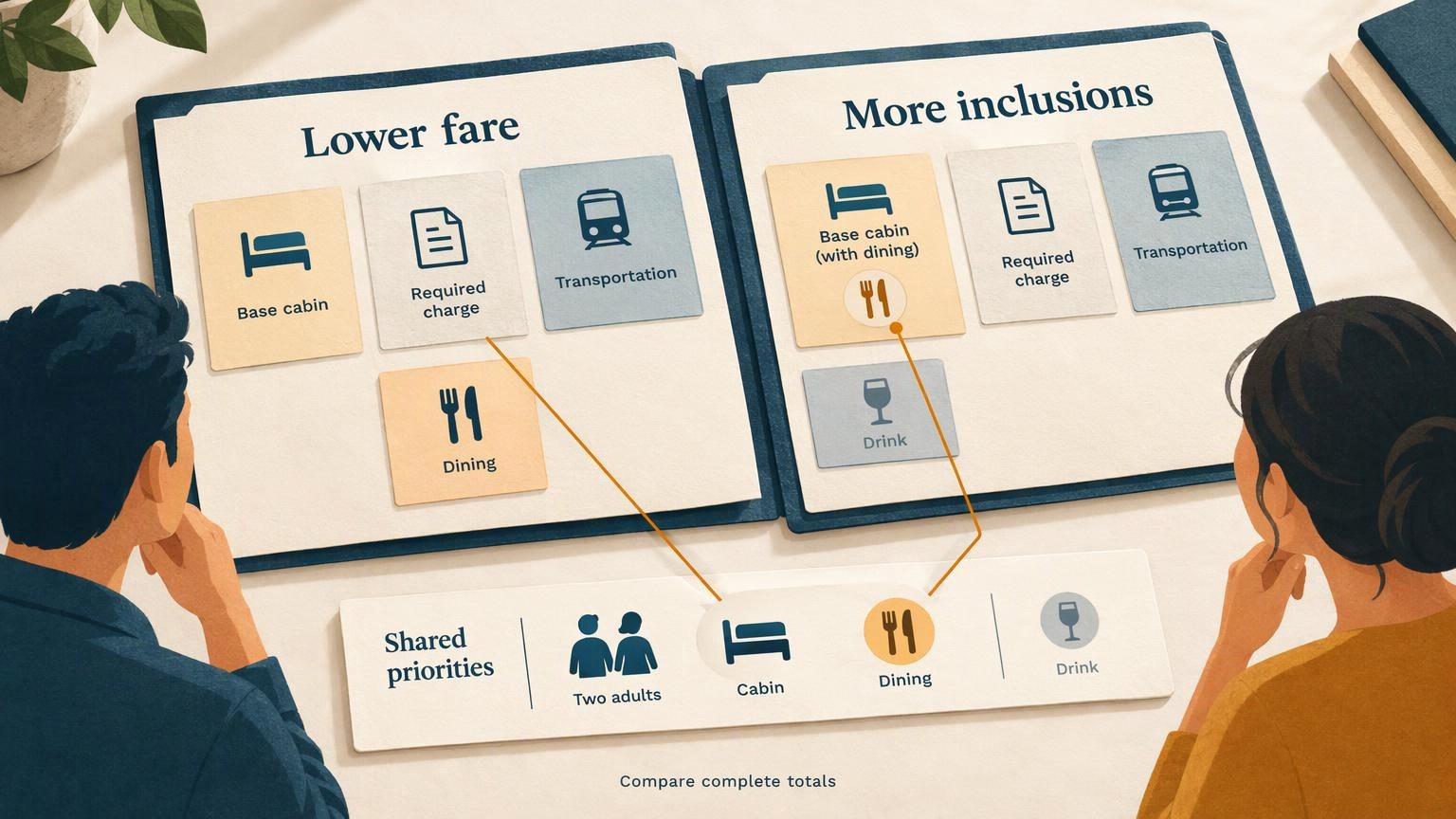
Illustration of two fare portfolios and a shared-priorities strip, with dining shown separately on the left and within the base cabin tile on the right.
My specialties include ocean cruises, river cruises and group travel. I can help frame a trip-specific cruise quote around your dates, accommodation preferences and spending priorities. That connects the worksheet to an inquiry grounded in the vacation you want.
I distinguish your maximum complete-trip budget from your preferred cruise-fare budget. Whether transportation, insurance and activities must fit within that maximum matters: an acceptable fare can leave too little for the rest of the journey.
I separate nonnegotiable preferences from flexible choices. Your departure window might be firm while cabin category is flexible. Those distinctions give the comparison direction without assuming a particular sailing or price is available. They also identify which changes would genuinely help rather than undermine your priorities.
For several travelers, I use group and cruise travel planning to keep cabin budgets separate. One person's optional-spending preferences should not become the whole party's assumed budget.
Before committing, I keep written inclusions, the full amount payable and payment conditions together. My goal is a financially understandable vacation, not a fare that appears affordable only before you account for the other costs involved.
Share the destination, dates and travel style you have in mind. A Superior Travel advisor will help turn the possibilities into one clear, personal plan.