
Identify the decision still pending
I would name what could change your stay before comparing rates. A pending work commitment calls for a deadline that extends beyond that decision, rather than flexibility that expires too soon.

I choose the best hotel booking by comparing cancellation cutoffs, time zones, prepayment, no-show charges and early-departure terms before paying. A flexible-rate label is insufficient. I favor conditions that protect your likely changes, balancing the total cost against the money at risk.
I approach the best hotel booking as a decision about changing plans. For Long Island travelers, the best hotel booking should fit your stay and when work or family commitments become firm.
My best hotel booking comparison starts with written conditions, not flexibility labels. I am Mary Susan Schilling, specializing in family travel, solo travelers and all-inclusive vacations. Through Superior's Long Island travel planning, I would connect those accommodation requirements to your customized trip discussion and the uncertainty that matters most to you.
I would name what could change your stay before comparing rates. A pending work commitment calls for a deadline that extends beyond that decision, rather than flexibility that expires too soon.
I would compare the extra cost of a more flexible rate with the money you could lose under the alternative. A lower price can be reasonable when your dates are firm and you accept the written loss.
I would read when money is collected and when it becomes nonrefundable as separate questions. Paying later does not establish that cancellation is free.
I would establish the required notification process before departure. If travel is disrupted, knowing who handles your reservation is more useful than assuming the room will remain available.
I would save the rate conditions with the booking confirmation. If you change or cancel the stay, I would also retain the written acknowledgment and any revised charges.
I would compare the cancellation cutoff with the point when your plans should become firm. A generous-looking deadline has little value if it expires before you can make the decision that matters.
My comparison would record the exact cancellation date and time, the charge afterward, and how cancellation must be submitted. I would distinguish full from partial refund eligibility rather than treating both as equal protection.
If you are planning a couples' stay with a work commitment still undecided, I would compare a nonrefundable rate with refundable options whose cutoffs fall before and after that decision.
I would favor the later cutoff if avoiding a cancellation loss matters more than the quoted price difference. The earlier refundable option does not solve your timing problem; the nonrefundable option remains reasonable if you accept its stated loss. I would still examine the other conditions before selecting either refundable rate, since a useful deadline alone does not establish complete protection.
For family and group vacation planning, I would apply that reasoning to each household. One family's certainty does not establish everyone else's ability to commit.
| Rate | Timing protection | My choice |
|---|---|---|
| Nonrefundable | None stated | Accept only a tolerable loss |
| Cutoff before decision | Expires too soon | Do not pay extra for unusable flexibility |
| Cutoff after decision | Potentially useful | Compare full terms, cost and avoided loss |
| Rate | Timing protection | Decision |
|---|---|---|
| Nonrefundable | None stated | Accept only a tolerable loss |
| Cutoff before decision | Expires too soon | Do not pay extra for unusable flexibility |
| Cutoff after decision | Potentially useful | Compare full terms, cost and avoided loss |
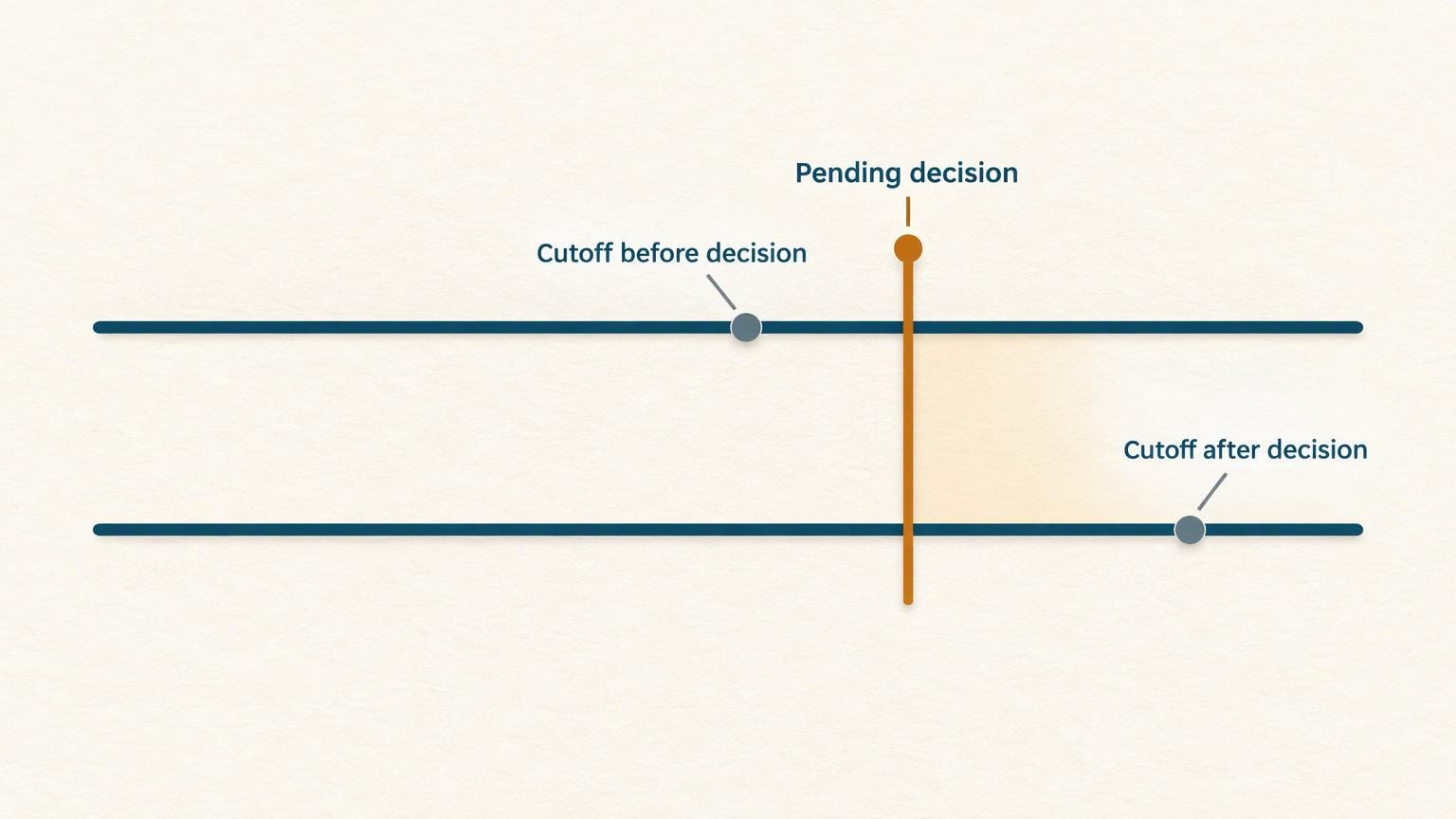
Illustration comparing cutoffs before and after a pending decision, with a shaded interval between the decision line and the later cutoff.
I would record the deadline with its stated time zone. A date alone leaves an essential question unanswered: which clock determines whether your cancellation arrived on time?
If the terms use hotel local time, I would translate that into the time you will use when acting. If the applicable zone is unspecified, I would get written clarification rather than assume it follows your home location or the booking website.
For customized European vacation planning, I would keep a separate deadline for each proposed hotel. I would not carry a time-zone assumption or cancellation rule from one reservation to another, even within the same itinerary.
I would distinguish sending a request from completing the required cancellation process. Before relying on email or a message, I would establish whether that method satisfies the terms and what acknowledgment to retain.
My practical approach is to act before the cutoff and save confirmation. A calendar reminder helps with timing, but it is not evidence of cancellation; I would look for a booking record showing the completed action and any resulting charge or refund amount.
I would separate the payment schedule from refund eligibility. My comparison would show what is collected at booking, any later payment requirement, and what portion is refundable at each stage.
I would not interpret pay later as cancel freely, or prepaid as automatically nonrefundable. I would use the exact conditions to answer both questions and distinguish payment from a card authorization if that affects your available funds.
To compare value, I would align room category, occupancy, dates, meal inclusions and total quoted charges. A lower total with different inclusions or stricter terms is a different purchase, not a like-for-like saving. I would compare the extra cost of flexibility with the loss you could accept.
The My Points Life guide illustrates why refundability, prepayment, deposits and inclusions belong in a rate comparison. I would rely on current booking terms, not a price-guarantee label, for refund rights.
For Caribbean and all-inclusive vacations, I would distinguish accommodation from package conditions. When comparing romantic getaway arrangements, I would establish whether added services have separate payment or cancellation terms before treating the whole trip as refundable.

Illustration of two separate desk folders labeled Payment timing and Refund eligibility, pairing a blank card and sequence markers with layered papers under a magnifying glass.
I would read the no-show clause independently from the cancellation clause. My question is what happens if you miss arrival without completing the required cancellation or notification.
Before booking, I would identify the stated charge, any effect on the remaining stay and the process for reporting delayed arrival. I would not assume notification automatically removes a penalty or preserves the reservation.
If you still intend to travel but a disruption delays arrival, I would distinguish that from abandoning the stay. Your priority is to establish whether the booking can remain active and obtain written acknowledgment of the agreed arrangement. I would retain that acknowledgment with the original terms so the change is documented, rather than rely on an informal assurance.
For a hotel stay attached to an escorted tour or river cruise, I would examine hotel terms separately. A change to one component is not permission to disregard another reservation's requirements.
My decision would turn on the consequence you can accept if arrival fails. If unclear, I would resolve it before payment rather than rely on a flexible-rate description to cover an arrival problem.
I would check early-departure terms even after finding an acceptable cancellation rule. Canceling before arrival and leaving after the stay begins are different actions; permission for the first does not establish a refund for the second.
My review would identify whether unused nights are refundable, shortening the stay triggers a charge, or remaining nights are repriced. These are separate questions about the proposed conditions, not charges I presume every hotel applies.
If your departure date may change, I would give this clause more weight than a cancellation benefit you are unlikely to use. A rate can fit your pre-trip uncertainty yet fail to protect the shortened stay you anticipate. I would compare that exposure with the cost of an alternative whose written terms address it.
My family travel, solo traveler and all-inclusive specialties are relevant to discussing those needs. Superior provides customized planning, so I would connect accommodation requirements to your dates and acceptable alternatives without promising a particular rate or exception.
Before committing, I would compare all five terms, the total quote and your acceptable financial exposure. My choice would fit likely changes, not simply favor flexibility or price.
Share the destination, dates and travel style you have in mind. A Superior Travel advisor will help turn the possibilities into one clear, personal plan.