
Start with your hotel day
I would decide how much time you expect to spend at the property. A long facilities list has less value when your plans keep you out until dinner.

I would favor boutique for an intimate setting and a larger luxury property when its facilities support your daily plans. Neither size guarantees better service or privacy. The best luxury hotels for your trip have room arrangements, usable facilities and rate terms that match your needs.
I compare the best luxury hotels by your daily plans, not lobby photographs. For Long Island travelers, choosing among the best luxury hotels means weighing an intimate setting against more places to eat, relax and spend time.
My approach to the best luxury hotels separates atmosphere from practical fit. Through customized travel planning on Long Island, I would connect your hotel preference to the wider trip, then examine the rooms and facilities that could change your choice.
I would decide how much time you expect to spend at the property. A long facilities list has less value when your plans keep you out until dinner.
I would judge privacy through the room's position, outdoor space and shared areas. A smaller hotel can feel sociable rather than secluded, so guest count alone would not settle my choice.
I would translate personalized service into a specific need, such as help with dinner plans or support after a late arrival. The relevant question is how that service operates during your stay.
I would favor a useful room arrangement over an impressive upgrade label. Separate sleeping space or a suitable bathroom can affect your stay more than a decorative difference.

Aerial view of beachfront hotel buildings beside a wooden pier Client photo (media library)
I treat boutique and luxury as different descriptions, not opposing categories. Boutique points toward an intimate, distinctive style; luxury describes an expected level of accommodation and service. A boutique property can belong on a luxury shortlist.
Here, I use grand hotel to mean a larger, full-service property. I would not treat grand in a hotel's name as proof of size, facilities or quality, or choose using a fixed room-count cutoff.
I would consider a smaller setting when intimacy matters and extensive shared facilities do not. I would consider a larger property when dining, recreation or separate spaces for members of your party would improve your day.
Choosing intimacy may mean accepting fewer on-site options. Choosing breadth may mean paying for facilities you rarely use or spending time in shared areas whose atmosphere you dislike. I would weigh those trade-offs against your routine.
I would make scale an initial preference, not a verdict. A small property with the wrong room is a weaker fit than a large one with suitable accommodation, even when the smaller hotel's photographs better reflect your taste.
| Priority | Boutique | Larger property |
|---|---|---|
| Atmosphere | I favor intimacy. | I favor broader shared spaces. |
| Facilities | Fewer options may suffice. | More usable choices may justify cost. |
| Service | I compare arrangements and hours. | I apply the same test. |
| Privacy | I prioritize layout and position. | A quiet room can outweigh scale. |
| Priority | Boutique | Larger property |
|---|---|---|
| Atmosphere | Intimate, distinctive setting | Broader shared spaces |
| Facilities | Fewer on-site options may suffice | More usable choices may justify cost |
| Service | Check arrangements and hours | Check arrangements and hours |
| Privacy | Judge room layout and position | A quiet room can outweigh scale |
I distinguish having a facility from being able to use it as intended. A restaurant matters differently when you need an early breakfast, a flexible dinner after returning, or somewhere to eat without changing out of pool clothes.
For a pool, spa or fitness space, I would evaluate access conditions, hours and separate charges. I would distinguish on-site facilities from services arranged elsewhere: either may be useful, but they create different routines and may require different amounts of travel time.
I apply that reasoning to service. I would examine the help you need and when it operates, rather than assume smaller means more attention or larger means every service. Support after a late arrival could matter more than a general promise of personalization.
For Caribbean and all-inclusive vacations, meals and hotel time may be central. I would weigh usable dining arrangements more heavily than venue counts.
For European vacation planning centered on days away, I would emphasize comfortable nights and convenient meals. I would not reject boutique simply for a shorter facilities list when those missing extras would contribute little to your trip.
For families, I would start with sleeping arrangements, bathroom access and permitted occupancy. A suite label does not establish whether one person can sleep while another reads, or whether everyone has enough privacy. I would compare the actual layout.
I would distinguish connecting rooms from nearby rooms, and a separate bedroom from an open sitting area. When that distinction determines whether the stay works, accommodation arrangements should outweigh the hotel's overall style, regardless of how appealing its shared spaces look.
For family and group travel, I would separate each household's room needs from shared preferences. An intimate property is not automatically unsuitable, but atmosphere cannot compensate for the wrong layout.
For a honeymoon, I would focus on room privacy and time together. A terrace, bathing arrangement or quiet position may matter more than lobby scale. I would treat these as preferences, not assumed features.
I would connect those priorities to honeymoon planning or romantic getaways. Couples enjoying active shared spaces may favor a larger hotel; those seeking a quieter routine may favor boutique, provided the room and usable facilities support that choice.
I would not assume boutique means cheaper or grand means better value. Dates, room category, meals and booking terms can change the purchase. I would compare the same dates and traveler details, then explain differences between proposed rooms.
I would separate accommodation charges from taxes, mandatory property charges and optional purchases. Breakfast, meals, transfers and facility access matter when they affect expected spending. I would count them as included only when the rate terms establish that, not because they appear in hotel descriptions.
A meal inclusion is valuable if you will use it. I would give less weight to credits for unwanted purchases or those requiring additional spending. Conditions matter as much as the advertised benefit.
I would compare cancellation deadlines, deposits and change terms. A lower nonrefundable rate may suit settled plans, but I would not accept that exposure merely to secure a hotel style.
Better value funds the parts of the stay you care about on acceptable terms. For a current quote, request James McParland by name so I can discuss your dates, party and accommodation preferences rather than an undated starting rate.
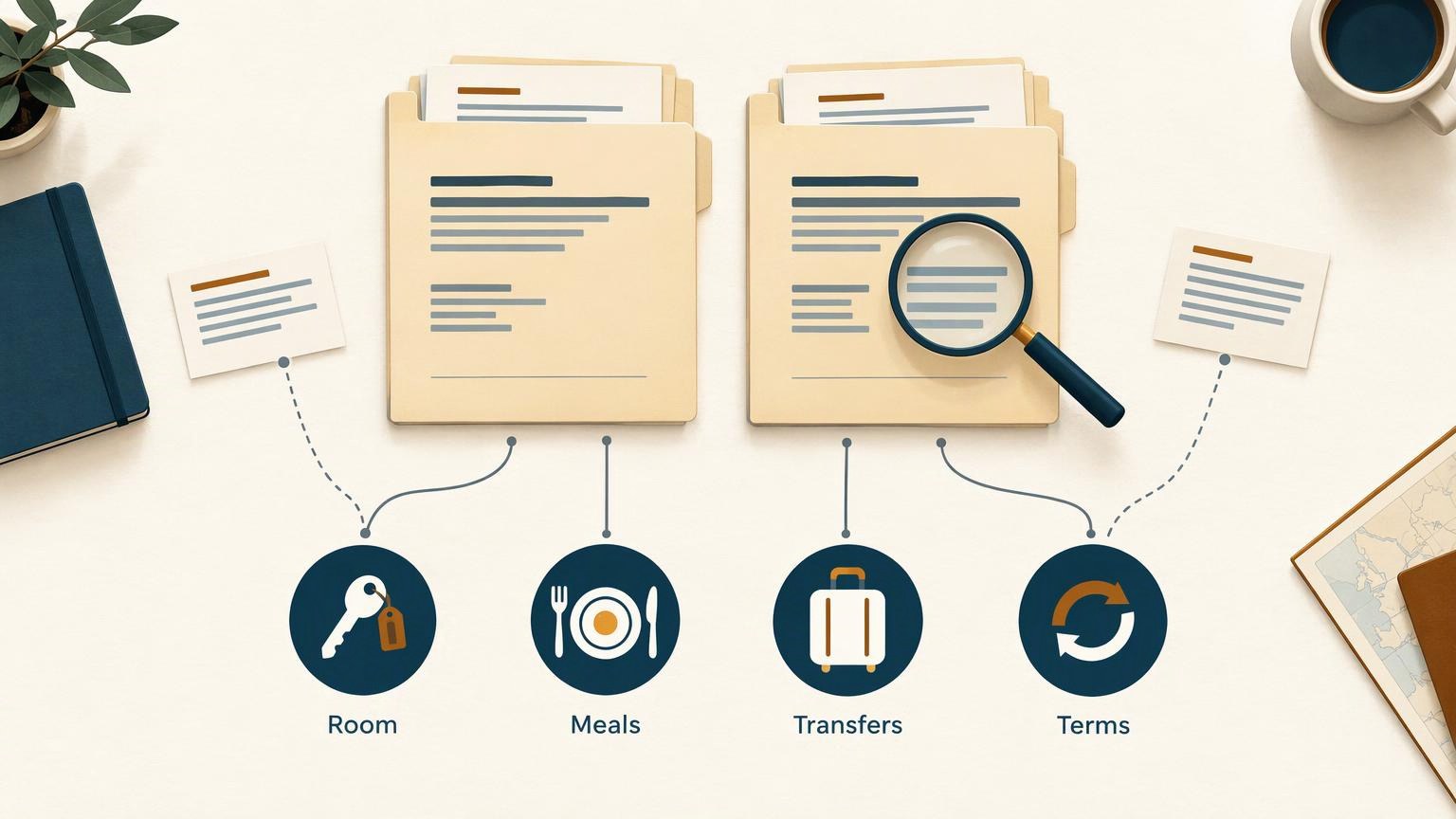
An illustration of two neutral folders and connected planning tokens, with a magnifying glass over abstract document marks, emphasizes examining rate inclusions and terms.
Suppose your honeymoon priorities are quiet mornings, private room space and leisurely hotel dinners, without a large recreation program. I would initially favor an intimate property, then evaluate whether its room and dining arrangements support that routine. Atmosphere would matter, but not at the expense of an essential need.
If boutique offers the setting you like but unsuitable dining, I would consider the larger property. A quiet room there could be the better fit. I would not trade a practical requirement for a smaller guest count.
Now suppose you will spend most days at the hotel, choosing different places to eat and relax. I would give a larger property's usable facilities more weight, while still comparing privacy and access conditions. That changes the starting preference, not the need to evaluate the room.
My specialties include all-inclusive vacations, groups, cruises, Punta Cana and Antigua. For those destinations, I would suggest the Punta Cana and Antigua resort guide as further reading. Superior Travel Consultants' customized planning connects accommodation preferences to your trip, so hotel scale remains one part of the decision rather than its sole focus.
Share the destination, dates and travel style you have in mind. A Superior Travel advisor will help turn the possibilities into one clear, personal plan.