
Separate arrival from departure
I would record when each person leaves home, not only when they reach the shared accommodation. An earlier independent stay belongs in the itinerary used to evaluate coverage.

I would compare the best travel insurance for families against insured-person eligibility, permission for independent travel, and each person's coverage start and end provisions. Shared or separate policies should fit the actual journeys, with unclear terms resolved before choosing an arrangement.
When considering the best travel insurance for families, I would begin with a separate itinerary line for each traveler. I would include an independent stay before the shared vacation and a later return home. A search for the best travel insurance for families should use those full journeys, not just the accommodation dates.
I am Robin Holian, and my specialties include family travel, groups and cruises. For Long Island travelers comparing the best travel insurance for families, I would also identify individual tickets and shared expenses. That gives the policy discussion a concrete question: whose financial exposure needs to be evaluated if one person cannot join?
I would record when each person leaves home, not only when they reach the shared accommodation. An earlier independent stay belongs in the itinerary used to evaluate coverage.
I would identify households, relationships and children's ages when requesting a comparison. I would not assume that relatives sharing accommodation satisfy the policy's insured-person requirements.
I would distinguish individual tickets from shared accommodation costs. That makes it easier to ask whose expenses are insured when one traveler cannot join.
I would consider what happens if someone becomes ill after relatives depart but before that person leaves. The question is which provisions apply to each affected traveler.
I would retain the applicable policy wording, itinerary and written explanation together. If the explanation and contract seem inconsistent, I would seek resolution before purchasing.
I would start by checking whether the people traveling can be insured under the proposed arrangement. Being related, paying together and sharing accommodation are different facts; I would not use them as a substitute for the policy's eligibility wording.
My comparison would identify every traveler, their age, residence and relationship to the other insured people. I would then examine any requirements concerning households, accompanying adults or travel together. A child joining another relative needs attention to the adult relationship specified in the contract, rather than an assumption based on the booking.
I would distinguish a person insured for their own journey from a relative whose illness might be relevant to someone else's cancellation claim. Those are separate questions. Listing a relative in the itinerary does not answer either one.
For family and group vacation planning, I would map households before comparing insurance arrangements. If the proposed wording accommodates everyone and their independent travel, a shared arrangement remains worth considering; if it does not, I would compare alternatives rather than adjust the itinerary description to make it appear eligible.
I would create a timeline for every traveler: departure from home, any independent portion, arrival at the shared stay, departure from that stay and return home. I would use those timelines to examine the dates and coverage provisions.
I would separate cancellation protection before departure from benefits intended for travel itself. I would look for the start and end provisions attached to each benefit, rather than assume that a single displayed date explains the whole contract.
For a customized European vacation, an adult might travel independently before joining the family. I would include that portion in the policy question, even when the shared accommodation begins later.
I would also examine early returns, extended stays and changes to scheduled dates. Entering the earliest family departure and latest family return may look tidy, but I would first establish whether those dates accurately represent each insured person's journey under the contract.
For escorted tours and river cruises, I would distinguish the organized itinerary from travel before and afterward. My coverage comparison would follow the person, not merely the tour's start and finish.
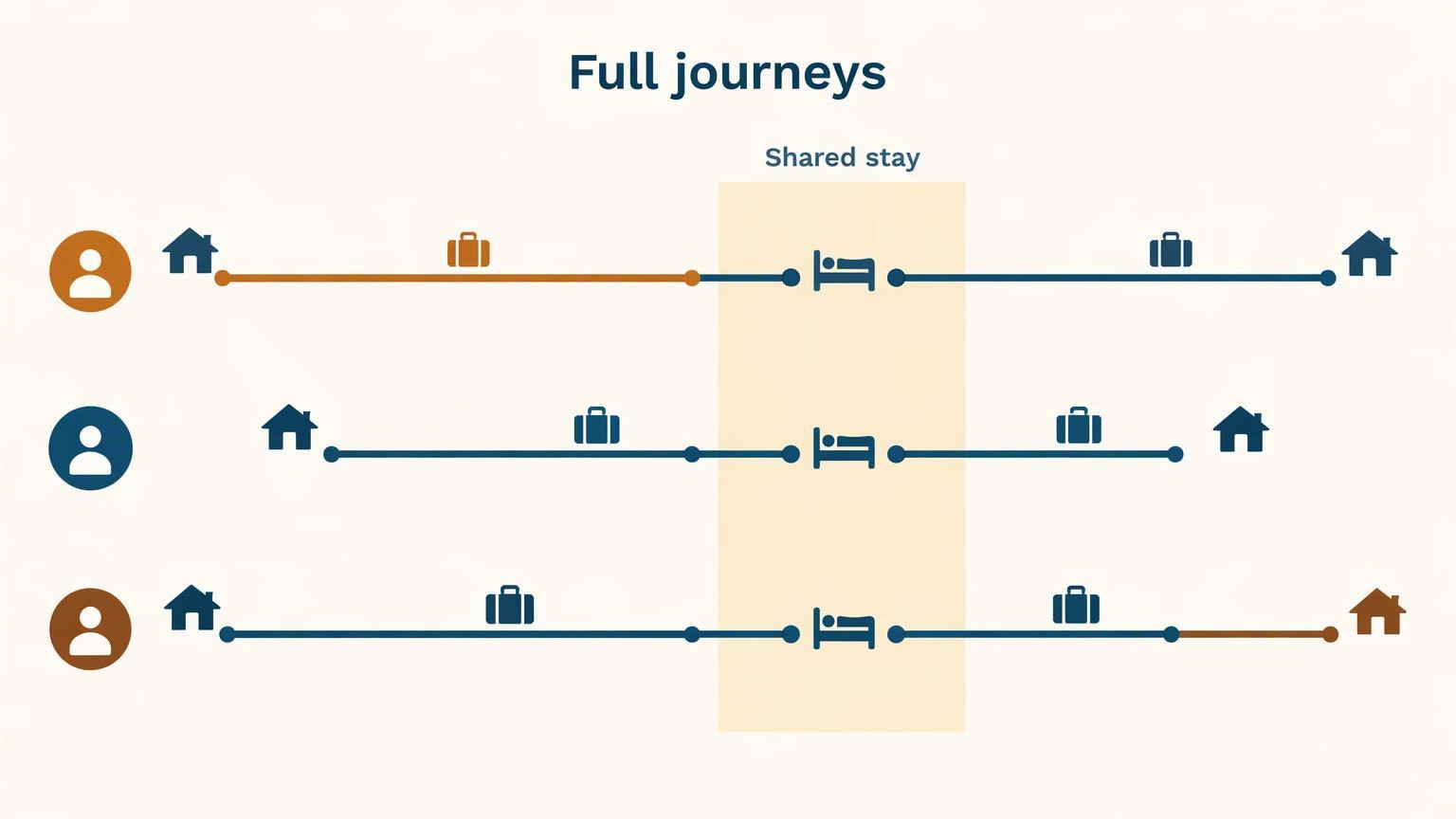
An illustration labeled Full journeys shows three travel timelines with different endpoints, a highlighted Shared stay band and contrasting segments before or after it.
I would test events affecting relatives at different journey stages. Travelers already away may face different questions from relatives still home.
Say an adult becomes ill before leaving, while another household is already at the shared accommodation. I would examine the cancellation question for the adult still home and the interruption question for relatives considering an early return. I would check the relevant definitions, covered reasons, exclusions and documentation requirements separately.
I would also distinguish a delayed arrival from the decision to cancel the remaining trip. I would examine any time threshold, qualifying cause and expense restriction. A disruption alone is not enough for me to conclude that reimbursement applies.
With Caribbean and all-inclusive vacations, I would identify who paid for shared accommodation and how each person's insured trip cost is represented. I would ask how the contract treats the affected expense rather than promise that everyone's share is recoverable.
For a cruise, I would pair this analysis with the cruise travel insurance guide. Medical care, missed embarkation and cancellation deserve distinct questions, not one general assurance that the family is covered.
I would compare arrangements after establishing eligibility and dates. My preference would depend on the contract's fit, not whether one purchase appears simpler.
Say parents and children travel together, while grandparents join after an independent stay and return later. I would test a shared arrangement against those journeys. If its provisions do not accommodate the grandparents' travel, I would compare household or individual arrangements with accurate dates rather than assume that the family relationship solves the mismatch.
If the shared arrangement fits everyone, I would keep it in the comparison. Separate policies would not automatically be better; I would still examine whether an event involving a relative under another policy is relevant to each person's benefits.
My trade-off is administrative simplicity versus a clear match to each journey. Separate arrangements require more records and potentially different terms to track. A shared arrangement is useful only if its convenience comes with suitable eligibility, dates and benefits.
I would compare current premiums alongside medical and evacuation provisions, cancellation and interruption benefits, deductibles, exclusions and optional coverage. A cheaper quote would not resolve an unanswered itinerary question.
| Arrangement | Required fit | Trade-off |
|---|---|---|
| Shared | Everyone and their independent journeys qualify | Fewer records; check individual timelines |
| Household | Each household's travelers and dates qualify | Check cross-household disruptions |
| Individual | Each person's full journey qualifies | More contracts; check relatives' relevance |
| Arrangement | Required fit | Trade-off |
|---|---|---|
| Shared | Everyone's independent journeys qualify | Fewer records; check individual timelines |
| Household | Household travelers and dates qualify | Check cross-household disruptions |
| Individual | Each person's full journey qualifies | More contracts; check relatives' relevance |

Illustration comparing Shared, Household and Individual groupings through folders and sleeves with traveler pictograms, travel cards and abstract papers; a magnifying glass and pencil emphasize examination.
My specialties at Superior Travel Consultants include family travel, groups and cruises. That matters when your insurance question depends on who travels together, who joins later and which arrangements the family shares.
I would organize the discussion around the itinerary and its policy questions. A useful request explains each person's departure and return dates, independent travel, shared bookings and the disruption you want to understand. I would keep trip planning separate from any insurer's determination of eligibility or coverage.
For travelers choosing a travel agency on Long Island, a named advisor makes the relevant planning specialties clear. My role is tied to your family itinerary; I would not treat a planning conversation as a replacement for the applicable insurance contract.
Before choosing, I would seek a written explanation addressing the dates and people involved. If an answer only describes ordinary travel together, I would ask about the separate portion rather than extrapolate.
You can share your separate departure and return dates and request me, Robin Holian, by name. Include the provision you want clarified and request a current quote for the proposed arrangement.
Share the destination, dates and travel style you have in mind. A Superior Travel advisor will help turn the possibilities into one clear, personal plan.