
Keep the easy parts independent
I would not recommend broader planning just because you have several reservations. If each choice is clear and changing one leaves the others intact, independent booking may suit you.

I would consider customized resort booking help when accommodation choices change your arrivals, sleeping setup or onward journey. A straightforward stay may suit independent booking. The deciding factor is whether changing one component forces you to rethink another, not reservation count.
I would start a resort booking with what the accommodation must make possible. For Long Island travelers, resort booking might mean a simple stay or a shared base for households with different schedules. I would distinguish those jobs through our Long Island travel agency.
My approach to resort booking connects the room decision to surrounding travel days. Amenities narrow choices, but essential sleeping arrangements or onward departures can determine which properties work. I would use those dependencies to decide how much planning help you need.
I would not recommend broader planning just because you have several reservations. If each choice is clear and changing one leaves the others intact, independent booking may suit you.
I would write down who needs to sleep where before selecting a room category. A category name alone does not establish bedding, privacy or access between rooms.
I would separate the shared resort stay from each household's journey. Traveling together does not require everyone to use the same airport, flight or transfer.
I would test the departure plan before treating the final night as settled. An onward journey can change how much of that night and the following morning you can actually use.
I would compare accommodation alongside meals, transportation and optional spending. A lower room total is useful only if the remaining arrangements still meet your needs.
I would narrow resort choices by your budget, preferred atmosphere and amenities you expect to use. Those criteria describe what you want; arrival plans and room requirements determine whether a property supports the trip.
I would then apply a dependency test: if you changed this resort or room, what else would change? A pool preference might leave everything else untouched. An unsuitable sleeping arrangement could require another category, property or set of dates.
I would distinguish the planning choices below rather than assume every stay needs the same service. The right scope is the smallest one that resolves decisions you cannot separate. Several independent reservations do not necessarily create an interconnected itinerary.
For a stay centered on meals and resort time, I would start with Caribbean and all-inclusive vacation options, then test the accommodation and travel arrangements. The vacation format alone does not establish what an offer includes.
Broader planning requires agreement on priorities and responsibilities before individual pieces move forward. I would keep that coordination proportionate: resolve the dependency without bringing unrelated, manageable decisions into the planning scope merely because they belong to the same vacation.
| Scope | Fits when | Responsibility |
|---|---|---|
| Independent | Decisions stand alone | You manage changes |
| Accommodation help | Room suitability determines choice | Assign other components |
| Customized planning | Rooms, arrivals and onward travel interact | Agree on shared decisions |
| Scope | Fits when | Responsibility |
|---|---|---|
| Independent | Decisions stand alone | You manage changes |
| Accommodation help | Room suitability determines choice | Assign other components |
| Customized planning | Rooms, arrivals and onward travel interact | Agree on shared decisions |
I would separate preferences from requirements before comparing amenities. A preferred view can be negotiable; sleeping arrangements that provide supervision or privacy may determine whether you can use a room at all.
I would describe the layout plainly: who shares a bedroom, whether rooms need an internal connection, bathroom access and who needs separate space. That is more useful than asking for a general family or luxury category.
Our team reviews occupancy rules, bedding, bathroom count and room relationships. I would distinguish configurations the property can confirm from those it accepts only as requests. Those offer different foundations for your decision.
Suppose you are comparing a suite with separate bedrooms against rooms you want connected. I would compare privacy and access first, then establish the connection's status. If it is essential, an unconfirmed request is not an equivalent solution. You would need to choose whether another confirmed layout meets your needs or whether the property should leave your shortlist.
For couples considering romantic getaway options, I would likewise prioritize how you intend to use the room. An appealing setting cannot compensate for a layout that conflicts with those priorities.
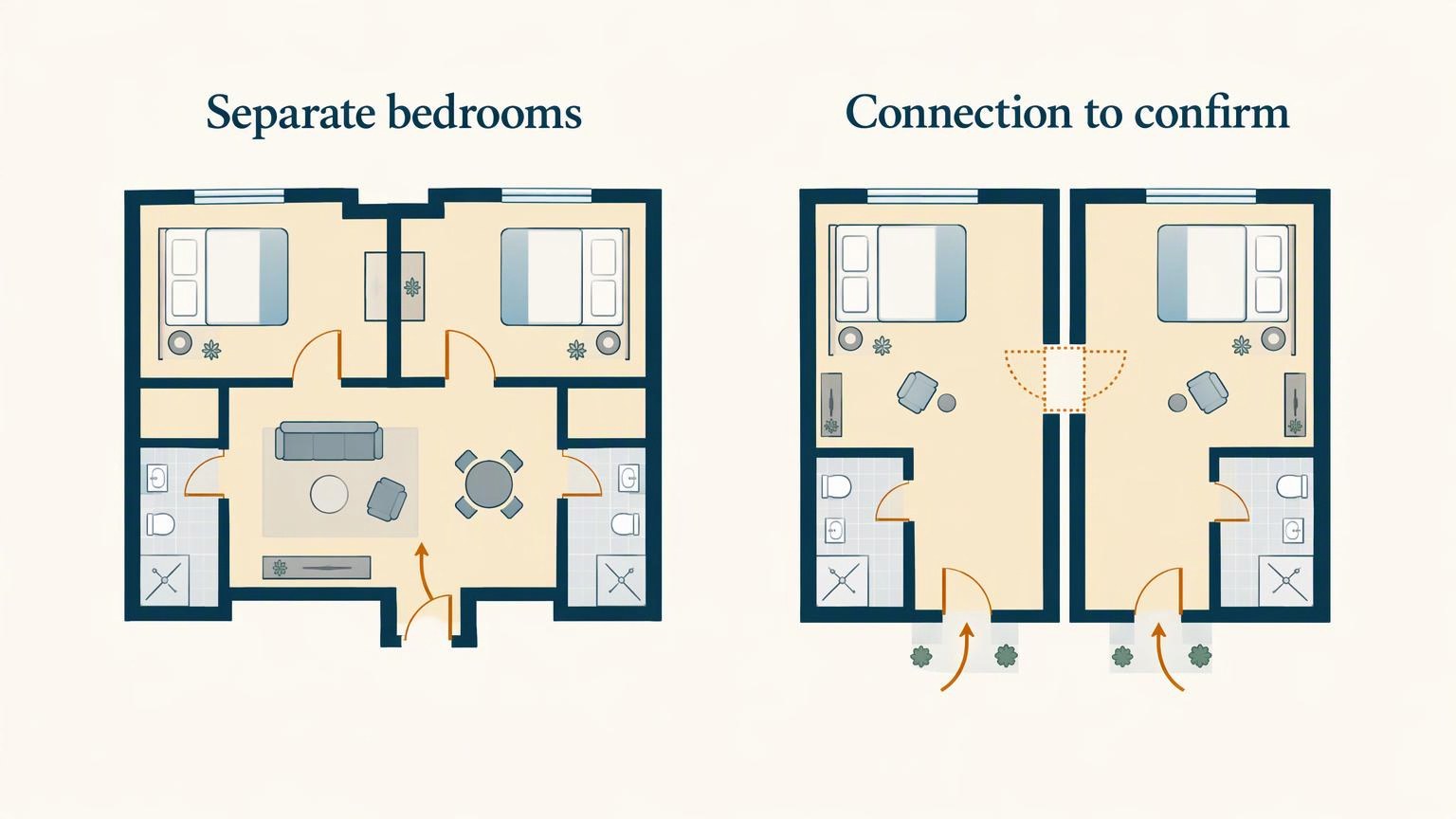
Illustration comparing separate bedrooms around a shared lounge with two independently entered rooms labeled “Connection to confirm,” linked by a dotted doorway.
I would create an arrival record for each household before considering a group transfer. It should identify the intended airport, date, expected arrival, travelers and luggage or mobility needs relevant to transportation.
Our team can organize key information, coordinate common arrangements and clarify which decisions belong to each household. I would keep that distinction visible so shared plans do not absorb responsibilities nobody agreed to handle.
For family and group travel, I would separate shared resort dates from individual flights, transfers and payments. Different arrivals can suit households with different budgets or departure needs. The goal is a workable shared stay, not identical journeys.
I would compare shared and separate transfers by waiting time and the consequences of a delayed arrival. The supplier must explain its arrangements; I would not assume a vehicle waits indefinitely or a flight change automatically updates transportation.
I would assign ownership before booking: each household should know who books flights and receives schedule updates. If transportation falls within the planning scope, pickup details and the change process should be clear. That lets you judge whether sharing transportation actually simplifies your arrival or creates another dependency.
I would work backward from the next commitment before choosing the resort's final night. An onward flight, tour or cruise creates a timing requirement that a room-only comparison misses.
Suppose you share a resort stay with relatives, then continue to a cruise while they return home. I would separate your departure needs from theirs, then compare staying together through the final night with leaving the resort earlier to support your onward journey.
You would decide how much shared time matters. I would frame the timing choices; relevant suppliers would confirm their arrangements. If departure prevents you from comfortably using the final morning, I would weigh that lost time against changing the stay.
Leaving earlier reduces time with relatives, while staying together may leave less flexibility for the next leg. I would choose according to that trade-off rather than automatically favor more resort nights. The households can share most of the vacation without needing the same final night.
My custom vacation and cruise planning specialties are relevant here. I would apply this approach to European vacation planning or a stay paired with an escorted tour or river cruise, without assuming every discussed component is included.

Illustration of coastal travel choices, with branching paths labeled Shared final night and Earlier departure, travelers with luggage, and a distant cruise ship.
I would compare offers after matching dates, travelers, room configuration and included components. A lower total may otherwise describe a different stay, not better value for the same trip.
I would treat room category, occupancy, meal coverage and transportation as separate cost drivers. Optional experiences and spending outside a meal plan belong in your overall budget, even when excluded from the booking total. This makes the comparison useful for deciding what you can comfortably spend throughout the vacation.
I would distinguish supplier terms from the planning arrangement. Payment requirements, changes and cancellation conditions apply to specific components. Any planning fee and the work it covers should be explained before you proceed. Separately booked pieces may have different terms, so I would not treat one component's flexibility as protection for the whole itinerary.
My specialties make group logistics or onward cruise travel a relevant planning conversation. They establish neither a universal fee nor a promise that every request can be fulfilled.
I would define my role as accommodation selection, shared arrival coordination or broader itinerary planning. Keep independent bookings visible so that scope reflects your actual trip.
Share the destination, dates and travel style you have in mind. A Superior Travel advisor will help turn the possibilities into one clear, personal plan.