
Match the trip before comparing prices
I would align the sailing, travelers and cabin requirements first. A cheaper quote for a trip you would not choose is a different option, not a saving on your preferred vacation.

I would choose a discounted fare when your plans are settled and its potential loss is acceptable. I would pay more when the written terms protect a change you may need. Neither a discount label nor a higher price proves better value.
I compare cheap cruise vacations by separating the cost of sailing from the cost of changing plans. For Long Island travelers, cheap cruise vacations need a like-for-like comparison before an advertised saving becomes meaningful.
My approach to cheap cruise vacations distinguishes flexibility before booking from flexibility afterward. Choosing another sailing broadens your search; it does not change a booked fare's terms. I would focus on your real uncertainty, such as time off or a companion's availability, and whether the quoted rights remain useful until that uncertainty is resolved.
I would align the sailing, travelers and cabin requirements first. A cheaper quote for a trip you would not choose is a different option, not a saving on your preferred vacation.
I would identify the actual concern, such as moving the departure date. Broad reassurance about flexibility matters less than whether the quoted terms permit that particular change.
I would not treat a smaller initial payment as evidence of a safer booking. The payment schedule and the amount recoverable after cancellation need separate consideration.
I would count a credit or package only to the extent it replaces spending you already intended. A benefit that encourages extra spending should not erase a fare difference on paper.
I would retain both quotes and their applicable terms together. That record helps distinguish the offer you evaluated from a revised quote with a different price or condition.

Cruise ship sailing through a mountain fjord beside waterfalls Client photo (media library)
I would judge the saving by its value to you, not the advertised discount's size. A lower fare deserves consideration when both quotes meet your needs, even if it carries restrictions.
I would not assume discounted fares are restrictive or higher fares are flexible. Price and booking rights are separate attributes; the written terms determine how they interact.
My decision has two parts: can you afford the vacation, and can you accept the financial outcome if you cannot take it? A fare can pass the first test and fail the second.
If losing the nonrecoverable amount would prevent a replacement trip, I would give that consequence more weight. With settled plans and a manageable potential loss, paying for rights you are unlikely to use may be unnecessary.
I would also compare the extra cost of flexibility with the loss it could prevent. If the premium strains your vacation budget but leaves your main cancellation risk unchanged, I would favor the lower fare or reconsider the commitment.
I would also reject an unwanted itinerary chosen solely for its discount. Frommer's discussion of port days versus sea days illustrates why the vacation itself belongs in the calculation. I would weigh the itinerary against your interests and intended excursion spending, not just its headline fare.
I would calculate the complete trip cost before weighing flexibility. My starting point would be the same sailing and travelers, with cabins meeting the same requirements. Otherwise, the apparent saving may reflect a different vacation.
I would separate inclusions from planned spending outside the quote. Dining, drinks, internet, excursions and gratuities belong in the comparison according to the actual offer, not assumptions about cruises generally.
I would include transport and necessary lodging. Cruise Fever identifies airfare as a potentially substantial vacation cost; I would compare current flight arrangements without assuming a cruise-line package is cheaper or provides particular protections.
For a longer trip, I would evaluate the land portion alongside European vacation planning. A flexible cruise fare does not make separately booked travel flexible. Those arrangements can add financial exposure even when the cruise itself permits changes.
Finally, I would distinguish cash paid from conditional benefits. A credit's value depends on permitted uses and your intended spending, not automatically its face value. I would count only spending it genuinely replaces, so an attractive perk does not disguise a higher total.
I would translate flexible into a specific right: changing sailings, canceling for cash and receiving future credit are different outcomes. Rescheduling may offer little help if your concern is whether you can travel at all.
I would compare rights at the time your plans should become clear. If work approval arrives after a change deadline, that option does not solve your problem. Paying more makes sense only when the terms address your actual decision window.
I would separate permission to change from its cost, including any fee and replacement fare difference. A waived fee need not preserve your original price. For future credit, expiration, eligible sailings and traveler restrictions determine whether it is a usable alternative to cash.
I would value a refundable deposit only for the commitment it protects. If later payments become nonrefundable under the quoted schedule, that initial right would not protect the entire vacation cost. My comparison would follow the amount at risk as each deadline passes.
The table is my quote-reading framework, not any cruise line's current policy. I would keep the lower fare when its potential loss is acceptable, rather than buy irrelevant protection.
I would evaluate insurance separately: coverage depends on policy terms and exclusions, not the fare label. My cruise travel insurance discussion explains that separate decision.
| Quoted right | Terms I would compare | Useful for |
|---|---|---|
| Refundable deposit | Conditions and deadlines | Initial commitment |
| Date change | Eligibility, deadlines, fees, replacement fare | Uncertain dates |
| Future credit | Expiration, users, redemption limits | Rescheduling without cash back |
| Cancellation refund | Recoverable amount at likely cancellation | Limiting potential loss |
Suppose your preferred sailing meets your cabin needs, but your time off is unapproved. You can afford either quote: a lower fare with a stated nonrecoverable commitment or a higher fare allowing a date change under written conditions.
I would not choose the higher fare simply because it sounds safer. If its change window extends beyond the approval decision and the permitted move works for you, I would consider the premium. I would still include any change fee and replacement fare difference.
If the window closes before your employer decides, I would not pay extra for that feature alone. Waiting may be more sensible, provided you accept that price and available options may change. That trades booking certainty for better knowledge of your own schedule.
If approval arrives before booking, I would find the lower fare more appealing: the uncertainty justifying flexibility has disappeared. Other restrictions still matter.
For a family, I would apply this reasoning to whoever determines whether everyone travels. Family and group cruise planning provides a place to discuss that shared dependency without assuming every traveler needs identical flexibility.
| Approval timing | Choice to consider | Keep in mind |
|---|---|---|
| Change window covers approval decision | Consider higher fare | Check fees and replacement fare difference |
| Change window closes before approval | Consider waiting | Price and availability may change |
| Time off approved before booking | Lower fare more appealing | Other restrictions still matter |
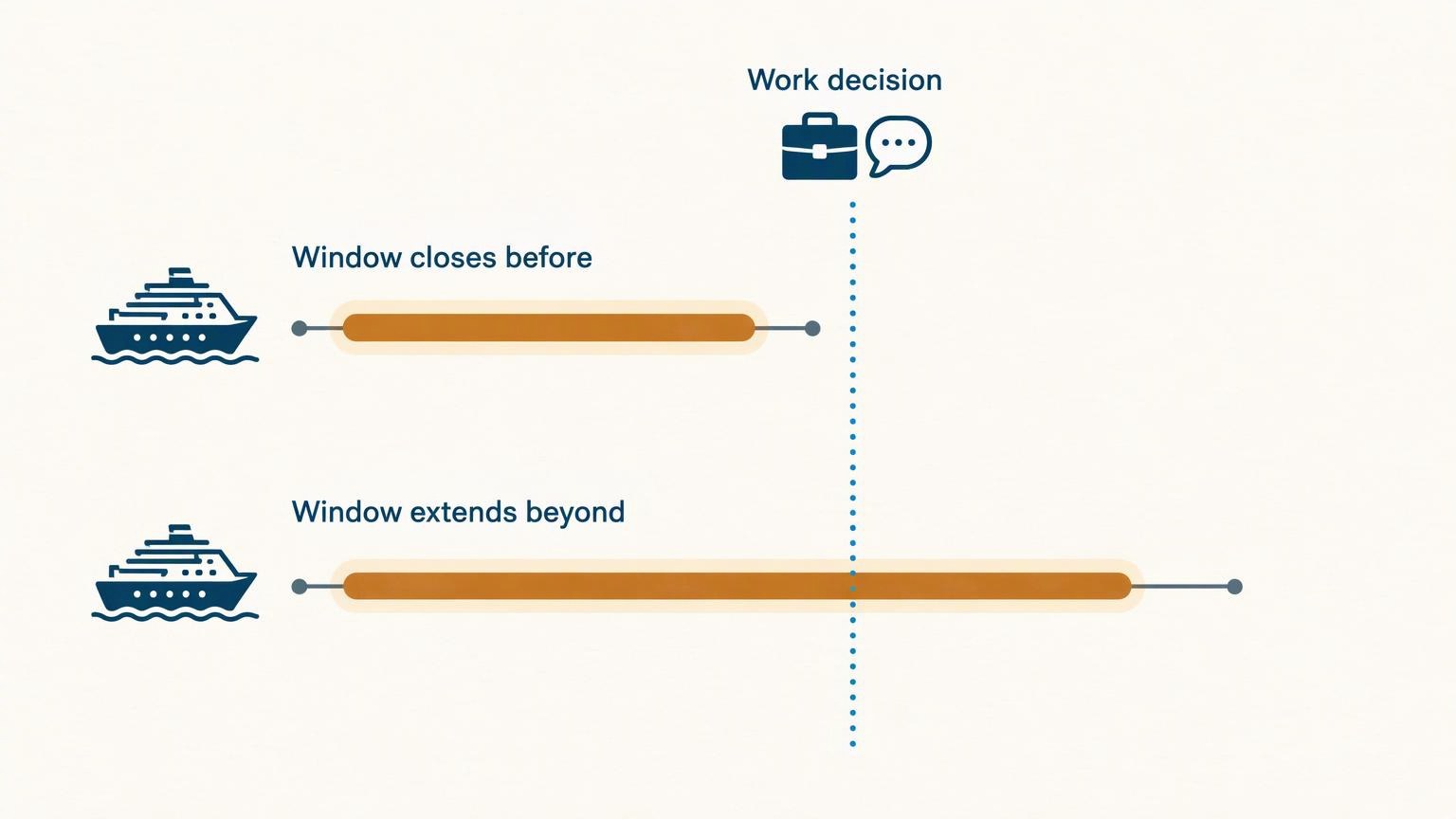
Illustration comparing two timing windows: the upper amber band closes before the dotted work-decision line, while the lower band extends beyond it.
My specialties include cruises, family travel and solo travelers. I hold the Royal Caribbean Master of Adventure credential; my advisor profile identifies whom to request.
I would connect the fare comparison to your trip: actual occupancy for a solo traveler, essential cabin requirements for a family. An advertisement for a different party is not your trip budget.
If you are considering another format, I would treat river cruise planning as a separate comparison, without assuming equivalent inclusions.
A specific offer gives our current quote discussion a useful starting point: sailing, cabin, travelers, inclusions, terms and the change you may need.
I would organize the choice around the cost if you sail as planned and the financial outcome if your likely change occurs. That keeps a lower fare's saving visible without overlooking its restrictions. It also shows whether a higher quote buys a useful right or simply adds inclusions you do not need.
My role is to help you connect those details, not promise the lowest price or universal protection. The benefits of advisor-led planning matter when they clarify whether a saving is worth its restrictions before you commit.
Share the destination, dates and travel style you have in mind. A Superior Travel advisor will help turn the possibilities into one clear, personal plan.