
Choose beds before a category name
I would assign a specific sleeping place to each traveler. If someone cannot comfortably use the proposed extra bed, I would change the configuration rather than rely on the cabin's maximum occupancy.

I would request one cabin if confirmed beds, bathroom sharing and privacy suit everyone. I would request two if separate routines justify the complete quoted difference. Before booking a Galveston departure, I would confirm occupancy, guest assignments and the exact layouts for either arrangement.
I approach cruise vacations from Galveston as a living-space decision. For cruise vacations from Galveston, I start with who sleeps where: permitted occupancy alone cannot explain how your evenings and mornings will work.
For Long Island travelers comparing cruise vacations from Galveston, my specialties include cruises and family travel. Meet Mary Susan Schilling through Superior's Long Island travel agency.
I would assign a specific sleeping place to each traveler. If someone cannot comfortably use the proposed extra bed, I would change the configuration rather than rely on the cabin's maximum occupancy.
I would decide how much separation your family actually wants at bedtime. A second cabin is useful only when the permitted guest assignments and room relationship support that plan.
I would compare bathroom access during your busiest morning, not only floor area. Separate bathrooms may matter more to your party than a larger shared sitting area.
I would compare a specific shared cabin with specific separate cabins. An attractive two-cabin total is not useful if the rooms do not provide the proximity your party needs.
I would decide whether you can accept neighboring rooms instead of an internal connection. If that changes supervision or comfort, I would treat it as a different option rather than an equivalent substitute.
I would keep one cabin on your shortlist when everyone accepts its beds, shared bathroom and bedtime space. Staying together can simplify supervision. Two cabins deserve more weight when separate sleeping or changing spaces solve a daily problem.
I would distinguish an internal connecting door from access through the corridor. Nearby cabin numbers do not establish a connection, and a second room elsewhere cannot substitute for essential proximity. The exact room relationship and permitted guest assignments must support your plan.
I would also separate wanting more space from needing privacy. If your main concern is storing luggage or getting dressed, I would evaluate those tasks in the proposed shared layout. If someone needs quiet while others talk or prepare for bed, I would give separate sleeping spaces more weight. A larger shared room would not necessarily solve that conflict, even if it offered more usable floor space.
I would compare complete party quotes for the same sailing, not headline fares. My choice would be one cabin if its confirmed layout works comfortably, or two if meaningful separation justifies the difference. Neither cabin count automatically offers better value.
| Arrangement | Best fit | Trade-off | Confirm |
|---|---|---|---|
| One cabin | Shared routines | Less privacy | Beds, bathroom, occupancy |
| Two connecting cabins | Separation with internal access | Requires a suitable pair | Connection, layouts, guest assignments |
| Two nonconnecting cabins | Independent routines | Corridor access | Locations, layouts, guest assignments |
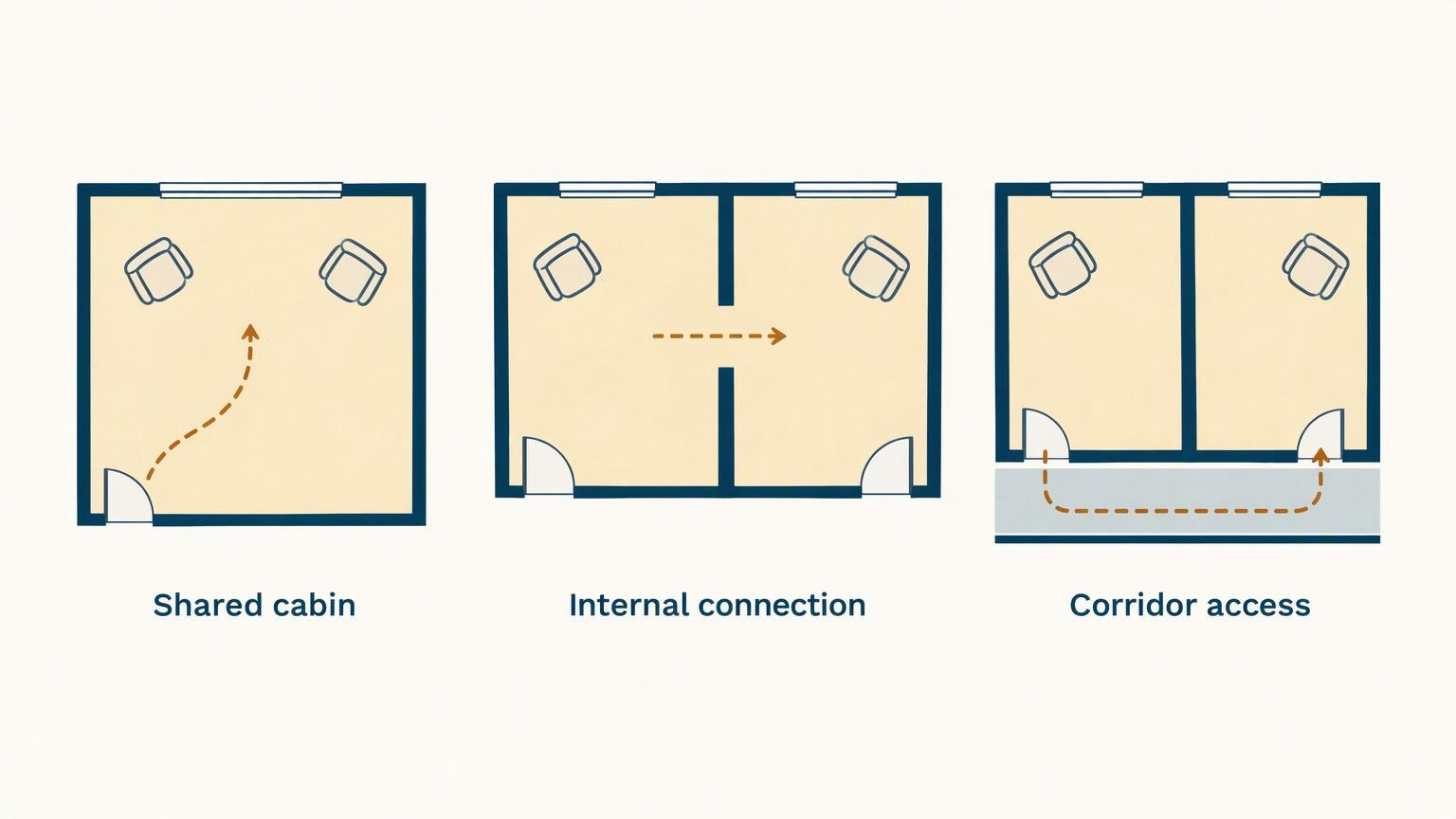
Illustration comparing Shared cabin, Internal connection and Corridor access, with seating symbols, wall openings and dashed directional paths.
I start with a bed assignment for every traveler. Permitted occupancy is the first test, but the sleeping arrangement must also suit each person. I would distinguish the main beds from additional sleeping places specified for the exact room, rather than assume all beds are interchangeable.
If the layout involves climbing, a converted bed or furniture moved at night, I would consider who can comfortably use it. For someone needing easy nighttime bathroom access, the route from bed to bathroom matters. A technically permitted sleeping place can still be a poor practical fit.
I would evaluate the cabin with every bed in use. A photograph showing extra beds stored away does not establish whether you can reach belongings, move around or help a child at bedtime. If those tasks become awkward, two suitable cabins may merit the extra cost even when one meets occupancy limits.
For bathroom sharing, I picture your busiest morning: showering, dressing and helping children. I would favor one bathroom if your party can stagger that routine; otherwise, I would compare confirmed bathroom access in both options.
I would review age and supervision requirements separately. My family and cruise planning connects accommodation needs with a suitable request, without assuming parents can occupy any nearby room while children sleep separately.
I would compare complete party totals for the same Galveston sailing, travelers and ages. A headline fare cannot establish whether sharing or separating costs less for your party.
Cabin category, guest distribution, location and fare terms can change the comparison. I would identify those differences rather than present different accommodation products as interchangeable. A lower total for distant rooms may not solve your need for proximity.
My comparison includes everyone's fare, taxes and required charges, with separately payable items identified. I would call meals, drinks, internet or other benefits included only when the written offer establishes that inclusion.
I would distinguish the deposit from the total commitment. Payment dates, cancellation terms and restrictions on changing cabins belong beside the price: a less flexible offer may not suit your plans.
Insurance is separate. I would use cruise travel insurance planning to frame questions, then examine the actual policy rather than assume booking provides coverage.
I would calculate the difference between complete totals and weigh the specific separation gained. Request a current quote from me, Mary Susan Schilling, rather than base your choice on an advertised starting fare.

Illustration of side-by-side One cabin and Two cabins comparison sheets with matching icons and abstract bars, separate envelopes and a magnifying glass.
Suppose your children go to bed earlier than the adults. You want time to talk afterward while keeping them readily accessible overnight. I would make that evening routine the deciding factor, not simply the number of rooms.
I would compare a shared cabin with internally connecting cabins, subject to permitted guest assignments. Sharing means accepting how adult conversation, light and movement might affect the children's sleep. Suitable beds alone would not resolve that conflict.
I would favor the connecting pair if its confirmed layout provides useful separation and its complete quote fits your budget. The benefit would be a workable routine, not merely extra cabin doors.
If only nonconnecting rooms are offered, I would reconsider. For younger children, corridor access may not support your intended supervision, even when rooms appear adjacent. That is a different arrangement, not an equivalent replacement.
I would still choose one cabin if everyone can settle comfortably and separation costs more than you want to spend. For adults prioritizing time together, my romantic getaway planning adds another consideration: whether shared accommodation supports the purpose of your trip and your preferred daily routines.
My specialties include cruises, family travel and solo travelers. I hold the Royal Caribbean Master of Adventure credential; that training neither establishes availability nor overrides a sailing's accommodation rules.
I would organize your inquiry around the problem the cabins need to solve. A request describing beds, privacy and supervision gives the comparison more direction than asking only for the cheapest room.
Include Galveston departure dates, traveler ages, preferred bed assignments and whether an internal connection is essential. Name your sailing if selected, so alternatives can be compared on the same basis.
I would also identify your acceptable fallback. A larger shared room, neighboring cabins and a connecting pair solve different problems. Your essential requirements should remain distinct from preferences you could compromise on, especially when assessing a lower quoted total.
My explanation of when travel-advisor help is useful applies here: room relationships, occupants and terms matter more than reservation count.
Use the contact form to describe the cabin arrangements you want compared and request Mary Susan Schilling by name. Your inquiry starts the confirmation process; it does not establish availability or make either configuration ready to book.
Share the destination, dates and travel style you have in mind. A Superior Travel advisor will help turn the possibilities into one clear, personal plan.