
Protect the arrival day
I would distinguish travel days from days you intend to spend in the parks. Avoid building an essential experience around an arrival time before transportation arrangements are settled.

I would start Disney vacation booking by naming your destination, dates, travelers, budget and essential experiences. For Walt Disney World, separate accommodation, admission, multi-park access, dining and flights. Compare equivalent proposals, distinguishing requested components from quoted inclusions and confirmed reservations.
I approach Disney vacation booking as a choice about your trip before comparing prices. For Long Island travelers, Disney vacation booking starts with naming the destination and explaining how your party wants to spend its time.
With Disney vacation booking, I separate required arrangements, optional additions and unconfirmed reservations. I am Heather Hamann.
I would distinguish travel days from days you intend to spend in the parks. Avoid building an essential experience around an arrival time before transportation arrangements are settled.
I would identify anything you have already purchased before requesting a package. That keeps an accommodation or flight comparison from duplicating arrangements you intend to retain.
I would name the person who can approve a revised trip total. For several households, each household should also understand which optional expenses it controls.
I would specify what may change if the first choice is unavailable. An alternative date or room arrangement is useful only if your party would actually accept it.
I would save the request you submit and date any later revisions. When a proposal changes, that record helps you tell whether the price changed because the trip itself changed.
I would name your intended Disney destination first. The package components discussed here concern Walt Disney World; I would not apply those assumptions to a different Disney trip.
Next, I would separate your travel window, accommodation nights and park days. These establish when you can travel, how long you need a room and how much admission you want priced. A resort rest day need not become an admission day.
I would describe adults, children, children's ages and required room arrangements. For family and group vacation planning, I would distinguish shared requirements from individual household preferences.
I would define whether your budget covers the whole trip or accommodation and admission only. Flights, meals and other spending need their own place in that boundary.
I would then describe your balance of park time and resort time. Regular breaks make room space and amenities more relevant than they are for travelers mainly seeking somewhere to sleep.
Finally, I would put essentials before preferences. A necessary sleeping arrangement should guide the options; a decorative theme should not displace it. Identify which dates or arrangements you could accept changing.
I would compare each Walt Disney World proposal's scope before its total. A package combines selected components; it does not automatically cover your entire vacation.
I would distinguish three stages: requested means you want something considered; included means it appears in the quoted scope; confirmed means you have confirmation for the booking or reservation. Those stages answer different questions.
Imagine your family requests a resort stay, tickets, multi-park access, prepaid dining and flights. I would list each separately, then compare the accommodation and admission products before evaluating additions. A lower total may cover fewer pieces rather than offer better value.
I would review dining separately. A dining plan is not resort-style all-inclusive coverage, and prepaid meals do not confirm a particular restaurant reservation. Preferred restaurants belong on your experience list, not just your food budget.
I would use the table to spot differences, then decide which additions fit your pace. Multi-park access warrants less weight if you prefer one park each day. Before comparing totals, I would account for requested items left outside either proposal and distinguish their estimated costs from confirmed arrangements.
| Component | My request | My proposal review |
|---|---|---|
| Accommodation | Travelers, nights, room needs | Property, room category, occupancy |
| Park admission | Park days, travelers | Admission product and terms |
| Multi-park access | Desired daily flexibility | Access explicitly described and priced |
| Dining | Meal preferences, requested plan | Coverage, exclusions, separate reservations |
| Flights | Whether airfare is required | Included arrangements or separate expense |
| Status | What it means |
|---|---|
| Requested | You want it considered |
| Included | It appears in the quoted scope |
| Confirmed | You have booking or reservation confirmation |
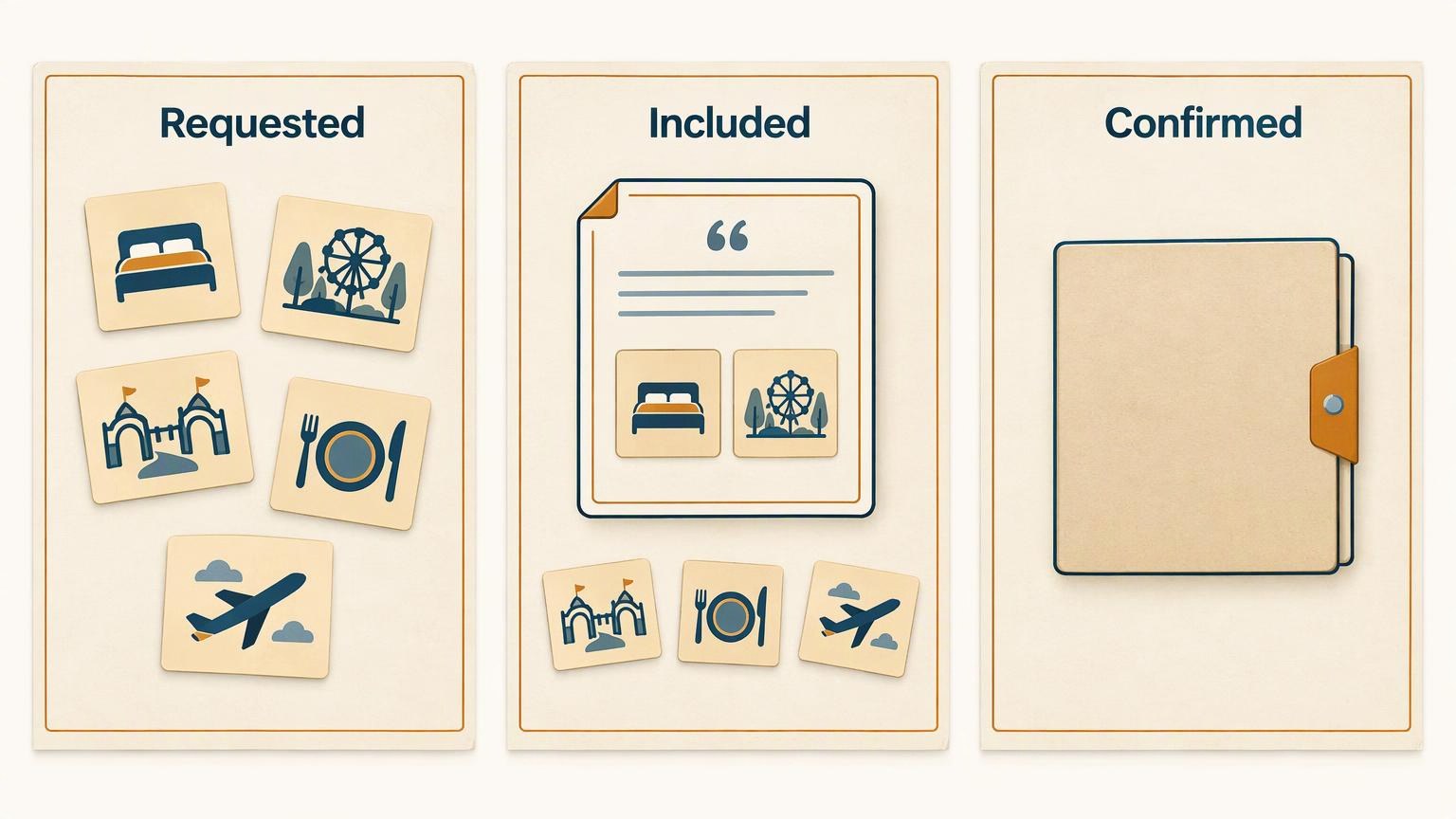
Illustration comparing Requested, Included and Confirmed: bed and park cards sit inside a quote folio, while gate, meal and airplane cards remain outside; a separate panel holds a closed folder.
I would flag experiences that could change your dates or itinerary before requesting options. A restaurant you would enjoy is different from an experience that motivates the whole trip.
I would rank priorities as essential, preferred or optional. That identifies what to protect if the schedule changes, without treating every idea as a firm commitment.
For Walt Disney World, popular dining and certain park experiences have advance planning windows. I would disclose priorities early while keeping requests distinct from confirmed reservations. Early disclosure does not guarantee availability.
I would also describe your daily pace. Unhurried mornings, resort breaks and flexible meals can conflict with a schedule full of reserved experiences. If rest matters most, I would leave room for it rather than maximize scheduled activities.
I would judge the plan by that fit, not a universal resort ranking. An addition is useful only if your party expects to use it.
Before accepting a proposal, I would identify who handles remaining reservations and what still needs action. A named experience is not secured without confirmation. If it is essential and not yet confirmed, that could change your booking decision.

An illustration of vacation pacing: a lounge chair and closed book occupy a spacious ribbon interval, while optional dining and activity tokens sit nearby, one dining token outlined in amber.
Imagine a Walt Disney World trip with children, regular breaks and a preferred dining experience. Your dates are flexible, but room arrangements and the overall spending limit matter more than accommodation tier.
I would start with your acceptable room setup and park pace. You choose those boundaries; the planning request asks for options that preserve them.
Next, I would compare a resort with more amenities against simpler accommodation. If you expect to spend breaks at the resort, usable amenities may justify additional cost. If you mainly want sleep and park time, I would give amenities less weight, while still examining the actual room arrangement.
I would then compare admission, dining and flights on equivalent terms. A lower proposal excluding airfare does not establish a lower whole-trip cost. You would decide whether the additional resort spending is worthwhile after accounting for those differences.
Finally, I would identify reservations still needing confirmation and who will handle them. Independent booking remains reasonable if you understand the products and want to manage those decisions yourself. I would use the explanation of when a travel advisor helps to weigh the support you want.
I would submit a compact brief: destination, travel window, party details, children's ages, room requirements, required components and priority experiences. Define the budget's scope and label acceptable alternatives, so flexibility does not undermine an essential requirement.
I would begin with the Disney vacation packages planning page, which explains Walt Disney World components and provides a relevant planning route. Its accommodation, admission, dining and airfare overview gives your request a starting structure, not proof that every component is included.
I would separate arrangements needing a current quote from experiences you hope to reserve. Save the submitted brief and compare proposals against that version; revised dates or components can change what the total represents.
I invite you to request me, Heather Hamann, by name. Superior Travel Consultants is an advisor-led agency on Long Island. I would use the travel-advisor benefits guide to consider the support you want.
For example, I would describe date flexibility as an acceptable travel window while keeping your required room arrangement fixed. That makes the boundary clear: an alternative date may fit, but an unsuitable room does not become acceptable merely because the total is lower. If your priorities change during a conversation through the contact page or by phone at +1 516 224 7880, I would record the new boundary before comparing the next current quote.
Share the destination, dates and travel style you have in mind. A Superior Travel advisor will help turn the possibilities into one clear, personal plan.