
Start with the travelers
I would check that every proposed component covers the intended travelers. A room total and a ticket total should not silently describe different groups.

I would approve a Disney proposal only when accommodation, admission and transport inclusions, optional extras and booking status are clear. A quoted total does not establish reservations. Understand the authorization, payment and confirmation steps applicable to your arrangements before proceeding.
I would review Disney vacations proposals by comparing components before totals. For Long Island travelers, Disney vacations should reflect your family, usable dates and preferred pace. An attractive itinerary does not establish a booking.
When comparing Disney vacations, I would separate choices from reservations. I am Heather Hamann, a travel advisor with our Long Island travel agency. Here, I explain what your proposal should clarify before you commit, rather than provide a complete park itinerary or assume every discussed item is included.
I would check that every proposed component covers the intended travelers. A room total and a ticket total should not silently describe different groups.
I would compare the actual proposed room category and sleeping arrangement. A general resort tier does not tell you whether the room suits your family.
I would choose ticket options around the park days you intend to use. Extra flexibility has little value if you do not expect to use it.
I would distinguish prepaid dining from unrestricted meals and drinks. Easier budgeting can matter, but it does not replace checking what the plan covers.
I would save the version you approved alongside later booking documents. That makes it easier to spot a changed room, omitted option or different travel date.
I would distinguish inclusion from status: one describes what belongs in the proposed trip; the other describes its progress toward booking. A proposed hotel may be unbooked, while a discussed flight may sit outside the total. Both distinctions affect your decision.
I would review accommodation, admission and transportation separately. The room description should identify the resort, category and stay dates. Admission should specify duration and optional additions. For transportation, I would distinguish included airfare from suggested flights, without assuming airport transfers are included unless explicitly addressed.
Imagine a proposal listing a resort room and tickets, followed by an optional flight. I would compare the room and tickets with your intended trip first. You would then decide whether airfare belongs in the package. The advisor preparing the proposal would clarify its price and status; your selection alone would not establish a booking.
I would read suggested, quoted, held and confirmed alongside their accompanying terms, not as universal labels. A held item needs conditions and a deadline explained. A confirmed item needs written reservation details matching your travelers and dates. Neither establishes the status of unrelated components.
Our Disney vacation planning page introduces the package building blocks. I would proceed when the proposal identifies your selections, optional pieces and remaining booking actions. This lets you approve defined arrangements instead of relying on a general itinerary description.
| Label | Establish | Do not assume |
|---|---|---|
| Suggested | Option and rationale | Checked availability |
| Quoted | Dates, travelers, inclusions, terms | Reservation |
| Held | Component, conditions, deadline | Entire trip secured |
| Confirmed | Supplier record matching arrangements | Other components booked |
I would compare itemized inclusions before prices. Disney packages can combine a resort stay and tickets, with dining and airfare added. The word package alone does not establish what your offer includes.
For accommodation, I would identify the property, room category, dates and travelers covered. For admission, I would identify the product, days, applicable dates and selected options. For airfare, I would distinguish the itinerary from its fare and baggage terms.
I would separate airport transfers from travel between the resort and parks. Airfare inclusion does not explain how you reach the hotel; resort transportation does not establish an airport transfer. Each journey needs its own inclusion or exclusion, especially if travelers arrive separately.
For dining, I would read the specific meal, snack and drink coverage. I would not interpret all inclusive as every dining expense being prepaid. Our Caribbean and all-inclusive vacation guide addresses a different vacation format.
I would separate the booking total from expected trip spending. Meals outside a plan and optional experiences still affect your budget. A lower quote may simply leave more expenses to pay later, rather than offer better value.
| Component | Verify | Do not assume |
|---|---|---|
| Accommodation | Property, room, dates, travelers | Resort tier establishes room suitability |
| Admission | Product, days, dates, selected options | Every discussed experience is covered |
| Airfare | Itinerary, fare and baggage terms | Suggested flights are included |
| Airport transfers | Separate inclusion or exclusion | Airfare includes the hotel transfer |
| Dining | Meal, snack and drink coverage | Every dining expense is prepaid |
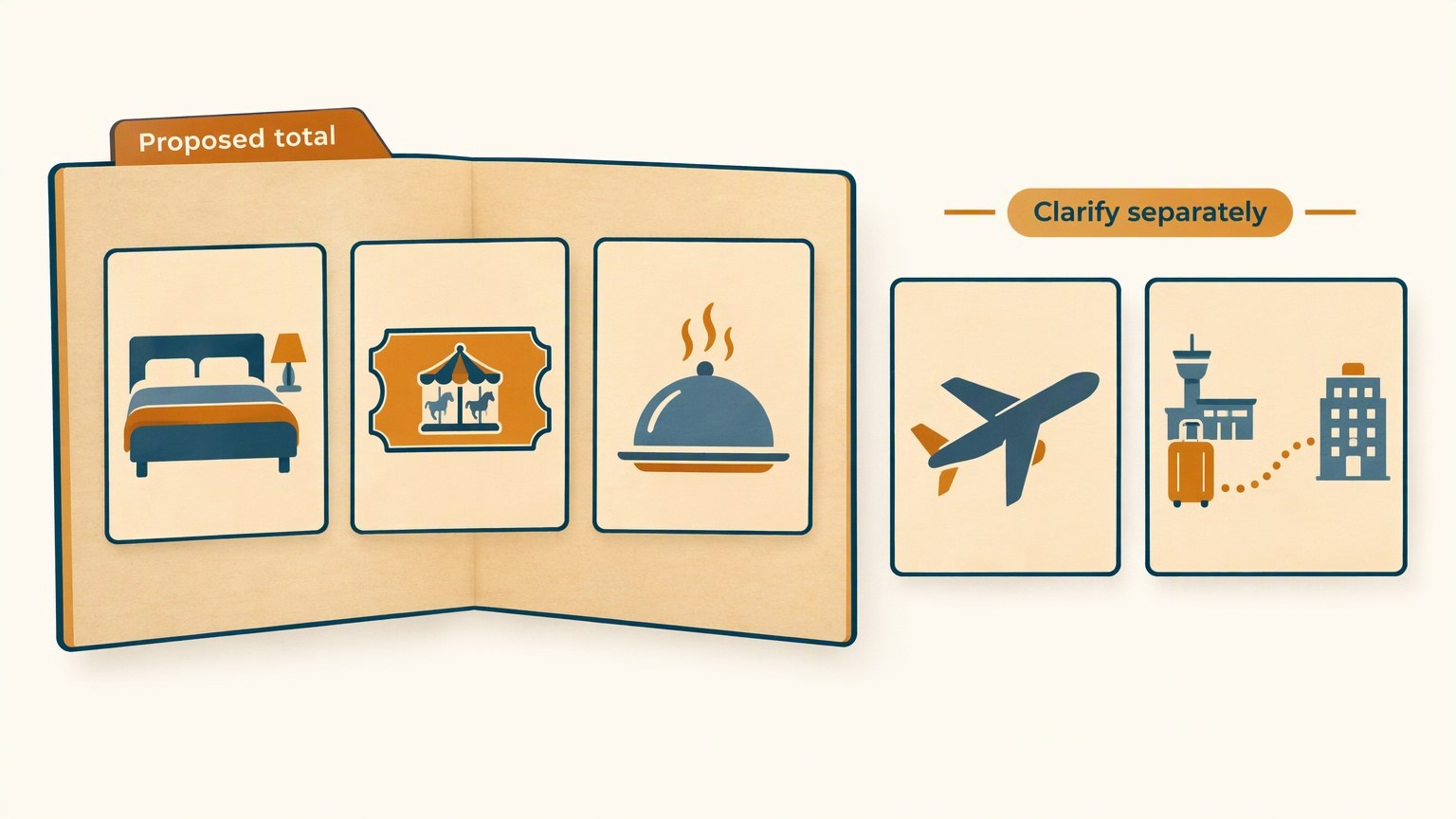
Illustration of a proposal folder with room, admission and dining icons, alongside independent airplane and luggage-and-route cards labeled Clarify separately.
I would evaluate a room by group size, sleeping arrangements and expected resort time, not its tier alone. A current quote should identify the category for your dates. A broad recommendation still leaves a choice to make until those details are settled.
I would connect admission to your pace. Multiple-park flexibility may suit a family that expects to use it. A simpler ticket may suffice if you prefer one park followed by a room break.
The Points Guy distinguishes base tickets, Park Hopper and special-event admission. I would compare these separately rather than assume one admission line covers every discussed experience. A special event central to your trip should remain visible as a separate choice.
I would also distinguish admission from optional paid access products. Disney Tourist Blog explains Lightning Lane as a paid planning choice; tickets alone do not establish its inclusion.
More flexibility can mean paying for unused options. The lowest total can omit something essential. I would judge each difference against your daily plan: adequate sleeping space and usable admission matter more than a long inclusion list that does not fit your family.
Imagine traveling with children and grandparents, planning park mornings and resort afternoons. You are comparing a lower-priced room-and-ticket proposal with another including dining and airfare. I would not treat either as complete until its components match your needs.
First, I would have you match travelers and dates, then compare room categories and sleeping arrangements. If the cheaper room does not suit your group, its lower total does not solve your accommodation need.
Next, you would identify admission days and options. I would weigh multiple-park flexibility against your afternoon breaks. If a slower schedule matters more, simplifying tickets could improve the fit without choosing the more expensive proposal.
Finally, I would separate airfare and dining from the remaining package. You would decide who handles flights and consider how the group eats. The proposal's preparer would need to clarify the resulting inclusions and total. Separate arrangements can be reasonable when the room-and-ticket offer meets your needs.
For coordinating travelers, our family and group travel planning page offers further context. I would distinguish shared priorities from separate arrivals rather than assume everyone needs identical arrangements. That distinction can change which proposal is useful.

Illustration of hands comparing two proposals under “Compare the fit,” with shared bed, park and shaded lounge chair tokens, a ticket between the panels, and separate meal and airplane tokens.
I would turn the comparison into a defined instruction: which room, admission and transport choices you want to proceed with, and which extras you are declining. Approval should refer to the proposal version you reviewed rather than an earlier conversation.
Before payment or authorization, I would have you read the applicable deposit requirements, payment dates, change and cancellation terms, and any quote deadline. Those terms belong to the particular arrangements. I would not assume one component's cancellation wording applies to the rest of the trip.
After the booking step, I would compare the confirmation records with your approved choices. Check the travelers, dates, room category, admission product and transport details. Keep any outstanding arrangements visible so a confirmed hotel does not make an unbooked flight disappear from your review.
My specialties are custom vacations, group travel and cruise planning. For this inquiry, my useful role is helping frame the trip around your travelers and priorities, while clarifying what a Disney proposal would cover. If you are deciding how much assistance you want, why use a travel agent provides broader context.
Share the destination, dates and travel style you have in mind. A Superior Travel advisor will help turn the possibilities into one clear, personal plan.