
Keep the travel party identical
I would use the same traveler list and travel dates for every proposal. If a child's birthday falls near the trip, I would ask which date the supplier uses to determine age eligibility.

I compare European tours for families by household total, not advertised per-person rates. Match every traveler and child's age, verify beds, and establish who can join each activity. Add separately priced travel and daily spending to judge whether the complete trip fits.
I approach tours for families as a household decision: does the quote cover everyone traveling and the experiences you want? For Long Island travelers comparing tours for families in Europe, I start with the proposal's assumptions and spending outside its price.
With tours for families, I separate age eligibility, beds and participation. Cheaper can mean different, not better. I am Robin Holian, a travel advisor specializing in family travel at our Long Island travel agency.
I would use the same traveler list and travel dates for every proposal. If a child's birthday falls near the trip, I would ask which date the supplier uses to determine age eligibility.
I would state who can share a bed and who needs a separate sleeping space. That makes a room comparison more useful than asking only whether a property has a family room.
I would distinguish activities everyone wants from those only some family members will join. That helps you compare a fully included itinerary with a lighter package without paying for unwanted participation.
I would keep confirmed proposal amounts apart from your allowance for meals and other personal spending. A clear distinction prevents a planning estimate from looking like a guaranteed trip price.
I would choose a lower-priced proposal when its differences suit your family. Paying more makes sense only when the added accommodation, activity or convenience answers a need you actually have.
I would reconcile the proposal with your household before evaluating its price. Every adult and child should appear, with ages tied to the travel dates rather than an undated description such as young children. An omitted traveler makes the headline total unusable for comparison.
I would then read the pricing basis. Per-person figures, room totals and household totals answer different questions. For a purchasing decision, I would use the complete family amount and its calculation, not multiply an advertised rate without checking its assumptions.
I would not assume a child discount exists. Any reduced rate needs an identified traveler, component and conditions. A reduction on an activity does not establish a reduction on accommodation or airfare.
For route exploration, country and city cost comparisons organize Europe by destination. I would use that context to explore possibilities, not determine whether your family is fully included in a particular proposal.
My starting point for a scoped inquiry is European vacation planning. Family details, dates and the proposed itinerary together define the trip to be priced and make competing proposals easier to compare.
I would compare sleeping arrangements before totals. A lower quote is useful only if every traveler has an acceptable sleeping space. Room labels alone do not establish bed types, assignments or permitted occupancy.
I would match each person to a specified bed, using the children's ages when reviewing occupancy conditions. A sofa bed and a regular bed may represent different compromises for your household; neither a family-room label nor shared occupancy establishes a child discount.
For illustration, suppose your children need an earlier bedtime while you want somewhere to sit afterward. I would distinguish a shared bedroom from separate sleeping spaces, then compare suitable proposals. The cheaper shared arrangement offers savings, but not equivalent privacy or bedtime flexibility.
I would distinguish a connecting-room request from a confirmed connection. Nearby rooms do not provide an internal door. If that door is essential for supervision, an unconfirmed connection remains a limitation.
Through family and group vacation planning, I would keep households' needs distinct. Shared space can be good value; separate space justifies its additional cost when it solves a privacy, comfort or supervision need.
| Arrangement | Verify | Trade-off |
|---|---|---|
| Shared room | Beds and occupancy | Togetherness versus privacy |
| Separate rooms | Assignments and locations | Privacy versus supervision |
| Connecting rooms | Confirmed internal door | Nearby is not connecting |
| Arrangement | Verify | Trade-off |
|---|---|---|
| Shared room | Beds and occupancy | Togetherness versus privacy |
| Separate rooms | Assignments and locations | Privacy versus supervision |
| Connecting rooms | Confirmed internal door | Nearby is not connecting |
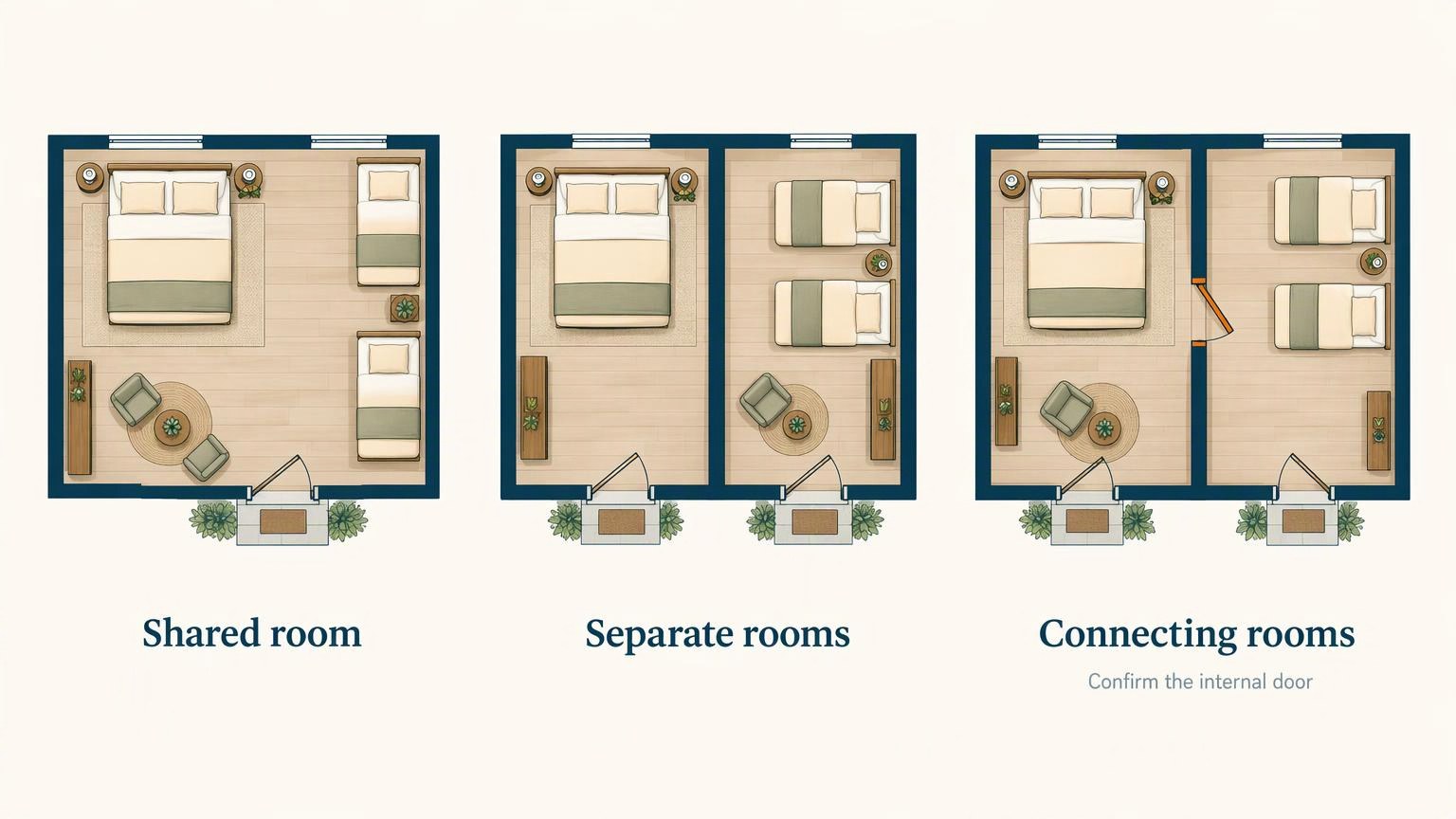
Illustration comparing shared, separate, and connecting room layouts, with beds, exterior entrances, and the note “Confirm the internal door” beneath the connecting rooms.
I would treat an included activity as a specific booking, not a general promise of sightseeing. For each experience your family values, I would identify the participants, what is paid for and any participation conditions.
Admission, a guided visit and transportation to the meeting point are different inclusions. An attraction mentioned in an itinerary is not necessarily a paid booking. Those distinctions affect both spending and how you organize the day.
I would evaluate suitability separately from price. A financially included experience may still have age, accessibility or participation conditions. The applicable supplier terms matter more than a family-focused label when deciding whether everyone can join.
For optional activities, I would compare what your household expects to buy. An excursion everyone wants belongs in the intended-trip total. An unwanted excursion does not become valuable merely because a more expensive package includes it.
I would also map activities onto the itinerary. If your family prefers rest at that time, or another planned experience conflicts, the inclusion may add little value. My comparison would prioritize usable experiences rather than the longest list of inclusions.
I would separate the package price from the complete vacation budget. Start with the household package total, add arrangements outside it, then allow for spending during the trip. Keep each category visible rather than treating the package as the final cost.
I would review airfare, baggage, airport transportation and travel between itinerary stops individually. Each belongs under included, separately quoted or estimated. This identifies gaps without assuming that extra charges apply.
For meals, I would budget only for those outside the package, avoiding duplicate allowances for included meals. Optional activities belong in the calculation when your household intends to choose them, not simply because they are offered.
I use the same approach for escorted tours and river cruises: the proposal establishes inclusions, not the trip format.
I would label currencies and distinguish confirmed charges from estimates. Amounts in unlike currencies cannot simply be added into a decision-ready total.
Finally, I would keep a reserve separate from expected spending. Its size is your choice. A visible reserve shows whether the vacation fits comfortably or depends on spending less than your household reasonably expects.

Illustration of vacation-budget trays labeled Included, Outside the package, and Estimates, with travel cards beside a Check proposal tag and a separate Reserve envelope.
For illustration, suppose you are comparing European proposals for parents and children who need separate beds. Everyone wants a guided visit, but your household prefers free afternoons to a heavily scheduled itinerary.
I would first align the traveler lists and ages. Then I would compare beds and activity bookings, adding outside costs for the visit and transportation you intend to use. You identify the acceptable compromises; the proposals need to show what each choice costs.
If the lower headline price assumes unsuitable beds and excludes the guided visit, I would request a revision. The revised proposal should price acceptable accommodation and the visit before I compare household totals again.
If that option remains cheaper and fits, I would consider it reasonable value. Unwanted afternoon activities in the higher quote would not justify paying more. The decision turns on usable differences, not the number of inclusions.
My family and group travel specialties connect with our agency's European vacation planning. I can discuss this proposal request with you; why use a travel agent offers context for deciding how much planning help you want.
Share the destination, dates and travel style you have in mind. A Superior Travel advisor will help turn the possibilities into one clear, personal plan.