
Name the person who can approve
I would ask each household to identify its decision-maker. The relative collecting ideas should not be assumed to have permission to commit someone else's money.

I would organize approvals before purchases: identify each household's decision-maker, approve dates and spending limits, then settle rooming dependencies. Set a shared reservation decision point. Each household must authorize its own proposal before anyone books arrangements that rely on everyone joining.
I approach family vacations as household decisions before purchases. For Long Island travelers coordinating family vacations, a pending work approval or shared room can determine whether the plan works. I would identify those dependencies before comparing destinations.
When planning family vacations, I would separate interest from booking permission. I am Mary Susan Schilling; my specialties include family travel, cruises and all-inclusive vacations. At our Long Island travel agency, I would coordinate shared arrangements while keeping each household's authorization separate, so enthusiasm does not become an unintended commitment.
I would ask each household to identify its decision-maker. The relative collecting ideas should not be assumed to have permission to commit someone else's money.
I would label a preferred date as pending until the household approves it. Enthusiasm about a school break does not settle a work-leave request.
I would show which expenses require agreement across households. An optional outing should not increase another family's committed budget without permission.
I would flag a shared room or transfer that changes if someone drops out. That dependency, rather than the number of reservations, determines how carefully to coordinate.
I would agree whether the ready households wait, continue separately or revise the trip. I would never treat a missed family deadline as automatic approval.
I would start with a household roster identifying travelers, spending decision-makers and undecided relatives. Give each open decision an owner and next action so the coordinator need not interpret scattered messages.
My suggested order is participation, dates, spending limits, room relationships, then authorization to reserve. These decisions inform each other, but a general statement that the trip sounds good does not approve them all.
I would distinguish your family response deadline from a supplier deadline. The former helps relatives decide together; it does not hold rooms, protect prices or change payment terms. Supplier deadlines belong to the actual proposal.
The reservation decision point brings these approvals together. If a required answer remains pending, I would keep planning or deliberately change who is included. An early booking should not decide for everyone, particularly when it creates costs that other households have not authorized.
I would collect each household's acceptable travel window and unavailable dates, then identify the overlap before developing an itinerary. A preferred week and an approved week are different answers, especially when work leave remains pending.
For budgets, I would compare complete household totals. Occupancy, trip length, transportation, meals and activities affect what each family must approve. I would distinguish quoted inclusions from planned expenses outside the quote rather than assume a package covers everything.
For Caribbean and all-inclusive vacations, I would review the proposal's actual inclusions. For European vacation packages, I would separate common arrangements from expenses each household chooses independently. That makes different options easier to compare fairly.
I would let relatives share spending limits privately with the coordinator or advisor. The family needs agreement on shared costs, not access to everyone's financial circumstances.
If dates overlap but budgets differ, I would consider separate room choices or different trip lengths. The compromise needs practical shared moments, not identical spending. I would also identify whether arriving later or leaving earlier changes shared transportation costs, so no household inadvertently subsidizes another without agreeing.
I would record each room's occupants and the households relying on that arrangement. Sharing a room across households creates a different approval problem from booking separate rooms: one family's withdrawal can change another's accommodation needs and budget.
I would distinguish essential room relationships from preferences. If connecting rooms are essential, a proximity request does not settle the decision. Before recommending commitment, I would check whether the proposal treats the required relationship as requested or confirmed. A preference can allow flexibility; a requirement can rule an option out.
My rooming notes would cover occupants, bedding, privacy and accommodation requirements that change the choice. For Disney vacation planning or family and group cruise vacations, I would apply that approval test rather than rely on a family-friendly label.
I would establish who pays for each room and who authorizes changes. Paying for relatives does not automatically settle their accommodation preferences.
Before approving shared accommodation, I would have affected households discuss what happens if someone cannot travel. They need to understand which room choices or costs require reconsideration. That family agreement does not replace a supplier's cancellation or occupancy terms, which must be reviewed separately.
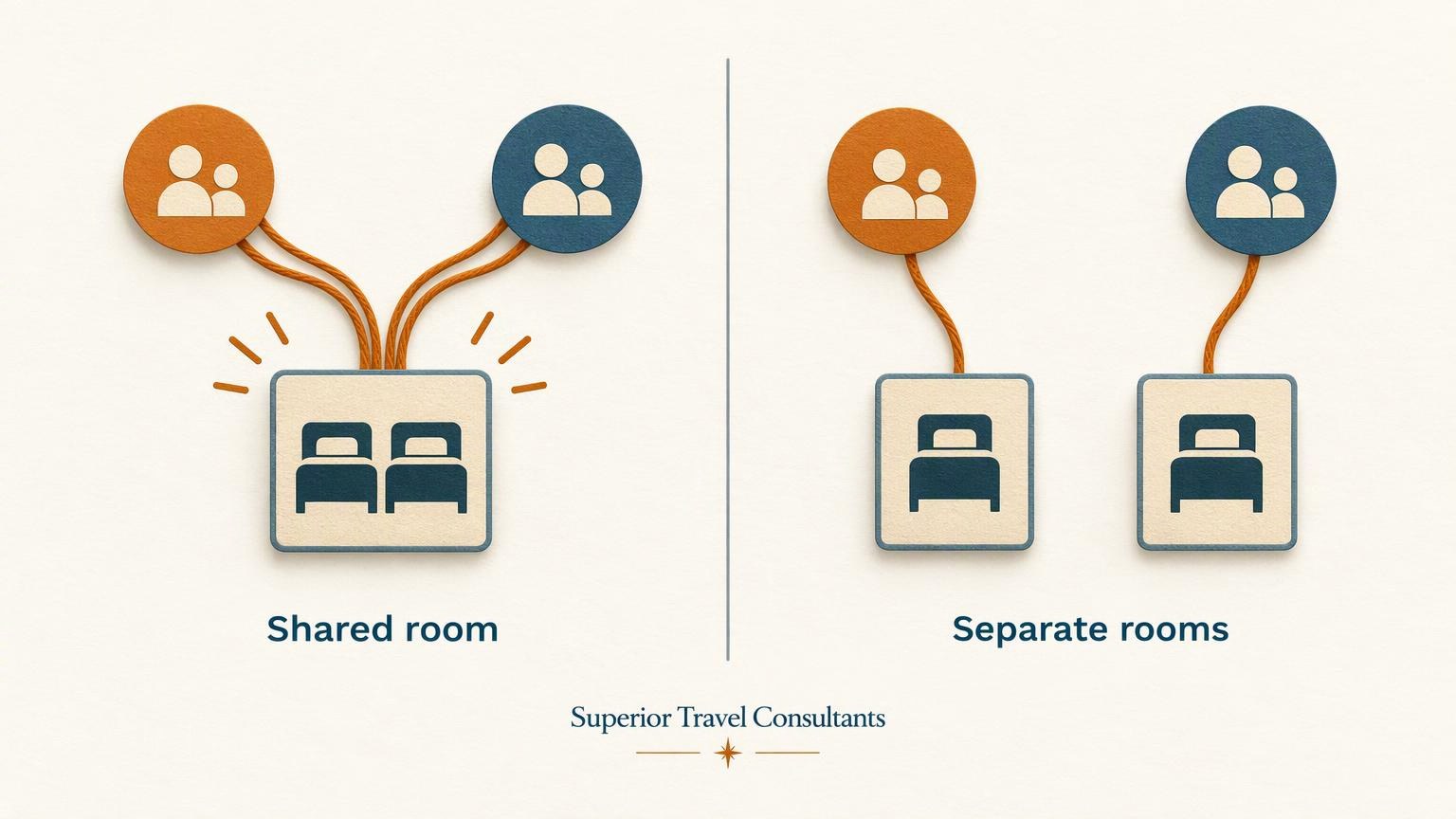
Illustration comparing shared and separate rooms: threads link two household tokens to one two-bed tile on the left and to separate single-bed tiles on the right.
Imagine parents, grandparents and another household awaiting work-leave approval. Shared accommodation fits the budget only if everyone joins. I would treat that pending approval as a dependency, not a minor loose end.
First, the pending household seeks its employer's answer. Next, the coordinator sets the family decision date and records the ready households' approvals. I would identify dependent arrangements, then compare the choices below. Waiting preserves the plan but not availability; independent bookings may change costs or shared time.
| Choice | Useful when | Trade-off |
|---|---|---|
| Wait for the approval | The shared arrangement needs everyone | The original proposal may change while the family waits |
| Proceed with ready households | Their bookings can work independently | The later household may have different options |
| Redesign the shared trip | Participation is uncertain but family time matters | Dates, rooms or the budget need fresh approval |
I would wait or compare smaller-party accommodation when affordability depends on an unapproved household. If separate rooms work within each ready household's budget independently, proceeding becomes more reasonable. The change removes the dependency, but later travelers may still face different options.
| Choice | Useful when | Trade-off |
|---|---|---|
| Wait for approval | Shared arrangement needs everyone | Original proposal may change while waiting |
| Proceed with ready households | Their bookings work independently | Later household may have different options |
| Redesign the shared trip | Participation is uncertain | Dates, rooms or budget need fresh approval |
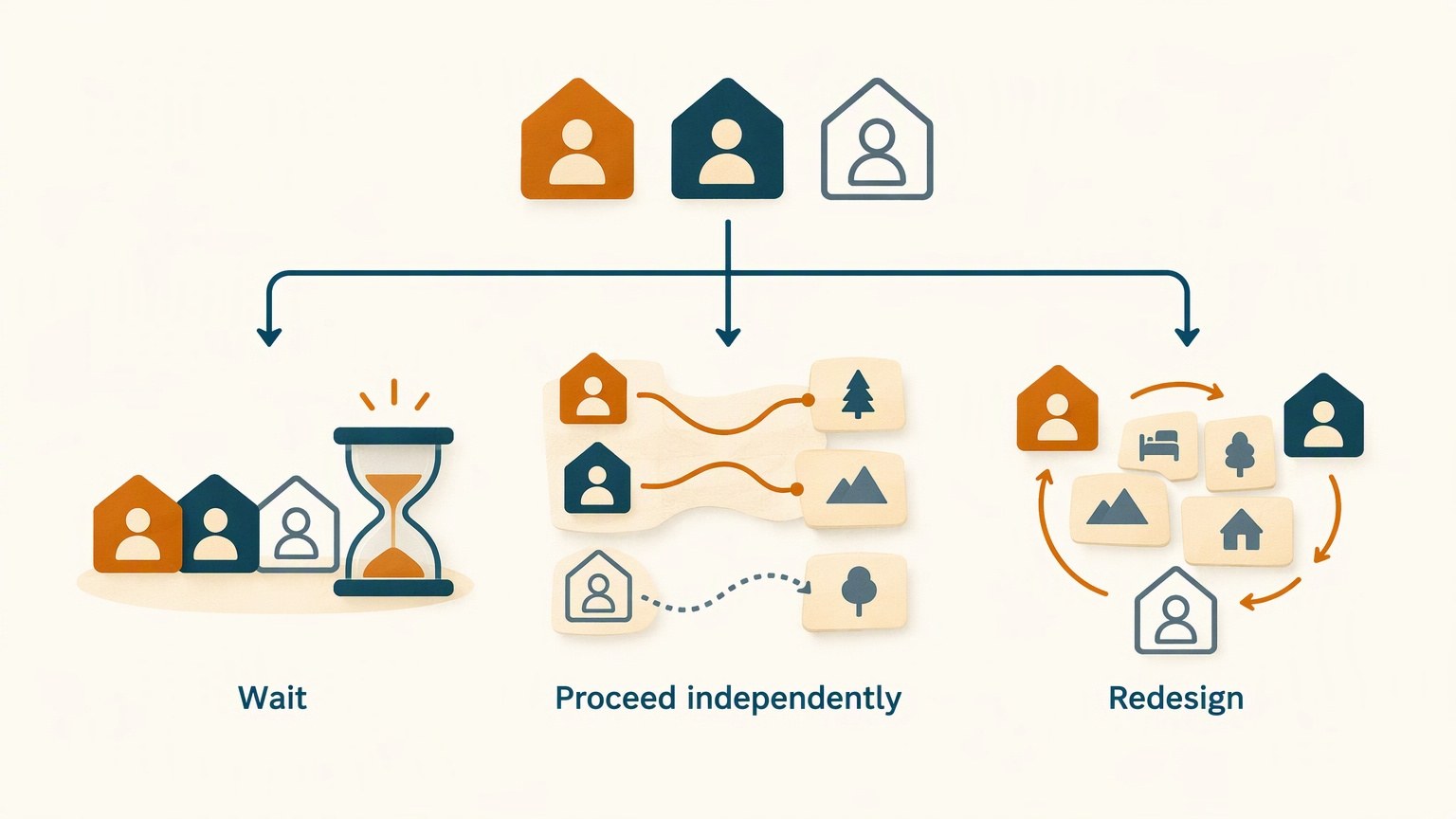
Illustration of three equally weighted planning options: household icons beside an hourglass, following separate routes, or surrounding tiles with bed, tree, mountain and house symbols.
I would prepare a final summary each household can read independently, identifying its travelers, approved dates, room arrangement, quoted costs, inclusions and relevant payment or cancellation terms. This gives everyone the same decision point without combining their authorizations.
I would label responses: approved to reserve, pending a named answer, or not participating. Approval must refer to the actual proposal, not an older version or destination preference. Material changes need fresh approval from affected households before commitment.
I would use the summary to distinguish common arrangements from decisions each household still owns. It connects responsibilities but does not authorize purchases. For context on the broader advisor role, I would point you to why use a travel agent.
After booking, I would have the coordinator record confirmed arrangements and remaining tasks. Each household should review its own details and deadlines rather than assume another relative checked them. Any mismatch belongs back with the person responsible for that booking.
For an inquiry, I would include household count, outstanding approvals, intended decision date, travel dates, departure cities and room relationships. That explains the coordination needed without presenting tentative decisions as final.
Share the destination, dates and travel style you have in mind. A Superior Travel advisor will help turn the possibilities into one clear, personal plan.