
Compare the same endpoint
I would carry each estimate through to your actual cruise terminal. An airfare quote and a parking quote do not describe equivalent journeys until the remaining transportation is included.

I budget for reaching Galveston separately from the sailing. Driving requires road costs and cruise-length parking; flying requires airfare and ground transportation. Either may need an overnight stay. I compare complete party totals, including the return journey, against your budget and preferred travel time.
I compare cruise vacations from Galveston by separating the sailing price from arrival costs. For Long Island travelers, cruise vacations from Galveston require a budget for reaching the terminal, parking if you drive, and any stay before sailing day.
My approach to cruise vacations from Galveston compares complete arrangements, not starting fares. Through travel planning for Long Island travelers, I help you weigh transportation, accommodation and travel time alongside the cruise itself, keeping quoted inclusions separate from expenses still to purchase.
I would carry each estimate through to your actual cruise terminal. An airfare quote and a parking quote do not describe equivalent journeys until the remaining transportation is included.
I would identify which costs apply to each traveler and which apply to your party. A vehicle quote only belongs in the shared column if it accommodates everyone and their luggage.
I would list covered parking or a more flexible hotel rate separately from the basic arrival plan. That makes it easier to see what you are paying for and what you could remove.
I would include transportation after the cruise even though this decision starts with embarkation. A one-way transfer price is not a complete substitute for leaving your car at the port.
I would distinguish a current quote from an amount you have set aside. A planning allowance helps you compare options, but it does not establish a supplier's price or availability.
I build an arrival subtotal covering transportation to the departure area and terminal, parking where needed, and pre-cruise accommodation and meals. This keeps the cost of reaching the ship visible beside the sailing price.
I read the cruise quote's inclusions first. A transfer included in a package stays in that package total; one you must purchase separately belongs in the arrival subtotal. I would not count the same service twice.
For driving, I include fuel, applicable road charges and parking for the required stay. For flying, I include everyone's airfare, applicable baggage charges and ground transportation at both ends. I also include the return journey when comparing these arrangements.
I compare complete party totals, not a per-person airfare against per-vehicle parking. Dividing the total afterward can help allocate expenses without distorting which arrangement costs more. Shared transportation must accommodate everyone and their luggage.
I keep a contingency allowance separate for changes such as a replacement ride. This is money you choose to reserve, not a supplier charge or evidence of availability. It helps distinguish the planned purchase from funds available if your arrangements change.
I price parking for your sailing dates and terminal, not a remembered daily rate. The Port of Galveston explains that rates vary with cruise length and selected parking type. I use those details to compare relevant reservations.
I weigh covered parking's weather protection against the cost of uncovered parking. If minimizing arrival expenses matters most, uncovered parking remains worth comparing; if protecting your vehicle matters more, coverage may justify the difference.
I also consider the terminal connection. Walking and shuttle arrangements offer different levels of convenience, particularly with luggage or mobility needs. A lower parking total is not automatically the better choice if reaching the ship becomes difficult.
I compare the final payable amounts using identical sailing information. Taxes and additional charges shown during booking belong in the total. A discount counts only if it applies to your reservation, rather than merely appearing in an advertisement.
I read cancellation and date-change terms alongside price. A less flexible reservation may suit firm plans, but its savings matter less if a likely adjustment could require another purchase. I keep that trade-off visible before choosing.
I compare driving and flying through the return journey. Driving replaces airfare with road costs and parking; flying replaces port parking with flights and ground transportation. Neither is cheaper until the complete party totals are comparable.
For family and group cruise planning, shared vehicle costs versus individual tickets can change the result. I use a transfer's stated pricing unit and include both directions. A vehicle quote must fit everyone and their luggage.
I compare a rental vehicle separately if you want transportation before sailing. Rental terms and the return handoff add considerations beyond a direct transfer; retaining the vehicle during the cruise also adds parking.
I would include transportation between the rental return location and the terminal if it is not part of the rental arrangement. Otherwise, the rental estimate ends before you reach the ship and understates the cost of that option.
For a Long Island departure, I weigh road travel time alongside money. Driving may suit your vacation, but days spent traveling still matter even when they do not appear on an invoice.
| Arrangement | Costs to include | Decision trade-off |
|---|---|---|
| Drive and park | Road travel, cruise-length parking, any overnight stay | You retain your vehicle but commit time to the road journey. |
| Fly with ground transfers | Airfare, applicable baggage charges, transfers in both directions, any overnight stay | You avoid port parking but depend on flight and pickup arrangements. |
| Fly with a rental vehicle | Airfare, applicable baggage charges, rental costs, fuel, return arrangements and parking if retained | You gain vehicle use but add rental terms and a vehicle handoff. |
| Arrangement | Travel costs | Other costs | Trade-off |
|---|---|---|---|
| Drive and park | Fuel and applicable road charges | Cruise-length parking; any overnight stay | Keep your vehicle; spend time on the road |
| Fly with transfers | Airfare, baggage, round-trip transfers | Any overnight stay | Depend on flights and pickup arrangements |
| Fly with a rental | Airfare, baggage, rental and fuel | Handoff, terminal ride; retained parking | Gain vehicle use; add rental terms |
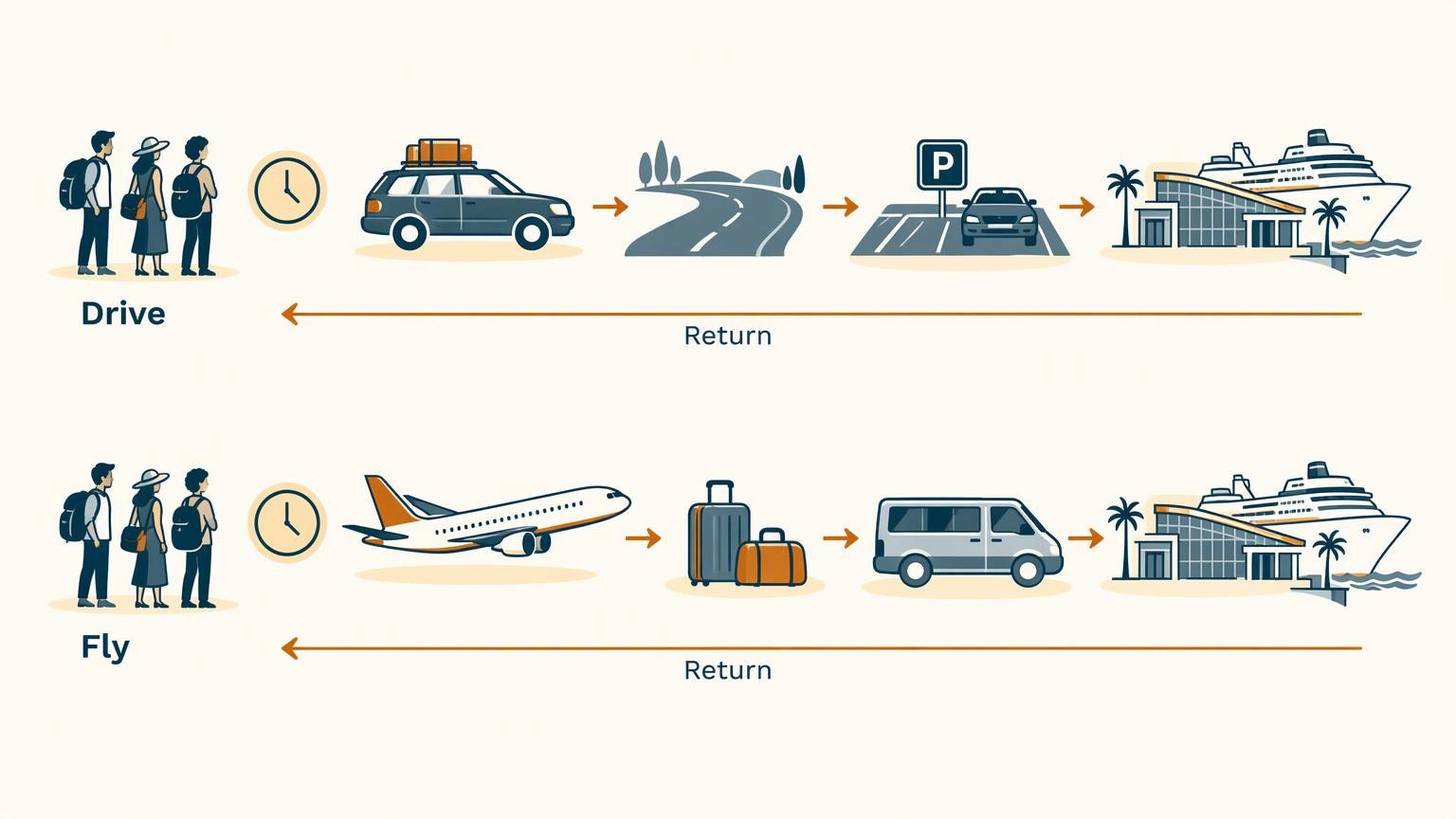
Illustration comparing driving and flying routes: car, road and parking above; airplane, luggage and transfer van below. Both lanes end at matching cruise terminals and include return arrows.
I consider an overnight stay when same-day travel makes arrival too dependent on an uninterrupted journey. The hotel adds expense but lets you complete more of the trip before embarkation day.
I price accommodation, applicable taxes or fees, meals, transportation to the hotel and the onward trip to the terminal. Comparing room rates alone can conceal a meaningful difference between overnight arrangements.
I count cruise parking or a hotel shuttle only when included in the selected booking. I also distinguish whole-party transportation from a limited inclusion that leaves another ride to purchase.
I compare hotel locations by the journey each leaves for sailing morning. A lower room total may still work well, but I weigh its onward transportation cost and remaining travel time against a more convenient overnight location.
I follow your cruise line's check-in instructions. Margaritaville at Sea, for example, assigns Galveston guests arrival windows based on stateroom location. Your own operator's instructions, not hotel checkout, determine when you should reach the terminal.
I would not describe an overnight stay as protection against every disruption. My cruise travel insurance guide addresses the separate question of whether a policy covers risks relevant to your trip. Accommodation and insurance serve different purposes in the arrival decision.

Illustration labeled Overnight stay, with a hotel room above a connected transport, room, meal and cruise-terminal sequence, plus a moon-to-sun journey ribbon.
For a Long Island family weighing both options, I would compare driving and flying for the same party, including return transportation and any overnight stay each plan needs.
If driving costs less but consumes too much vacation time, I would favor flying when airfare and transfers fit the budget. If the road journey is part of your preferred vacation, driving may remain the better choice after parking.
For a solo traveler, I would rebuild the totals: fewer air tickets and different opportunities to share transportation costs can change the conclusion.
I would also separate essential expenses from preferred upgrades before deciding. If the higher total comes mainly from covered parking or a more flexible hotel rate, you can weigh those choices individually rather than dismissing the entire drive-in or fly-in arrangement as unaffordable.
My specialties include cruises, family travel and solo travelers. My Mary Susan Schilling advisor profile lists my verified Royal Caribbean Master of Adventure credential. I can discuss the sailing and surrounding arrangements without promising supplier prices.
My guide to why use a travel agent explains that planning role beyond comparing booking screens. The goal is a complete arrangement that fits your budget and preferences.
Share the destination, dates and travel style you have in mind. A Superior Travel advisor will help turn the possibilities into one clear, personal plan.