
Start with the document's purpose
I would identify whether you are reading a proposal, payment receipt or reservation confirmation. If its purpose is unclear, ask the sender before treating it as proof of the booked stay.

I would treat a hotel booking confirmation as confirmation of the details it explicitly records, not every preference you discussed. Match the property, dates, guests and room category, then separate confirmed inclusions from requests. Keep the reservation reference and amendment contact, and seek a written correction wherever the paperwork conflicts with your intended stay.
I would compare a hotel booking confirmation with the stay you intended to buy. For Long Island travelers, a hotel booking confirmation matters whether the hotel is the whole trip or one itinerary stop.
When reading a hotel booking confirmation, I separate errors from preferences still awaiting confirmation. I am Heather Hamann, a travel advisor at our Long Island travel agency. Here, I focus on what your paperwork confirms.
I would identify whether you are reading a proposal, payment receipt or reservation confirmation. If its purpose is unclear, ask the sender before treating it as proof of the booked stay.
I would look beside the bed, floor or room-location preference for words such as requested or confirmed. A preference matters to the decision only if you understand its status.
I would keep each reservation reference with the company that issued it. That makes a later question more precise than sending an unexplained code.
I would compare revised paperwork with the earlier record, including details you did not intend to change. Save the latest version clearly so an older email does not guide your arrival.
I read confirmed status as applying to explicitly recorded details, not every preference submitted. My first decision is whether the booked accommodation works without any extras still awaiting confirmation.
I compare the property, dates, guest names, occupancy and room category with your intended stay. A matching hotel name cannot resolve a wrong departure date or category.
Next, I separate the booked category from request notes. If separate beds are essential but listed only as requested, I would treat that arrangement as not yet confirmed. The overall confirmation does not settle that requirement.
I would also look for qualifications beside the detail itself. For example, a room-location note marked subject to availability would not give me the same basis for a decision as an explicitly confirmed category. I would keep that distinction visible when comparing options.
I distinguish payment receipts from accommodation records, as the table shows. Keep the reservation reference with its issuer and stated amendment contact. My dividing line is whether a missing detail affects the stay's suitability: clarify essentials, and accept optional requests only if you can do without them. Read accompanying terms for qualifications.
| Wording or record | What I would take from it | Next decision |
|---|---|---|
| Room category explicitly confirmed | The category is recorded as booked. | Compare its description with your intended room. |
| Bed or location listed as requested | The preference is recorded as a request. | Decide whether the stay works without it. |
| Reservation pending confirmation | The document does not state final confirmation. | Obtain the stated status before relying on it. |
| Payment receipt without room details | The record addresses payment, not the complete stay. | Locate the accommodation confirmation. |
| Wording or record | What it means | Next action |
|---|---|---|
| Room category explicitly confirmed | Category recorded as booked | Compare description with intended room |
| Bed or location listed as requested | Preference recorded as a request | Decide if the stay works without it |
| Reservation pending confirmation | Final confirmation not stated | Obtain status before relying on it |
| Payment receipt without room details | Payment record, not the complete stay | Locate the accommodation confirmation |
I would match the property name and address before reviewing amenities. Compare arrival and departure with the itinerary using the hotel's local dates; a travel departure date is not necessarily your check-in date.
Next, I would check the lead guest's name, occupancy and guest details requested by the supplier. For family and group travel, keep each room's occupants visible. The party's total headcount does not establish who is recorded in each room.
I would read the category alongside its description. A label alone should not settle bedding, separate sleeping spaces or essential accessibility features. If a required feature is not explicit, seek a written answer tied to the reservation rather than infer it from photographs or a general description.
I would be especially careful when the wording differs between a proposal and the final record. Compare the descriptions rather than assume differently named categories are equivalent. The important question is whether the recorded features meet the same needs.
For a romantic getaway, I would distinguish the booked category from atmosphere or location preferences. A detail's importance to you does not establish its inclusion.
My final test is whether everyone could use the recorded accommodation without optional preferences. If not, resolve the requirement before relying on the booking. That separates a room that meets your needs from one that merely has the right name.
I would not read confirmed as paid in full, refundable or inclusive of everything. Review payment records and rate terms separately, then reconcile them with the accommodation confirmation.
I would distinguish the stated total, amount paid, remaining balance and separately payable charges. If an amount is unexplained, ask what it represents rather than assume it is a deposit or balance. This determines what financial obligations remain.
For Caribbean and all-inclusive vacations, I would trace meals, transfers and other important inclusions to the booked rate or package description. A broad vacation label cannot replace the applicable wording.
I would compare amendment and cancellation terms separately. A cancellation deadline may not explain whether dates can change, who handles changes or which revised terms apply. Keep those distinctions visible when deciding how much flexibility you need.
To judge a price difference, I would compare dates, occupancy, category, inclusions and flexibility. A cheaper option can make sense when its differences are acceptable, not merely because its total is lower. For a proposed trip, request a current quote from me rather than rely on assumed prices or fees.
Suppose your couples trip confirmation matches the intended property, dates and guests but lists your desired bed arrangement only as requested. I would first have you decide whether that arrangement is optional or essential.
If either arrangement works, accepting the recorded category may be reasonable. I would keep clear that the request is not confirmed rather than interpret it as part of the confirmed room.
If the trip would not work without it, I would direct your question to the stated booking contact: can the arrangement be confirmed within this category, would another category address it, or does it remain a request?
You would compare the written response and any revised quote. I would weigh another category against the requirement it addresses, without assuming availability or unchanged prices and terms. The choice changes only when the response resolves your concern or offers an acceptable alternative.
For European vacation planning, I would review the affected hotel rather than restart the itinerary. With escorted tours and river cruises, identify the accommodation record's issuer before requesting changes. One essential room detail can deserve more attention than several otherwise straightforward reservations.
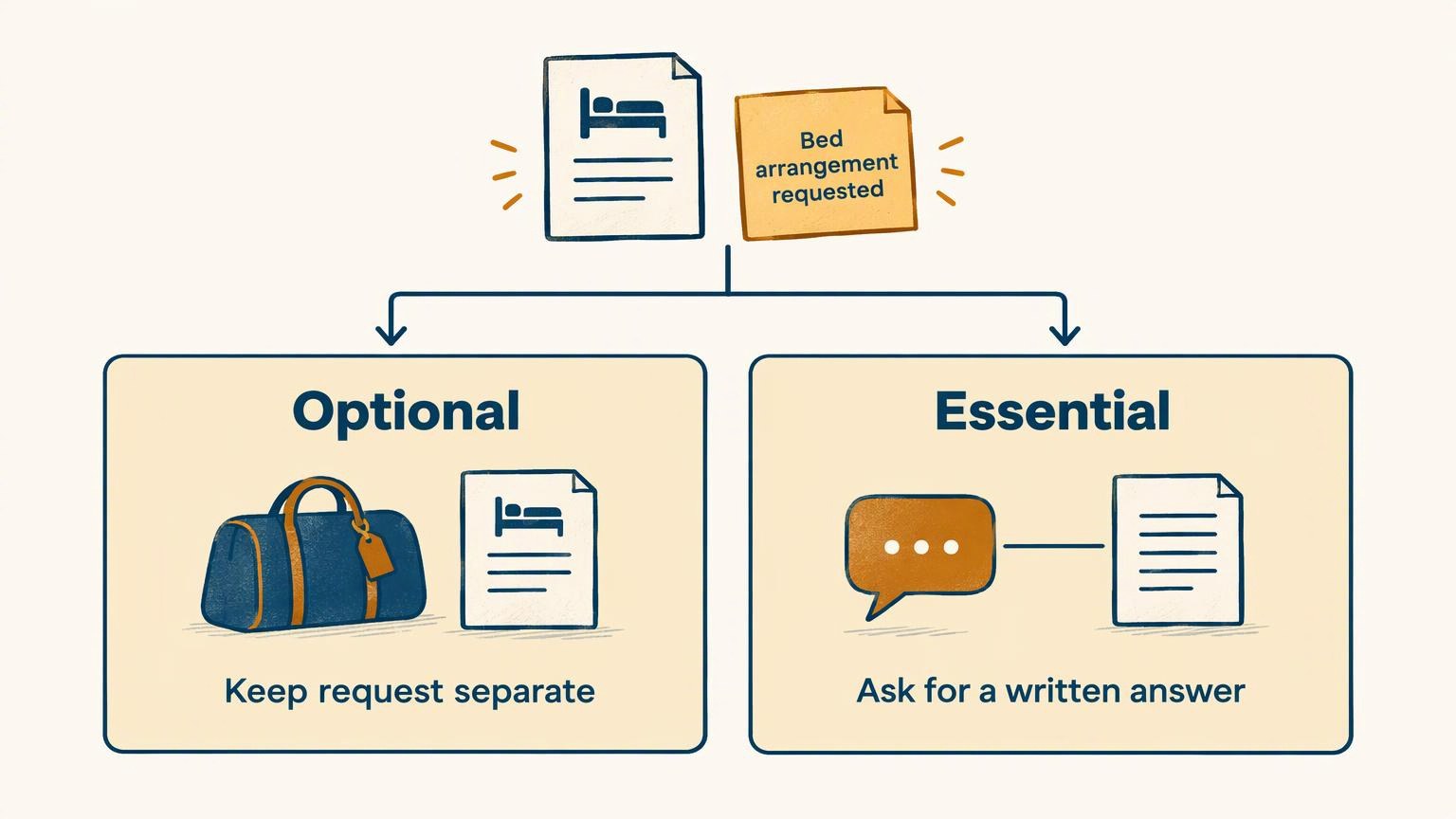
Illustration of a branching bed-request diagram: Optional says “Keep request separate”; Essential says “Ask for a written answer.”
I would report discrepancies to the stated amendment contact, giving the reservation reference, incorrect field and intended detail. Keep preference questions separate from booking corrections so the recipient can distinguish an error from a request still awaiting an answer.
I would request the outcome in writing. When revised paperwork arrives, compare dates, occupants, category and rate terms again, not just the changed line. A correction is useful only if the complete revised record still matches your intended stay.
I would save the latest confirmation with applicable terms, payment records and amendment contact. Mark earlier versions clearly: they help explain changes but should not guide arrival when superseded.
This takes more attention than saving an email. I would focus that effort on details that determine whether the accommodation works, rather than give every optional preference equal weight.
My specialties are cruise planning, custom vacations and group travel. For a proposed customized trip, I would discuss which accommodation details would accompany the itinerary, what remains requested and who handles amendments. That planning discussion is not a supplier guarantee; the actual accommodation confirmation and terms must establish what is booked.

Illustration of a hand organizing papers in a cream folder, with Latest confirmation in front and Earlier version behind, alongside Terms and Payment record tabs.
Share the destination, dates and travel style you have in mind. A Superior Travel advisor will help turn the possibilities into one clear, personal plan.