
Compare the room you actually need
I would keep the dates, guest details and essential room arrangement identical across quotes. A lower price for a different room answers a different question, especially if bedding or occupancy is essential.

I would choose a hotel rate by comparing the full stay cost, cancellation conditions and payment schedule for matching dates, guests and room requirements. A lower nightly price is useful only if the total and terms suit you. Request an itemized quote before deciding that one rate is better value.
I start a hotel booking comparison with what your reservation needs to secure. For Long Island travelers, a hotel booking may be part of a family vacation, couples getaway or wider itinerary.
My hotel booking approach separates staying costs from changing-your-mind costs. I compare matching rooms, included and separately payable items, then payment and cancellation terms.
I would keep the dates, guest details and essential room arrangement identical across quotes. A lower price for a different room answers a different question, especially if bedding or occupancy is essential.
I would count an inclusion as useful only if you expect to use it. A meal benefit or other extra can justify a higher total, but its advertised presence does not establish value for your trip.
I would compare the difference between acceptable flexible and restrictive rates. That difference is what you pay for the stated cancellation rights, not a promise that every change will be free.
I would record when money leaves your account separately from whether it is refundable. A smaller initial payment may help your budget, but it does not establish a smaller cancellation penalty.
I would match arrival and departure dates, guest count, room category and essential bedding before comparing prices. Include children's ages where relevant, rather than assume every occupancy arrangement is priced or accepted identically. Otherwise, the lower quote may describe a stay you cannot use.
I would distinguish a room description from a confirmed requirement. If you need particular bedding, accessibility provisions or connected accommodation, establish what the reservation secures and what remains a request. An attractive price does not resolve an unmet requirement.
In family and group travel planning, I would compare each household's needs separately. Rooms are not interchangeable simply because they appear in the same group quote.
For couples, I would separate necessary accommodation from preferred extras. In romantic getaway planning, a suitable room category may matter more than a longer inclusion list. Compare benefits you expect to use, not their advertised presence alone.
Finally, I would record the currency and quote date. Keep the complete proposal rather than a cropped nightly price, so you retain the room details and conditions attached to each amount when deciding which rate to request.
I would calculate the stay total from quoted room charges, stated taxes and identified mandatory charges. Amounts payable at the property still belong in that total, even if they are not collected before travel. Payment location does not make a required cost optional.
I would budget separately for optional parking, meals or other purchases you expect to use. I would not label them mandatory unless the terms do, or add them again when the quote explicitly includes them. An inclusion matters most when it replaces spending you intended.
I would keep temporary payment-card holds outside the expected final cost. Their amount and release arrangements may affect available funds, but a hold is not automatically another accommodation charge.
For Caribbean and all-inclusive vacations, I would read the exact inclusions rather than rely on the label. For European vacation packages, I would separate accommodation from transportation and other trip elements.
My comparison would show the stay total and separately payable items together. If a charge remains uncalculated, I would mark its amount as still needed, not count it as zero or treat the subtotal as the complete cost.
| Cost item | Treatment | What to check |
|---|---|---|
| Room charges | Include in stay total | Use quoted charges |
| Taxes and mandatory charges | Include in stay total | Include amounts payable at the property |
| Optional meals or parking | Budget separately | Do not add items already included |
| Temporary card holds | Keep outside expected final cost | Check amount and release arrangements |
| Uncalculated charges | Mark amount as still needed | Do not count as zero |

Illustration separating room, taxes and required charges in a Stay total tray from optional meal and parking spending and a temporary card hold.
I would compare cancellation flexibility by its usable deadline, not just a refundable label. Read the cutoff, time zone, penalty and amount returned after an eligible cancellation. Any retained charge belongs in your assessment of the protection offered.
I would evaluate date changes separately. Permission to cancel does not establish that moving your stay preserves the price or room availability. For late arrival or early departure concerns, I would examine no-show and shortened-stay terms.
My choice would balance the extra total cost of flexibility against the alternative's potential loss. A restrictive rate may fit settled plans if that loss is affordable. A flexible rate may justify its premium when its deadline covers your uncertainty. The written offer determines the trade-off; neither label alone establishes the better choice for your particular trip.
For example, if an offer's cancellation penalty increases as arrival approaches, I would compare the possible loss at each stage with the flexible rate's added cost. A modest initial penalty does not describe the risk throughout the booking. I would also note how cancellation must be submitted, so a useful deadline is paired with a clear way to exercise that right.
| Rate description | What I would establish | When it may fit |
|---|---|---|
| Refundable until a deadline | Deadline, time zone and later penalty | Plans may change before that deadline |
| Partly refundable or penalized cancellation | Amount retained and applicable dates | The possible loss is acceptable |
| Nonrefundable | Cancellation loss and separate change terms | Plans are settled and the risk is affordable |
I would identify which decision remains open and when you expect an answer. A cancellation deadline before that answer does not protect your actual uncertainty. Flexibility is worth considering when its timing helps, not simply because the rate costs more.
I would place the initial payment, later balance and property payment beside the cancellation terms. Paying later and being able to cancel are different benefits; neither establishes the other.
As an illustration, suppose you and your partner want a getaway but await approval for time away. A lower-priced nonrefundable room and a higher-priced flexible room both meet your needs. You would identify when you expect approval; I would compare that date with the flexible offer's cancellation cutoff.
If the window extends beyond the expected answer, flexibility provides a relevant option. If it ends earlier, its premium may buy little protection against that uncertainty. I would then compare both quoted totals and the written penalties to weigh the option's cost against the potential loss.
If approval arrives before you reserve, I would reconsider the restrictive rate. Settled plans may make it reasonable, provided you can accept the stated loss.
Finally, I would test affordability against the payment schedule. Suitable cancellation rights do not solve a balance due before you can comfortably pay. Conversely, a convenient payment date does not erase cancellation exposure or establish refundability.
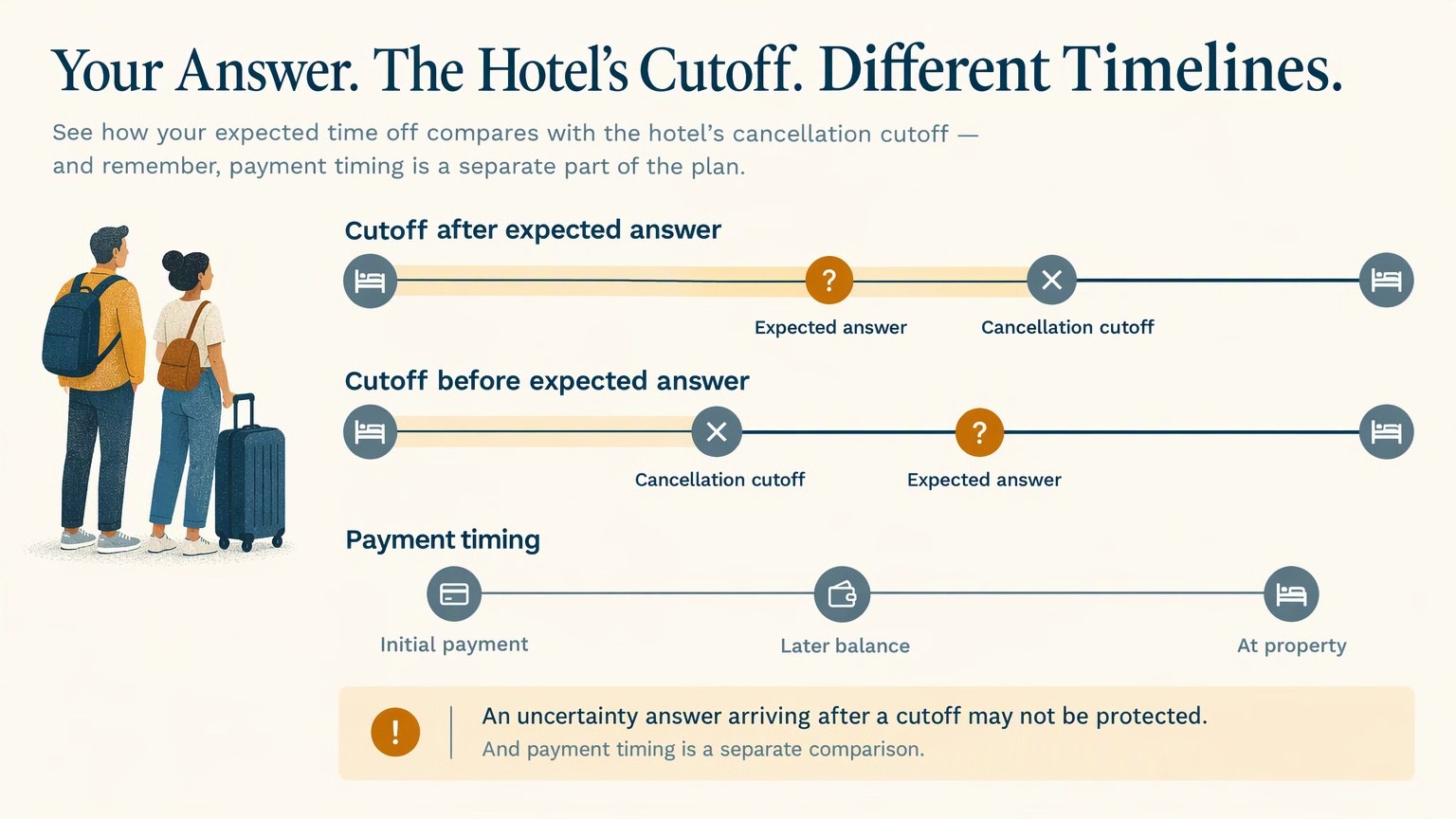
Illustration comparing expected-answer markers with cancellation cutoffs in two orders. A separate payment track shows Initial payment, Later balance and At property.
I am Mary Susan Schilling, a Superior Travel Consultants advisor specializing in cruises, all-inclusive vacations, family travel and solo travelers. My role in customized planning provides a way to discuss accommodation within your wider trip requirements.
Through advisor-led travel planning on Long Island, I would consider how the stay fits surrounding dates and travel arrangements. A suitable room alone may not make a suitable itinerary.
For a current quote, send dates, travelers, children's ages where relevant, essential room requirements and budget. Include cancellation preferences and payment-timing needs. If comparing an existing offer, share its full details so the discussion can distinguish included costs, separately payable charges and cancellation exposure.
I would use your priorities to frame the comparison. If bedding is essential but breakfast is optional, a suitable room without meals may be the stronger choice. If dates remain uncertain, I would give cancellation timing more weight than an extra you might not use.
A straightforward stay may suit independent booking. I would use the benefits of using a travel agent to consider where planning support adds relevance, rather than assume every reservation needs it. The goal remains a rate whose total and terms fit your trip.
Share the destination, dates and travel style you have in mind. A Superior Travel advisor will help turn the possibilities into one clear, personal plan.