
Name the sound that matters
I would distinguish music and bass from hallway voices or traffic. A room preference aimed at one may leave the other unchanged.

I would choose a family hotel by comparing surrounding nightlife, the hotel's evening entertainment, and the position of the room you can actually book. I would treat a quiet-room request as a preference unless its terms establish otherwise. A hotel with fewer identifiable bedtime conflicts is a better starting point than a promised request alone.
I approach hotel booking for Long Island families by starting with bedtime. Hotel booking becomes a different decision when your children need to settle while adults elsewhere are still enjoying dinner, music, or evening activities. A family-friendly label does not tell me whether that overlap suits you.
My hotel booking comparison separates the property from the individual room. I am Renata Boulos, and families are among my specialties.
I would distinguish music and bass from hallway voices or traffic. A room preference aimed at one may leave the other unchanged.
I would compare evening activities with when your children settle, not when you retire. An event that ends before your bedtime may still overlap with theirs.
I would identify which attributes belong to the accommodation you are buying. A preferred floor or building should remain separate unless the booking terms include it.
I would consider a separate sleeping area when family members keep different hours. I would still assess exterior noise independently.
I would pack familiar bedtime items rather than rely entirely on moving rooms. If the hotel itself conflicts with bedtime, I would reconsider the property before booking.
I would begin with the hotel's surroundings before choosing a floor. An appealing daytime setting does not describe what happens after dinner, and a room-location request cannot change the activity outside the building.
I would use a map to identify entrances, outdoor dining, entertainment venues, and roads around the property. Then I would look for current operating information relevant to your dates. A map establishes position; it does not establish how much sound reaches a bedroom.
When reading guest comments, I would favor descriptions of the sound, its timing, and the room's orientation over a bare complaint that a hotel was noisy. I would treat repeated descriptions as a reason to investigate, not proof that every room has the same conditions.
For European vacation planning, I would weigh the appeal of an active evening setting against an early bedtime. The downside of choosing somewhere quieter may be giving up the setting you most wanted for meals or evening walks.
I would not reject a hotel simply because nightlife exists around it. I would reject the assumption that convenient daytime surroundings automatically make it a suitable sleep setting.
I would compare the entertainment location and schedule with your family's actual settling time. Knowing that a hotel has evening activities is less useful than knowing where they take place and whether they overlap with sleep.
For Caribbean and all-inclusive vacations, I would separate children's activities from music or performances intended for a wider audience. Family entertainment can be appealing without being compatible with every child's bedtime.
I would look for a current program and a property layout together. A schedule without a location leaves the room relationship unclear; a layout without a schedule leaves the timing unclear. Neither establishes the sound level inside a particular room.
I would also distinguish published quiet hours from the end of a scheduled event. Those answer different questions. If evening programming changes by date, I would avoid treating an older program as a commitment for your stay.
The same comparison belongs in vacation planning around your family: an evening activity may be part of the trip you want, rather than a problem to eliminate. I would decide which nights you want to participate and which nights you need an earlier retreat.
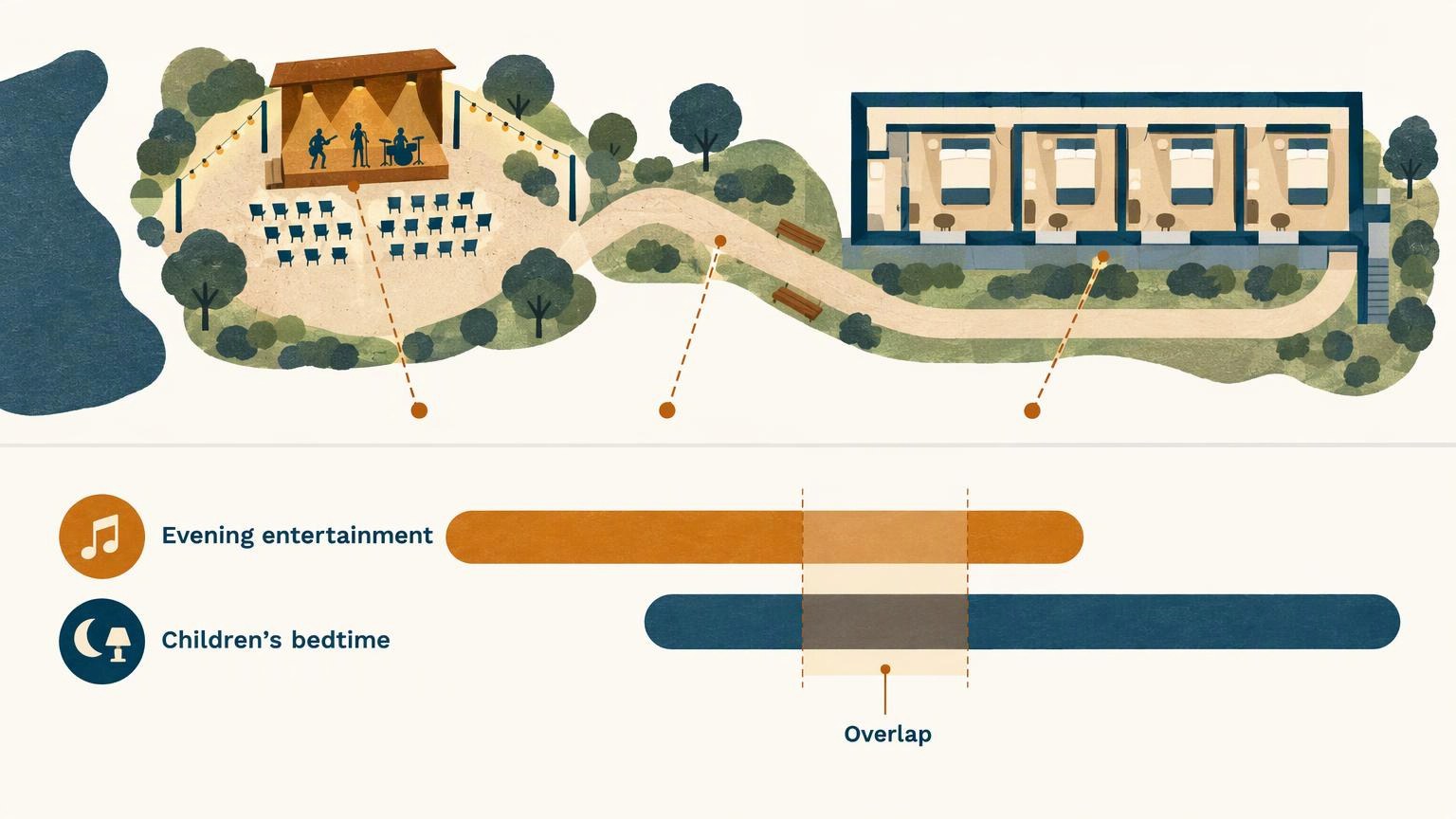
Illustration pairing a stage, pedestrian path and bedroom layout with evening entertainment and children’s bedtime bands; a shaded interval is labeled “Overlap”.
I would read the room-category description before relying on a note saying "quiet room." I would distinguish a named building, orientation, or layout included in the booking from a preferred position the hotel may consider later.
In Travel + Leisure's reporting carried by Yahoo, hotel managers describe room preferences as dependent on what can be accommodated. I would use that distinction when comparing choices, rather than interpreting an acknowledged request as a guaranteed assignment.
I would make a request specific to the concern: away from evening entertainment, for example, rather than simply "high floor." A higher floor does not establish the relationship to every possible noise source.
I would also separate internal room layout from external exposure. A separate sleeping area addresses different family schedules; it does not establish sound insulation. A desirable view does not establish quiet either.
In family and group travel planning, I would keep these distinctions visible when several households have different needs. The comparison below shows how I would assess the strength of the information, without assigning any hotel a guarantee it has not made.
| Information | What it establishes | What it does not establish |
|---|---|---|
| Named room layout in the category | The described accommodation arrangement | Protection from outside sound |
| Building or orientation included in written terms | The stated location attribute | Silence throughout the stay |
| Quiet-room preference acknowledged | The hotel has received the request | A guaranteed room assignment |
| Published entertainment program | Listed activities and timing | Sound levels in your bedroom |
| Information | Establishes | Does not establish |
|---|---|---|
| Named room layout | Described accommodation arrangement | Protection from outside sound |
| Location included in written terms | Stated building or orientation | Silence throughout the stay |
| Quiet-room request acknowledged | Hotel received the request | Guaranteed room assignment |
| Published entertainment program | Listed activities and timing | Sound levels in your bedroom |

Illustration of two separate papers labeled Included layout and Location request, with a magnifying glass between them and a map fragment above.
I would reconfirm the room-location preference at arrival and ask how the assigned room relates to the concern you named. If possible, I would inspect the room before fully unpacking, while recognizing that a quiet afternoon cannot predict the entire night.
I would listen for what is present rather than assume: hallway activity, equipment sounds, or entertainment already underway. If an identifiable issue conflicts with your requirements, I would raise it then. An alternative room may not be available.
For shared-room routines, I would pack familiar quiet activities and agree on lighting before bedtime. Valley Family Fun's practical suggestions include a small reading light and quiet activities for family members keeping different hours. I would use these as preparation, not as a remedy for a poor hotel match.
If noise becomes disruptive, I would contact reception promptly, describe what you hear and when it started, and let staff investigate. I would avoid confronting another guest myself.
I would keep notes of the disturbance and the response if it continues. A move is one possible remedy, not an entitlement I would assume. I would also avoid moving your family to another hotel before understanding the existing reservation's terms and the cost of the alternative.
Say you are comparing a resort with evening entertainment and another accommodation whose described room location is away from that activity. Your children settle before the entertainment ends, but the adults like the livelier property's program.
I would first determine whether the livelier option has a suitable location included in an available room category. If the only protection is an unconfirmed preference, I would favor the alternative when early sleep is the priority. I would not choose it merely because it has fewer activities.
If your children enjoy the program and later nights fit your plans, the livelier property may be the better choice. The decision follows the overlap and the evidence, not a blanket rule that family hotels must be quiet.
My family specialty and Superior Travel Consultants' custom vacation planning give you a way to put sleep requirements alongside the rest of the trip. For travelers choosing a travel agency on Long Island, that means working with a named advisor whose specialties match the decision.
I would compare dates, room category, layout, included meals, and change terms before judging value. A more expensive room needs a useful documented attribute, not merely a reassuring name. The benefits of advisor-led planning belong in clarifying that comparison, not promising silence.
Share the destination, dates and travel style you have in mind. A Superior Travel advisor will help turn the possibilities into one clear, personal plan.