
Identify the legal business
I would ask for the seller's and operator's legal names, not only the tour's marketing name. If the documents use different names, I would have their relationship explained before treating them as the same company.

I would choose tour packages only after the proposal identifies the package seller, the operating company and the terms applicable to each arrangement. Before approving, I would review the itinerary, inclusions, payment and cancellation conditions, and issue-reporting contacts. An advisor's name or a partner listing does not establish who operates your particular tour.
I compare tour packages by tracing promised services to the responsible company. For Long Island travelers, tour packages should make those relationships clear before payment, especially when presented through an advisor.
When reviewing tour packages, I separate planning help from selling and operating the arrangements. I am Izabela Melli, specializing in Europe, the Caribbean, Mexico and cruises. Here, I explain how documents connect your itinerary to defined responsibilities.
I would ask for the seller's and operator's legal names, not only the tour's marketing name. If the documents use different names, I would have their relationship explained before treating them as the same company.
I would connect each set of terms to the arrangements it covers. A hotel's cancellation wording should not silently become my assumption about the entire tour.
I would read an inclusion as a description of the proposed service, not proof that it is reserved. I would look separately for the booking status and the confirmation expected after authorization.
I would have a requirement that determines your choice addressed in writing. If a particular room arrangement or sightseeing pace is essential, a general description of a family-friendly tour is not enough.
I would save the operator's applicable contact instructions with the itinerary. I would distinguish reporting a problem during travel from submitting a later complaint, since neither process should be assumed from a general support statement.
I begin with roles rather than logos. The advisor helps frame the trip; the package seller sells the arrangements; the operating company delivers the tour. One company may fill several roles, but I would establish that from the proposal.
Travel services arranged through Superior Travel Consultants are supplied by independent providers whose own terms may apply. A proposal through me does not mean I operate the tour or every service shares one provider.
I would have the preparer identify each legal entity. Marketing names, invoice headings and operator names may differ; the documents should explain their relationship and responsibilities for your booking.
I also distinguish the operator from individual guides and local providers. If services are subcontracted, I would clarify responsibility and reporting arrangements without assuming subcontracting creates or removes contractual obligations.
For example, I would not treat a payment recipient's name as sufficient evidence that it operates the sightseeing. I would trace the sightseeing description to the named operator and its applicable terms, while separately identifying the business receiving payment and the arrangements that payment covers.
Understanding the planning role of a travel advisor helps separate advisor selection from operator verification. Both matter, but neither replaces the other.
| Role | What I would establish | Evidence to request |
|---|---|---|
| Travel advisor | Who helps shape and communicate the proposed arrangements | Named advisor and explanation of planning responsibilities |
| Package seller | Which legal business sells the package and handles the stated transaction | Proposal, invoice and applicable sales terms |
| Operating company | Which business delivers the tour and how local services fit | Operator identity, booking terms and travel documents |
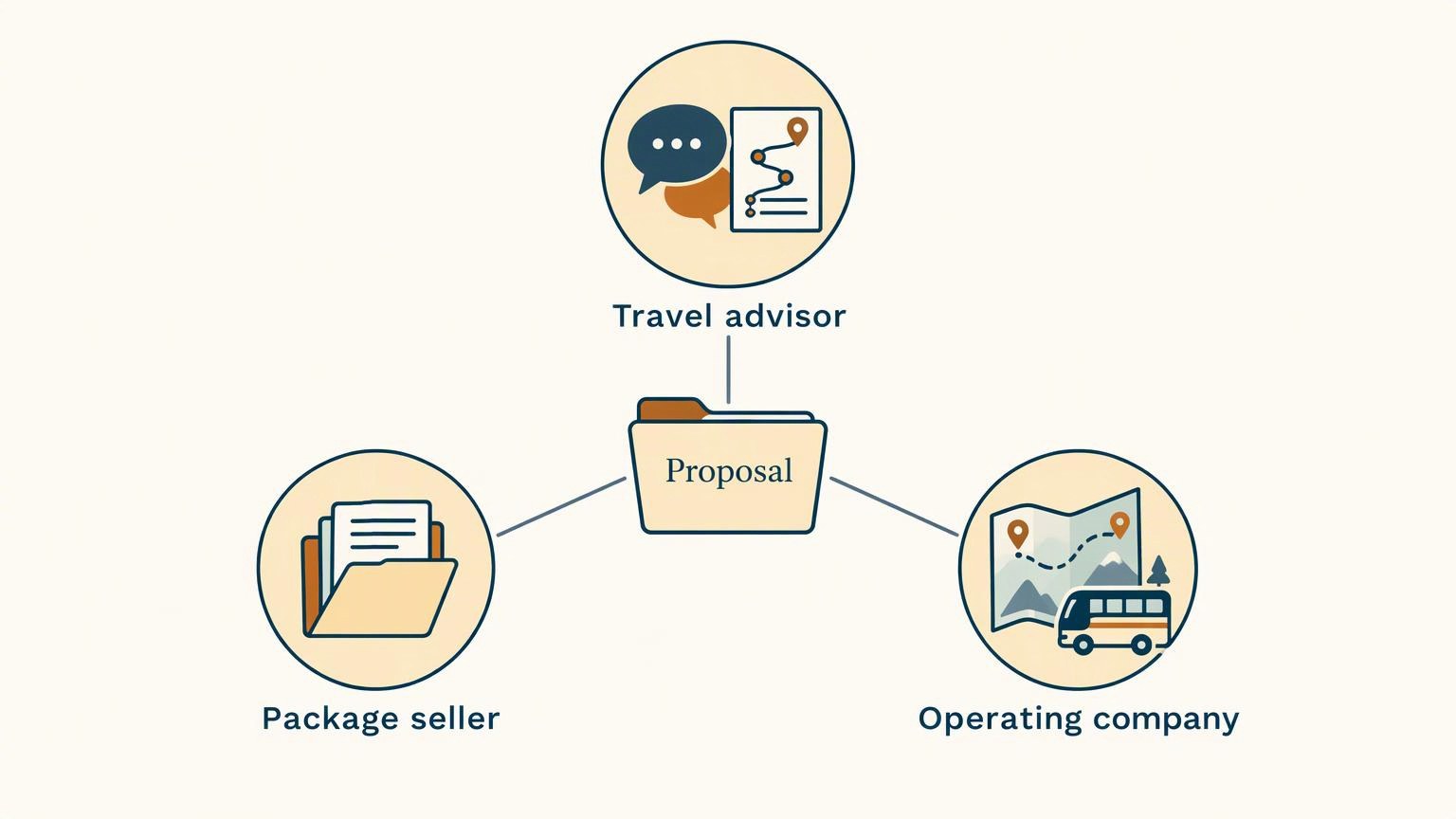
Illustration of three roles connected to a Proposal folder: speech bubbles and an itinerary for Travel advisor, documents for Package seller, and a schematic map and bus for Operating company.
I read the proposal, itinerary and booking terms together: what you are choosing, what is included and which conditions apply. An attractive itinerary alone cannot answer all three.
Superior's website does not confirm availability or create a booking. Final details, supplier terms, prices and cancellation conditions are provided during planning and booking. I distinguish website terms of use from terms governing your arrangements.
My pre-approval review follows this sequence:
If documents conflict, I would request a written explanation or correction before approval, rather than assume a newer email overrides a contract or a brochure overrides the proposal.
I would keep the version you approve together with the terms supplied for that decision. If a revision changes a hotel, service or payment condition, I would compare that specific change with your priorities before treating the revised proposal as acceptable.
For escorted tours and river cruises, I review the proposed product, not merely its category. After booking, I compare the confirmation with the approved version and track outstanding arrangements. That comparison distinguishes what you authorized from what has actually been confirmed.
I compare equivalent arrangements before totals. Accommodation, transportation, sightseeing, meals and private versus shared services can affect cost, but I would not assume they are included without proposal details.
A lower quote may exclude an essential transfer; a higher quote may include services you would not use. I separate the booking total from additional spending needed for your intended trip.
For family and group arrangements, I examine who each component covers and whether rooming and participation suit everyone. For couples and anniversary travel, I consider whether shared sightseeing leaves enough independent time. A honeymoon label establishes neither privacy nor flexibility.
I compare payment and cancellation conditions alongside inclusions: what happens to your arrangements and payments if plans change? The word flexible is not an answer.
I also consider the trade-off between included activities and usable free time. If your preference is a slower pace, additional sightseeing is not automatically better value. I would compare the daily itinerary with what you actually want to do, not simply count inclusions.
I would not promise packages cost less than separate bookings. Defined, connected services may suit you; separate bookings may offer the independent choices you prefer to manage. Request a current quote from me with inclusions and applicable terms, rather than treating an advertised price as your total.
Suppose your family is comparing European tours and wants an included arrival transfer. One proposal identifies its seller and operator and describes the transfer. Another has a lower total but vague transportation wording.
First, I would help you define the requirement: which travelers and arrival the transfer covers, and whether it must be included. Your preference determines whether separately arranged transportation is an acceptable alternative.
Next, the second proposal's preparer would clarify inclusion, provider and conditions. You could then compare equivalent arrangements. I would not interpret a lower total as evidence of better value or worse quality.
If both meet your needs, I compare terms and remaining differences. If the cheaper offer leaves transportation to you, it may suit you when you are comfortable arranging it. If inclusion is essential, I favor the documented transfer, subject to acceptable terms.
My Europe specialty supports discussing the trip's shape, with broader context in European vacation planning. It does not replace operator identification or review of the proposal's conditions. The deciding difference is the service documented for your family, not the destination label.
| Check | Documented offer | Lower quote |
|---|---|---|
| Transfer wording | Arrival transfer described | Transportation wording vague |
| Total | Not specified in the example | Lower total |
| Before deciding | Confirm traveler coverage and terms | Clarify inclusion, provider and terms |

Illustration of two adults comparing proposal diagrams: one shows a shuttle between airport and lodging icons; the other shows a transfer gap and inquiry bubble. A map and notebook sit on the table, with luggage nearby.
I would establish reporting routes before departure: the operator's during-trip contact, contacts for separately booked services and escalation instructions. Keep them accessible while traveling, rather than relying on a general support statement.
I separate immediate assistance from formal complaints or reimbursement requests. The provider's process should specify any during-trip notice requirement, later deadline and supporting records. I would not assume a universal reporting period.
If a problem occurs, I recommend recording what happened, when, the affected service and whom you contacted. Clarify which matters come to me and which require direct operator contact. Support does not itself define contractual responsibility or guarantee a remedy.
For a missed included transfer, for example, I would use the transfer's documented reporting route and retain messages and any receipts. A separately booked transfer may have a different contact. Identifying that distinction beforehand gives you a practical starting point without assuming either provider's remedy.
I use Travel Partners as a supplier-research starting point, not proof of who operates your package. The proposal must establish that connection.
Through our Long Island travel agency, my documented specialties help with advisor selection. I would base the package decision on its supplier identities, documents and terms, keeping the planning relationship distinct from the operator's obligations.
Share the destination, dates and travel style you have in mind. A Superior Travel advisor will help turn the possibilities into one clear, personal plan.