
Name the result you need
I would describe the decision you want resolved, not simply request a beautiful itinerary. A route recommendation and a booking-ready plan are different deliverables.

I would establish whether itinerary planning carries a separate charge before commissioning a plan. Compare the proposed fee with the work included, not with airfare or hotel prices. For your trip, request current terms covering deliverables, revisions, payment timing and any booking credit before deciding whether to proceed.
I would compare itinerary planning fees by asking what decision the work will help you make. For Long Island travelers, itinerary planning might mean choosing a trip structure, evaluating accommodation options or organizing arrangements around different travelers' needs. Those are different assignments, even when each produces a travel plan.
I am Heather Hamann, and my specialties include cruise planning, custom vacations and group travel. At Superior Travel Consultants, a travel agency serving Long Island, I would approach itinerary planning by separating the design work from the travel purchases and identifying the terms that affect your decision.
I would describe the decision you want resolved, not simply request a beautiful itinerary. A route recommendation and a booking-ready plan are different deliverables.
I would account for any design charge separately from the money available for travel. That keeps a planning purchase from quietly reducing the accommodation or activity budget you intended.
I would explain what an option gets wrong before requesting replacements. Clear feedback helps distinguish a refinement from research for an entirely different trip.
I would compare the service at its full charge unless you understand and expect to meet the credit conditions. A possible future credit is not the same as a lower payment today.
I would match the assignment to the uncertainty that matters most. Once the travel format is settled, you may need less design work than you first expected.
I would treat a planning fee as payment for the work described in the agreement. It should not be confused with money that purchases a flight, hotel stay, cruise or other travel arrangement. A proposed itinerary and a paid reservation answer different questions.
Before comparing totals, I would separate the design charge from supplier travel costs and any additional service charges. If a proposal combines them, an itemized breakdown helps you see whether you are comparing equivalent work and travel purchases.
I would also distinguish a fixed charge from a charge calculated by time or another stated unit. A fixed amount needs a defined scope; an hourly arrangement needs an explanation of billable work and how further spending is authorized. Neither label tells you whether the service suits your trip.
The useful price is the amount for your requested assignment under its current terms. I would not use another traveler's fee, a general online estimate or a supplier's advertised trip price as a substitute. An attractive starting figure is less useful if it leaves the essential planning task outside the quoted work.
| Charge | What it buys | What to establish |
|---|---|---|
| Planning or design | The agreed research and itinerary work | Deliverables and scope |
| Supplier travel costs | The actual travel arrangements | Inclusions and supplier terms |
| Additional service work | Work outside the original assignment | Trigger and approval process |

Illustration separating planning work from travel purchases, with papers and a pencil in one tray and airplane, hotel and cruise-ship cutouts in the other.
I would describe the desired result before judging the fee. Do you need a route recommendation, a comparison of travel styles or a day-by-day plan? A list of possibilities is different from a recommendation that explains why particular choices fit your pace and priorities.
For European vacation planning, I would distinguish choosing the order of stops from selecting individual arrangements. For escorted tours and river cruises, the central task might instead be comparing established itineraries. Those assignments require different work, so I would not assume they should have the same price.
I would identify what the proposed service includes: research, recommendations, booking assistance, itinerary documentation and any support after booking. These are scope questions, not a promise that every proposal includes each service. A useful agreement also names what you will handle yourself.
My cost comparison would focus on the work needed to resolve your open decisions. For family and group travel, reconciling different priorities may matter more than the number of reservations. For Caribbean and all-inclusive vacations, choosing the right vacation format may be the main assignment. More expensive travel does not automatically mean more design work.
I would distinguish refining an agreed plan from changing the assignment itself. Replacing an accommodation recommendation while keeping the trip's purpose and route is different from abandoning that route and researching a different destination. The distinction matters if the agreement limits revisions or charges for added work.
Before work begins, I would want the revision terms to explain what a revision means. Does it cover feedback on the first proposal, alternative recommendations or adjustments after bookings are made? A revision allowance is difficult to evaluate without that definition.
I would also separate design changes from supplier changes. Revising a document does not itself change a reservation. If travel has already been booked, an alteration can require a separate supplier response and may affect the travel price under that supplier's terms.
For useful feedback, I would start with why an option does not fit: the pace feels rushed, the accommodation choice misses your priorities or the plan leaves too little flexibility. That gives the next version a clearer direction than asking for an entirely different list without explaining the reason.
If the requested work expands, I would establish the added scope and any charge before authorizing it. Neither you nor the planner should have to infer whether a new assignment is covered by the original agreement.
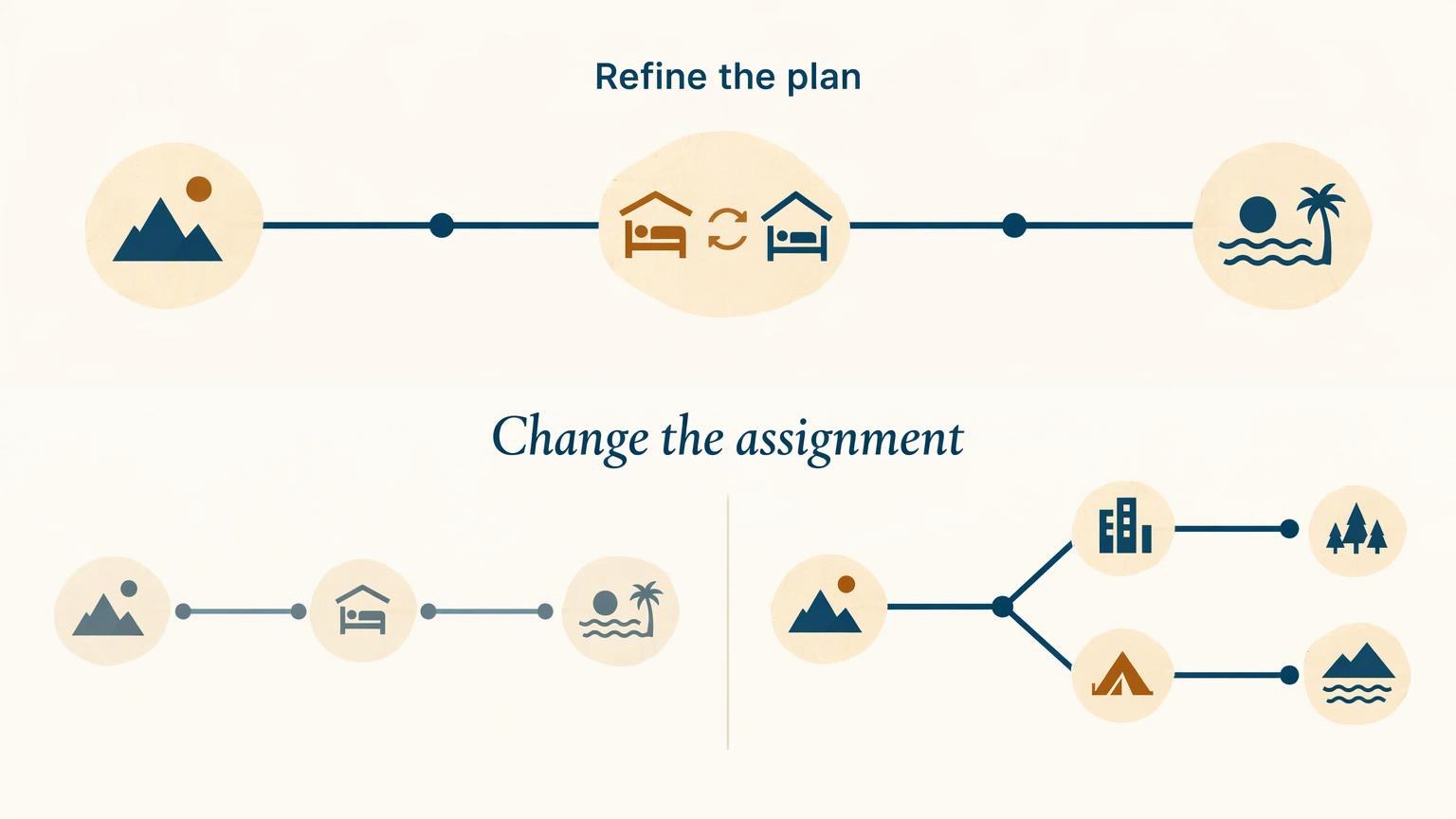
Illustration contrasting “Refine the plan,” with exchanged lodging icons, and “Change the assignment,” with a separate branching route beside a faded original.
I would read payment terms alongside the planning scope. Establish when a charge becomes due, what authorizes the work to begin and what happens if you decide not to continue. Payment for completed design work and a deposit toward travel are separate commitments.
I would not assume a planning charge is refundable or credited toward a booking. If a credit is offered, its conditions should identify the eligible purchase, required booking route, timing and treatment if you later change or cancel the travel arrangements.
A credit also needs a clear application method. I would establish whether it reduces a later invoice, is returned after an eligible purchase or works another way. Until those terms are clear, I would evaluate the planning service at the full charge rather than count on a future reduction.
I would keep the accepted scope, payment terms and any credit conditions together. That record helps distinguish what you agreed to buy from options discussed but not accepted. Supplier deposits and cancellation terms should remain identifiable separately.
Before committing, my final test would be whether you would still value the design work if you did not make the eventual travel booking. If the answer is no, the credit conditions deserve particular attention before payment.
Say you want a European vacation but have not decided between an independent itinerary and a river cruise. Your main uncertainty is the travel format: how much structure you want and how much responsibility you want for daily arrangements. I would resolve that choice before commissioning detailed independent-trip research.
If an established itinerary fits your priorities, comparing suitable trips may be enough. If you want a route built around your interests and pace, custom design becomes more relevant. If you already know your route and enjoy researching the remaining details, handling the planning yourself is a reasonable alternative.
The downside of paid planning is the added cost and the need to explain your preferences and review recommendations. I would not promise that it will pay for itself through lower travel prices. Its value depends on whether the agreed work solves a problem you want help solving.
My specialties in custom vacations, cruise planning and group travel make those trip decisions relevant starting points for a conversation. I would connect the requested work to that focus rather than assume every trip needs a commissioned itinerary.
For the broader choice, my agency's explanation of why to use a travel agent provides further context. When you request a planning discussion, name Heather Hamann and describe the decision you need help making. Request the scope and confirmation of any planning charges before proceeding.
| Planning option | Best fit |
|---|---|
| Compare established trips | An established itinerary fits your needs |
| Custom design | A route built around your interests & pace |
| Plan it yourself | You know the route and enjoy research |
Share the destination, dates and travel style you have in mind. A Superior Travel advisor will help turn the possibilities into one clear, personal plan.