
Protect the return requirement
I would write down when you need to be ready for your next obligation, not merely when you want to land. Those are different endpoints if you still need to get home and rest.

I recommend customized itinerary planning when essential stops depend on difficult transitions between fixed commitments. First, separate immovable dates from preferences and count the complete journey between stops. If removing an optional stop resolves the conflict, I would favor simplifying.
I approach itinerary planning as a calendar problem before a destination search. For Long Island travelers, itinerary planning starts with when you can leave, when you must return and what must happen between those dates. A preferred departure time differs from an obligation you cannot move.
With itinerary planning, I clarify each stop's purpose before reservations complicate changes. Our advisor-led planning on Long Island offers a place to discuss those choices, but customization is not automatically the right answer.
I would write down when you need to be ready for your next obligation, not merely when you want to land. Those are different endpoints if you still need to get home and rest.
I would label a stop essential only if removing it changes the reason for the trip. A stop added because you will already be traveling should earn its place against the time it consumes.
I would connect checkout, luggage, transport and the next arrival requirement in one timeline. A departure and arrival time alone do not explain whether the next commitment fits.
I would test the itinerary without its lowest-priority stop. If that change protects every essential commitment, compare the simpler route before paying to develop a more elaborate one.
I would record the earliest point you can leave and the latest point you must be ready for your next obligation, then place essential events inside that window.
I separate hard conflicts from preferences. An exam or wedding commitment may prevent travel; wanting a later departure or warmer weather changes which option you prefer. Treating both as immovable can unnecessarily eliminate a workable trip.
Before searching destinations, I would make this record:
I would distinguish maximum trip length from nights away. A hotel night does not show how much of the preceding or following day is available for activities.
For several stays, such as those explored in our European vacation packages, I would rank stops before arranging them. That ranking helps you shorten the route without trimming every stay until none feels worthwhile. If everything seems essential, I would revisit the trip's main purpose before adding reservations.
I would measure a transition from being ready to leave one place to being ready for the next commitment. Flight or train time is only part of that interval. Checkout, reaching transport, luggage handling and the onward transfer belong in the same timeline.
My starting sequence would be: leave accommodation, reach transport, complete departure procedures, travel, complete arrival procedures, collect luggage if needed and reach the next destination. If an activity requires check-in or a change of clothing, include that step too.
I would use the actual operator's requirements and route information, not a universal allowance. Scheduled times that do not overlap are not enough to establish a workable connection. An unanswered timing question remains a dependency, even if the rest of the route looks straightforward.
I would also consider the consequence of lateness. Arriving at accommodation later than preferred differs from missing an essential departure or event. The latter deserves more attention and an alternative before commitment.
Finally, I would preserve a usable gap. If luggage, transfers and check-in must all take the shortest imaginable time, I would change the sequence or remove something rather than fill the remaining interval with another activity.
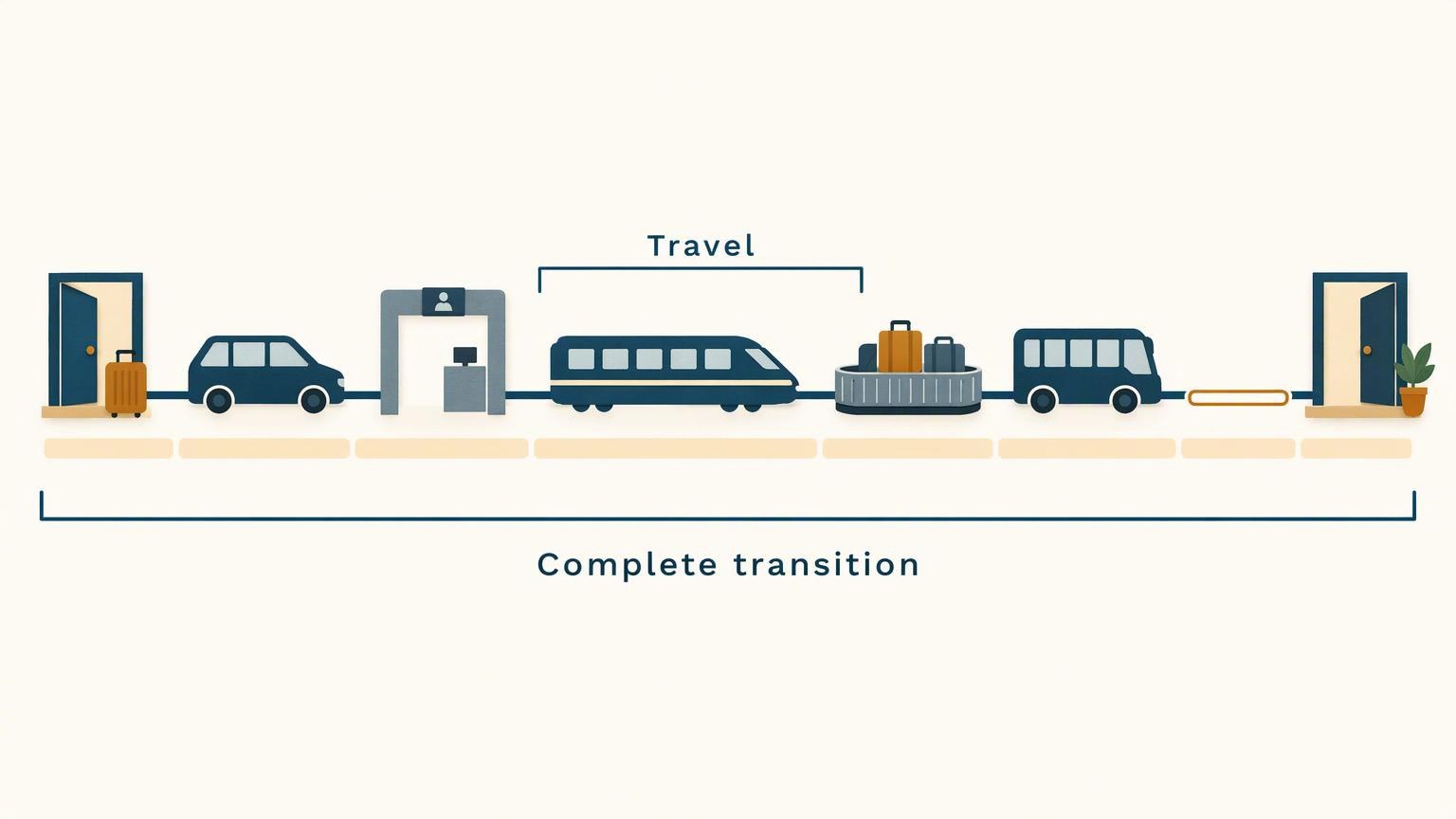
Illustration of a complete transition between doorways, with transport, a gate, luggage collection and an outlined pause; a smaller Travel bracket sits above the train.
I would choose the planning approach based on the dependency remaining after optional stops are removed. Several straightforward reservations may be manageable independently; one reservation with an unanswered arrival requirement may deserve help.
A short vacation does not itself justify customization. With a clear route and flexible activities, I would favor straightforward planning. When essential commitments compete for a travel window, I would compare trip structures before selecting reservations.
A fixed departure can organize the trip but limits calendar flexibility. Our escorted tours and river cruises offer a starting point for exploring that structure. I would compare actual departure and return requirements with your dates, not assume a packaged route fits.
A single-property stay may suit a goal that does not require multiple stops. Our Caribbean and all-inclusive vacation planning is relevant to that alternative, though arrival and return travel still count.
Tailoring can mean more decisions and dependencies. I would choose it when preserving essential stops justifies that work, not to retain every appealing idea. The comparison below separates the reason to choose each approach from the compromise it asks you to accept.
| Approach | Starting point | Trade-off |
|---|---|---|
| Plan independently | Clear route, flexible activities | You check timing |
| Simplify | Optional stop creates conflict | Lose a desired experience |
| Discuss customized planning | Essential transitions remain difficult | Agree on coordination scope |
| Compare structured departures | Calendar fits your window | Less schedule flexibility |
| Approach | Best fit | Trade-off |
|---|---|---|
| Plan independently | Clear route, flexible activities | You check timing |
| Simplify | Optional stop creates conflict | Lose a desired experience |
| Discuss customized planning | Essential transitions remain difficult | Agree on coordination scope |
| Compare structured departures | Calendar fits your window | Less schedule flexibility |
Say you want to attend a family celebration, add a second stay and return before work. The celebration and return requirement cannot move. The second stay is appealing but is not the reason for traveling.
I would first place the celebration and work requirement on the calendar. You would identify when you can leave, your maximum trip length and any existing reservations. I would then map the travel needed to reach the celebration and return home.
Next, I would compare the trip with and without the second stay. Keeping it requires another transition and useful time after arrival. Removing it creates room around the essential event without changing the trip's purpose. That comparison shows what the extension costs in available time, even before comparing spending.
If the second stay depends on an unverified connection, I would favor removing it. If it has an essential purpose, I would discuss whether another sequence could preserve both commitments.
For family, group or cruise vacations, I would separate the shared calendar from individual needs. An optional extension need not determine everyone's trip, unless a shared transfer or fixed departure makes one person's timing affect others.
Customized planning earns its place here only if a meaningful timing problem remains. It cannot create additional vacation days.
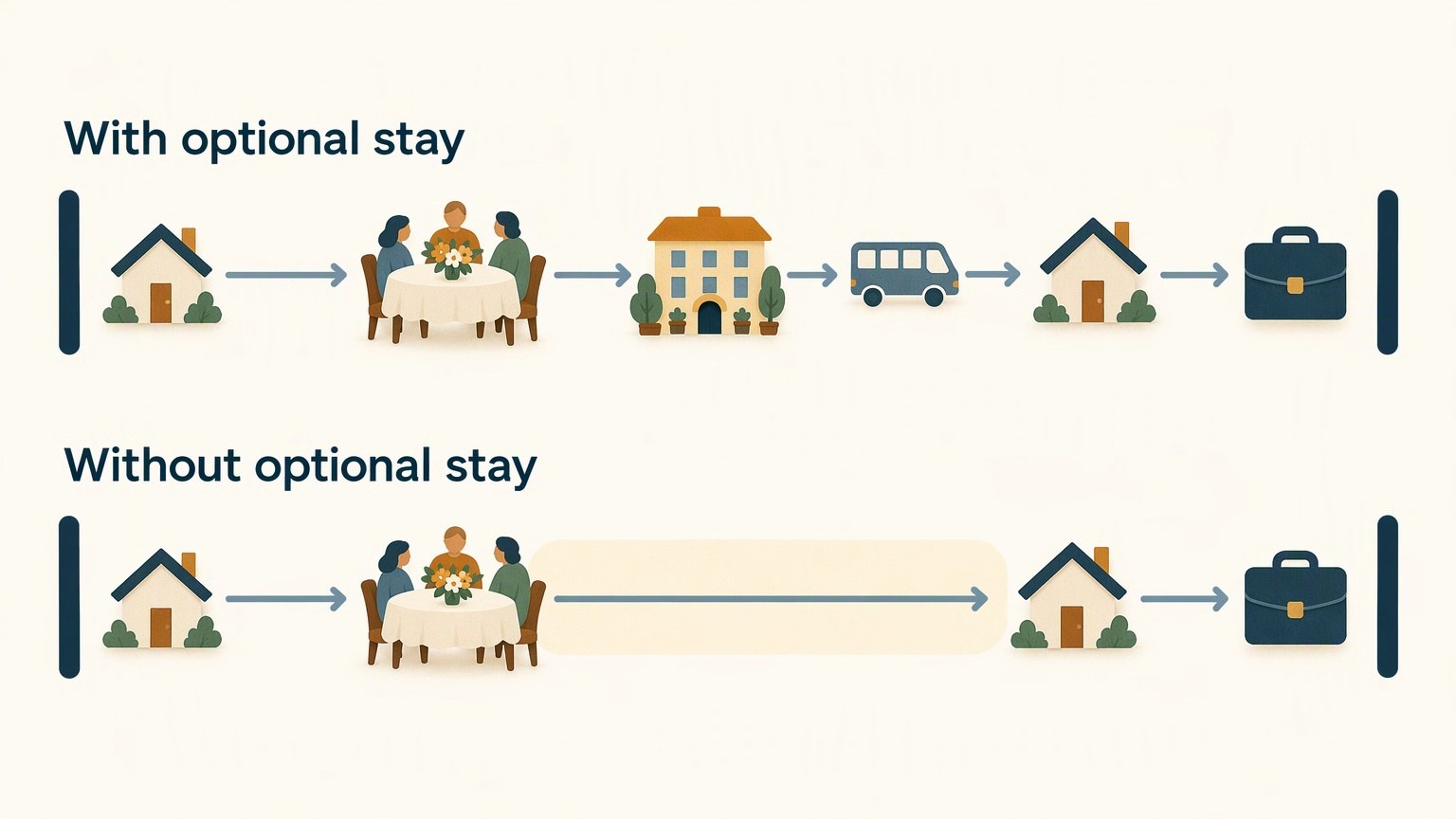
Illustration comparing routes labeled With optional stay and Without optional stay. The upper route includes a lodging building and van; the lower leaves a broad pale interval before the return home.
I would define the job before comparing planning proposals. Developing a route differs from reviewing an existing trip; neither description establishes which reservations, revisions or support are included.
For a tight schedule, I would want the scope to address essential stops, transitions and alternatives if the preferred sequence does not fit. Existing bookings matter because they may limit available changes. A proposal focused only on adding activities may leave the central timing problem unsolved.
I would separate any planning charge from travel purchases. Fixed dates, accommodation choices, transport arrangements and additional transfers can change trip costs. A more detailed itinerary is not proof of better value. Request a current quote from me, Blake Rehfield, with an itemized explanation of inclusions and exclusions.
For example, I would compare a route with an optional overnight stop against one without it. The extra stay adds accommodation and transport to the comparison, but its value depends on the usable time it provides. I would weigh that experience against both the spending and the tighter schedule.
Our guide to why you might use a travel agent offers broader context. Our agency provides customized planning, with one dedicated advisor from planning through your return.
You can find my Blake Rehfield advisor profile here. I would begin with your calendar and essential stops, then establish an appropriate scope rather than assume every component needs redesigning.
Share the destination, dates and travel style you have in mind. A Superior Travel advisor will help turn the possibilities into one clear, personal plan.