
Keep optional stops movable
I would distinguish dated commitments from places you merely hope to visit. That leaves room to reverse the route or change its endpoints without losing the purpose of the trip.

I would choose airports after sketching your European route. A same-airport return suits a single base or natural loop; different airports can suit a directional trip. I would compare backtracking, transfers, total spending, and final-night positioning before committing to flights.
I begin itinerary planning for Long Island travelers with the trip's endpoints and fixed commitments. Good itinerary planning keeps airport choices open until the route takes shape, rather than letting the first airfare dictate your stops.
My itinerary planning also considers the ground journey behind a flight's price. I am Carol McParland, owner of Superior Travel Consultants and a Certified Travel Consultant specializing in Europe. I would compare your stops as a connected trip, including arrival and departure.
I would distinguish dated commitments from places you merely hope to visit. That leaves room to reverse the route or change its endpoints without losing the purpose of the trip.
I would compare a multi-city search with a same-airport return before buying individual flight legs. I would judge the actual itinerary and ticket terms, not assume the search label determines value.
I would assess each transport change with the bags you intend to bring. A journey that looks manageable on a map may be a poor fit for your party's mobility or carrying needs.
I would show additional route costs alongside the time spent repositioning. You can then decide whether a lower flight quote is worth giving up time at a stop you chose deliberately.
I would choose the final accommodation after checking the departure journey. I would avoid leaving an essential transfer dependent on transportation that has not been checked for your travel date.
I would list your stops in order and mark fixed commitments, such as a tour departure. Then I would distinguish a natural loop from a directional route: does returning add a stay you want, or only transportation?
I use open-jaw to describe flying into one city and home from another, planning the journey between them separately. I would compare a multi-city flight search, not assume separate one-way purchases are necessary.
I would also consider reversing the route if commitments allow. For an escorted tour or river cruise, I would establish its actual starting and ending points before choosing airports. The table outlines the trade-offs I would compare.
| Arrangement | When I would consider it | Main trade-off |
|---|---|---|
| Same-airport return with one base | You want to stay in one place | Arrival and departure transfers still need evaluation |
| Same-airport return with a loop | Returning completes the route you want | The loop must fit your available trip time |
| Different arrival and departure airports | Your stops form a directional route | Flight options and both airport transfers need comparison |
| Arrangement | Best fit | What to compare |
|---|---|---|
| Same-airport return: one base | You want to stay in one place | Arrival and departure transfers |
| Same-airport return: loop | Returning completes your desired route | Whether the loop fits your trip time |
| Different arrival and departure airports | Your stops form a directional route | Flight options and both airport transfers |
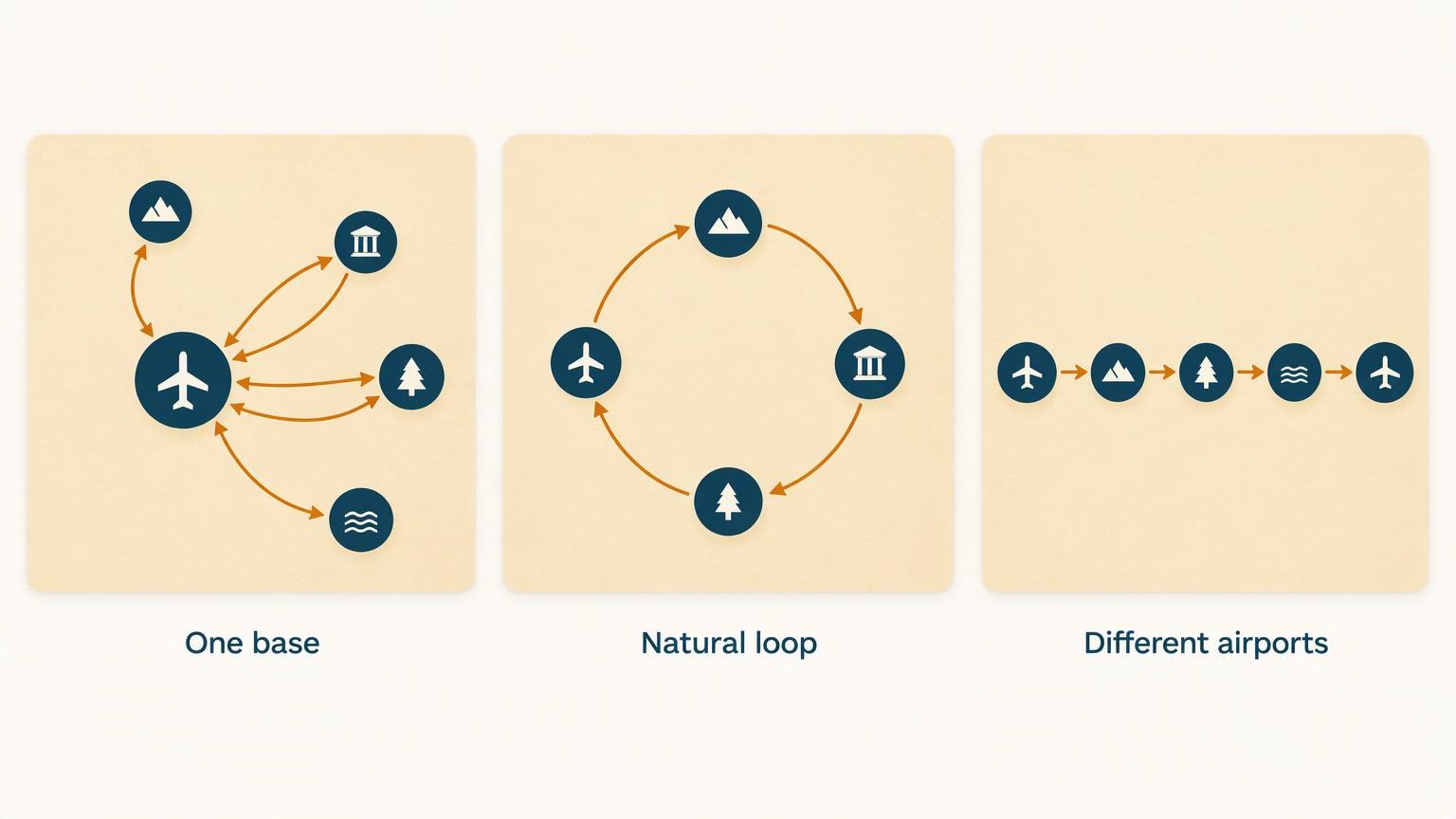
Illustration comparing One base, Natural loop, and Different airports using arrowed routes and circular airplane, mountain, building, tree, and water icons.
I would compare the journey from the arrival terminal to your first accommodation, not simply the airport's association with a city. The useful endpoint is where you will sleep, with your luggage and companions accounted for.
For each airport, I would trace the terminal exit, pickup point or station, onward transportation, and final connection. Waiting and transport changes belong in the comparison, not just the main ride. I would also consider how much effort that arrival leaves for your first evening. If one option requires several changes while another reaches your accommodation directly, I would weigh the extra handling and walking against any fare saving, not just compare estimated travel time.
I would match transportation to the flight's arrival time. A daytime connection may not suit a late arrival, so I would not count on it until the travel date and operating timetable are checked.
For family or group travel, I would weigh moving bags, changing vehicles, and keeping everyone together. A lower fare may not justify a transfer your party cannot comfortably manage.
I would assess departure separately, including the journey back to Long Island. An easy arrival does not establish an easy return. I would compare exact airports, especially when search results substitute an airport you did not intend.
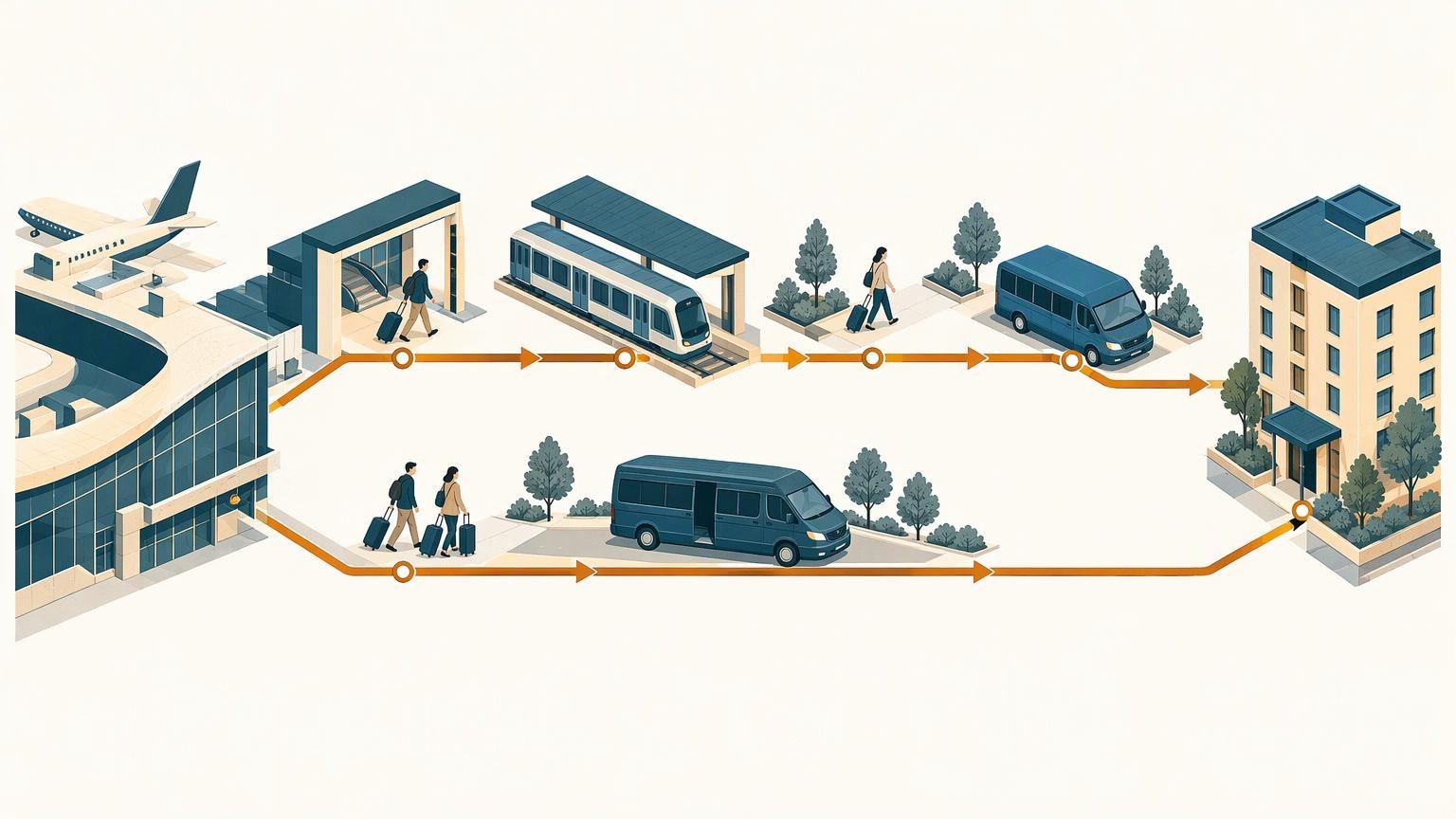
An illustration of two airport-to-building routes, with amber arrows and circles linking travelers with luggage, a station, a train and vans.
I would compare matching dates, travelers, cabin needs, and baggage requirements before judging airfare differences. Otherwise, the quotes may represent unlike bookings rather than alternative routes.
My comparison would include flights, airport transfers, intercity transportation, and lodging added to reach the departure airport. I would separate shared expenses from costs created by one arrangement, making clear which differences actually affect your decision.
For a same-airport return, I would count transportation used to retrace the route and any associated overnight stay. For different airports, I would include any more demanding arrival transfer. Neither arrangement has a cost advantage until the complete journey is priced.
I would compare inclusions, such as checked baggage, seat selection, transfers, and accommodation, alongside actual change and cancellation terms. A fare label alone does not establish those terms.
I would show repositioning time separately, without inventing a dollar value for vacation hours. You can decide whether losing sightseeing time is worth the saving.
I explain the broader role in the benefits of using a travel agent. Request me, Carol McParland, for a current route quote rather than assuming one booking method is always cheaper.
I would work backward from departure to choose the final night's location, considering the airline's applicable airport-arrival guidance, accommodation checkout, and the ground journey to the terminal.
If departure depends on an intercity train or long road transfer that morning, I would consider moving to the departure area the day before. That leaves less travel for departure day but adds a hotel change and may reduce time at your final stop.
I would not automatically choose an airport hotel. A departure-city stay may preserve an evening you value if transportation works at the required hour. An airport-area stay may suit you better when reducing morning transfers matters more. I would compare those benefits against packing again and moving accommodation, not treat proximity as the only criterion.
I would verify the journey from the exact accommodation, including any intended hotel transportation. An airport-area address does not establish access to the correct terminal when needed.
For an anniversary or romantic getaway, I would consider whether the final evening is part of your trip's purpose, balancing that preference with a realistic departure journey.
Suppose your European trip begins in one city and ends in another, with relaxed time reserved for the final stop. Returning to the first city would mean transportation, not another stay you want.
I would compare a same-airport return, different airports, and the route in reverse. Different airports would be my preference if transfers and flights fit, and any additional airfare is acceptable against the cost and time of returning.
If departure from the final city introduces an awkward connection or unwanted repositioning night, I would reconsider. A same-airport return may offer the easier complete journey when its return leg fits your available time.
For a traveler wanting one base with straightforward transfers, I might see little reason to use different airports. The arrangement should solve a route problem, not become a goal itself. I would weigh the whole journey rather than favor either flight-search label.
My Europe specialty supports this comparison through Superior's European vacation planning, where your stops and dates frame a route-focused enquiry.
When choosing a travel agency on Long Island, I would match documented specialties to your trip. Europe is my relevant specialty here.
Share the destination, dates and travel style you have in mind. A Superior Travel advisor will help turn the possibilities into one clear, personal plan.