
Use the real deadline
I would compare arrival with the next required reporting or check-in time. Comparing only departure times can hide a deadline that comes earlier.

I would approve a proposed itinerary only after comparing each arrival with the next required check-in time, accounting for the steps between them, and identifying components still awaiting confirmation. A workable connection needs supported timing assumptions and an acceptable fallback, not simply a gap between reservations on a calendar.
I approach itinerary planning by examining the handoff between reservations: when you arrive, when you can leave, and where you must be next. For Long Island travelers, itinerary planning should expose travel-day assumptions before bookings become financial commitments.
My focus in itinerary planning is the connection that could change your decision, from luggage collection to cruise check-in. I am Heather Hamann; my specialties are cruise planning, custom vacations and group travel. I would distinguish an attractive route from one ready for approval.
I would compare arrival with the next required reporting or check-in time. Comparing only departure times can hide a deadline that comes earlier.
I would establish where a transfer starts and ends before using its estimated duration. Time spent reaching the pickup point belongs elsewhere in the connection calculation.
I would give more weight to a connection whose failure affects the rest of your trip. A movable dinner and a required embarkation appointment call for different decisions.
I would label a suggested component differently from a supplier-confirmed reservation. A complete-looking itinerary should not obscure an arrangement that still needs acceptance.
I would first examine whether moving an optional arrival-day activity resolves the pressure. Adding accommodation or changing transport makes sense only when it addresses the actual dependency.
I would judge a connection by the time available for its required steps. Scheduled landing is not readiness at a pickup point. I would record the arrival date, local time and location, then the next reporting point and check-in deadline. An overnight journey can change the arrival date.
For illustration, suppose your route pairs an airport arrival with an onward train. I would work backward from the rail operator's reporting requirements, allowing separately for transfer travel, terminal movement, baggage collection and applicable entry procedures. The operators provide their requirements; you complete the arrival procedures and reach the departure point. Remaining time allows for uncertainty, but does not prevent delays.
If the connection requires skipping luggage collection or assuming immediate pickup, I would favor a different onward departure. Removing an optional meal might instead resolve activity pressure without changing transport.
Superior Travel Consultants offers customized planning, and my personalized itinerary guidance provides a setting for discussing these handoffs. I would distinguish confirmed arrangements from proposed components throughout: availability remains subject to supplier confirmation, regardless of how complete the timeline looks.
I would trace the connection in travel order: leave the arriving service, complete applicable entry procedures, collect luggage if required, reach pickup, travel onward and complete the next check-in. Only applicable procedures belong in the calculation, but I would not assume them away.
For airport or terminal changes, I would establish the transfer endpoints. Vehicle travel time excludes reaching the vehicle and completing the next required procedure. Those steps need their own allowances.
I would examine whether pickup depends on scheduled arrival, a meeting time or a message after luggage collection. The written arrangement should explain the handoff and what happens if you arrive late. A transfer estimate alone cannot resolve an uncertain pickup arrangement.
I would treat hotel access separately. If an activity requires changing clothes or leaving bags in your room, I would compare a later activity with another confirmed arrangement unless that access is established.
For family and group travel, I would trace separate arrivals individually. Shared pickup must accommodate everyone it collects, not just the first arrival; otherwise, separate transfers may better fit the proposed route.
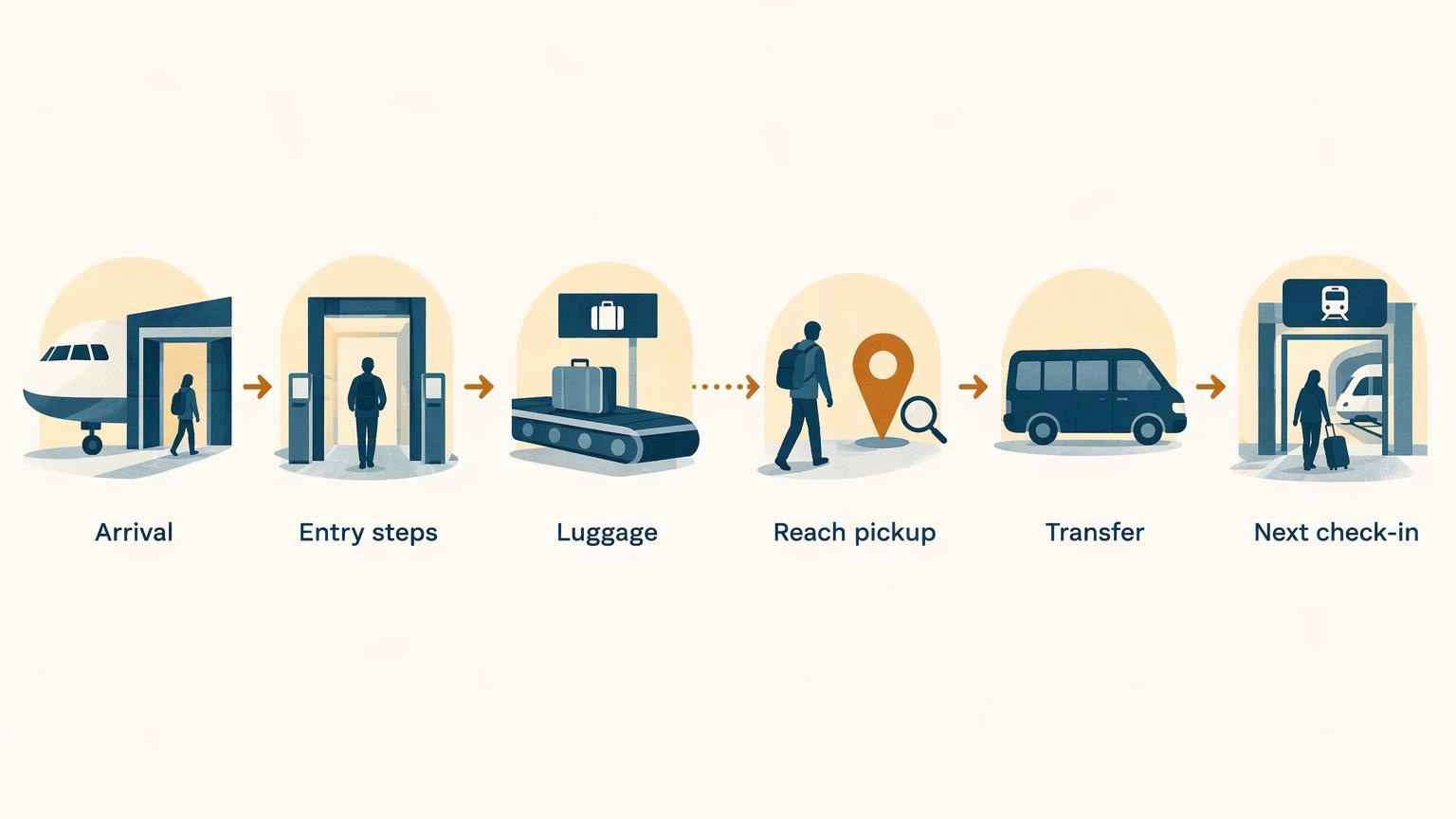
Illustration of a left-to-right travel sequence, with a dotted arrow between luggage and the pickup stage and a separate vehicle transfer stage.
I would choose extra time according to the consequence of failure. Moving an optional activity may solve schedule pressure; protecting a fixed onward departure may require changing transport.
For illustration, suppose you want to avoid extra accommodation before a cruise. I would compare the embarkation deadline with the complete arrival-to-port sequence using supplier information. Same-day arrival needs supported allowances and risk acceptable to you. If every step must take its shortest expected time, I would favor earlier arrival, subject to availability.
I would compare an earlier service with an overnight stay, not add a night automatically. Accommodation costs and vacation time matter alongside booking terms. I would also trace the revised arrival through to the port rather than judge it by the flight alone. An earlier landing helps only if the intervening arrangements support the required check-in; an overnight stay still needs a workable next-day transfer.
For a European vacation joining an escorted tour or river cruise, I would apply this reasoning to the first required meeting. As a planning principle, the trip's purpose changes how you prioritize time and movement; arrival-day savings are less persuasive when that purpose is at risk.
| Choice | Useful when | Trade-off |
|---|---|---|
| Keep the proposed arrival | The full handoff fits with supported allowances | Less added travel time, but remaining disruption risk |
| Choose an earlier service | It improves the handoff without creating another weak connection | Different fare, schedule or booking terms |
| Arrive before the onward-travel day | Separating the travel days better protects the central commitment | Additional accommodation and vacation time |
| Move an optional activity | The transport connection works but the day's activities do not | Less arrival-day sightseeing without changing transport |
| Choice | Useful when | Trade-off |
|---|---|---|
| Keep the proposed arrival | Full handoff fits supported allowances | Remaining disruption risk |
| Choose an earlier service | Improves handoff without a new weak link | Different fare, schedule or booking terms |
| Arrive before the onward-travel day | Separate days protect the key commitment | Extra accommodation and vacation time |
| Move an optional activity | Transport works; activities do not fit | Less arrival-day sightseeing |
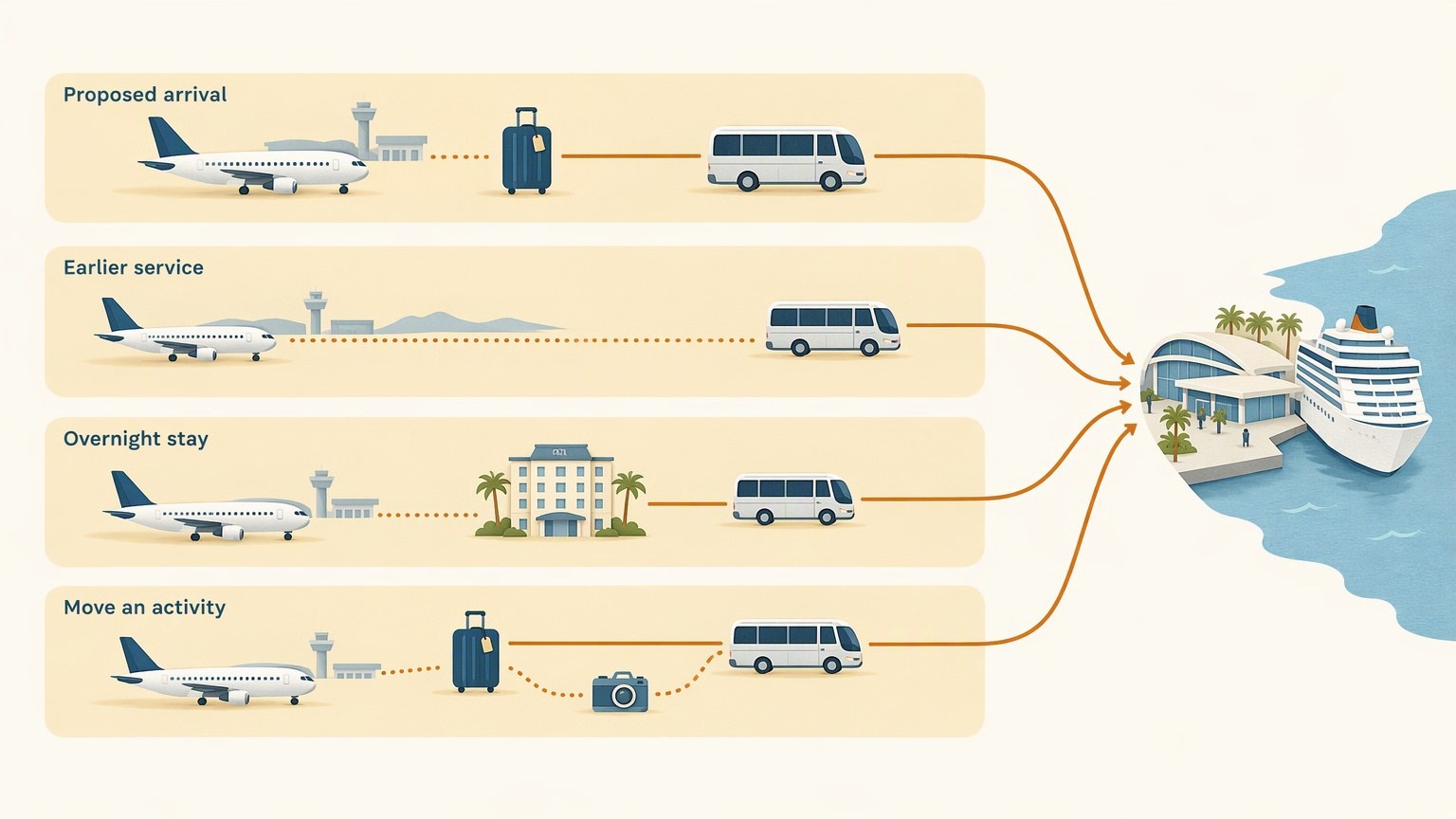
Illustration comparing proposed arrival, earlier service, overnight stay and moving an activity, with separate routes leading to a shared cruise-port destination.
I would separate route approval from component confirmation. Availability is subject to supplier confirmation; a hotel, transfer or service appearing in an itinerary does not establish that it is secured.
I would distinguish suggested options, arrangements awaiting responses and confirmed bookings. Anything described as held needs its expiry and conditions identified, rather than being treated as a completed reservation.
Before authorizing a dependent purchase, I would identify what makes it workable. Buying onward travel before its required arrival service is confirmed could commit you to a route that needs revision.
For illustration, if a proposed transfer is still awaiting acceptance, I would keep its pickup time preliminary. If an alternative transfer changes when you reach the next check-in, I would reassess that connection before treating the onward booking as ready for approval.
I would save the approved version with confirmations and terms. If an arrival changes, I would revisit pickup, hotel access and onward travel even when those reservations remain unchanged. The earlier timing decision may no longer apply; keeping the original assumptions makes it easier to see which handoffs need another comparison before further purchases.
My cruise planning, custom vacation and group travel specialties relate directly to how separate arrangements fit your journey. Superior Travel Consultants provides advisor-led customized planning for Long Island travelers, a relevant starting point for discussing your route.
I would focus on the connection that matters most. Reaching embarkation, meeting a group or accessing accommodation before an activity each creates a different planning priority. Explaining that priority helps distinguish essential timing from preferences you could change.
I would compare complete costs, not transport fares alone. Earlier arrival may add accommodation, meals and another transfer; a revised service may carry different fare conditions or amendment costs. I would distinguish included arrangements from purchases outside the proposal and provide a current quote for your needs.
I would also distinguish supported timing from guaranteed performance. Planning cannot eliminate delays or establish that a supplier will accommodate a missed deadline.
For bookings made elsewhere, I would discuss their details and applicable terms first. My specialties do not establish a separate review service or authority to amend every reservation; those limits matter when choosing assistance for an existing route.
Share the destination, dates and travel style you have in mind. A Superior Travel advisor will help turn the possibilities into one clear, personal plan.