
Use the full-party total
I would compare totals for everyone traveling rather than mix a per-person headline with an accommodation total. The difference is meaningful only when both quotes use the same basis.

I would choose a suite when its documented space or added benefits solve a need the entry-level accommodation cannot, and the premium fits your budget. I compare equivalent quotes for the same sailing and travelers, counting only benefits the upgrade adds.
I compare luxury cruise cost as an accommodation decision, not a contest between category names. For Long Island travelers, I start with the same sailing and consider what the suite changes about daily life onboard. A higher luxury cruise cost needs a reason beyond an appealing photograph.
I separate luxury cruise cost into the baseline and the upgrade premium. That distinction shows whether you are buying useful space, benefits you will use or a category you prefer. I consider preference a valid reason to spend, but not a cash saving.
I would compare totals for everyone traveling rather than mix a per-person headline with an accommodation total. The difference is meaningful only when both quotes use the same basis.
I would name what the room needs to do, such as provide separation for different sleep schedules. More floor area is useful only if the layout supports that need.
I count an included extra as avoided spending only if you would otherwise purchase it. A benefit you would enjoy but never buy belongs in your preference decision.
I would retain the category name alongside its description and terms. A broad suite label does not give me enough detail to judge the accommodation being purchased.
I would leave room in the budget for the rest of your journey before choosing the upgrade. Better accommodation may be a poor trade if it displaces something you value more.

Cruise ship sailing through a mountain fjord beside waterfalls Client photo (media library)
I start with the entry-level accommodation you would genuinely book, not an advertised fare that fails to meet your needs. My comparison holds the ship, sailing, itinerary, duration and travelers constant. I also use the same currency and occupancy basis.
I calculate the accommodation premium by subtracting the entry-level total from the suite total. Both totals must cover everyone traveling and equivalent required charges. I keep flights, hotels and other arrangements equal so their differences do not inflate or disguise the upgrade.
If promotions or flexibility differ, I treat the offers as an accommodation-and-fare choice, not a pure room comparison. A lower deposit alone does not establish a lower total cost. I separate the amount payable from when payments are due.
I then use the table to identify what the premium buys. Documented space, additional inclusions and different terms belong in the decision; shared benefits do not justify paying extra. Before payment, I reconcile any refreshed price or package with the version considered. If either offer has expired, I need current comparable quotes before recommending which accommodation better fits your trip budget.
| Factor | Entry-level | Suite |
|---|---|---|
| Basis | Ship, sailing, travelers, currency | Identical basis |
| Total | Full-party fare plus required charges | Equivalent total; calculate premium |
| Space | Suitable baseline layout | Documented useful additions |
| Benefits | Shared inclusions | Added savings or enjoyment |
| Terms | Promotion, deposit, deadlines, cancellation | Identify differences |
| Validity | Quote date and expiry | Current comparable offer |
| Factor | Entry-level | Suite |
|---|---|---|
| Quote basis | Same sailing, travelers and currency | Same sailing, travelers and currency |
| Total | Full-party fare plus required charges | Equivalent total; subtract baseline |
| Space | Suitable baseline layout | Documented useful additions |
| Benefits | Shared cruise inclusions | Only benefits added by the upgrade |
| Terms | Deposit, deadlines, cancellation | Identify differences from baseline |
| Validity | Quote date and expiry | Current comparable offer |
I read the category description and floor plan before valuing extra space. I distinguish interior room from balcony area and examine sleeping, seating and storage arrangements. Advertised area alone does not tell me how comfortably you can use the room.
I start with what the entry-level accommodation cannot do. If you want to read while your companion sleeps, a documented separate living area may matter more than a larger room without separation. I would not treat those layouts as interchangeable.
I consider your likely time in the accommodation. Extra private space may matter less on a trip centered on time ashore and shared ship spaces than during quiet afternoons inside.
For families, I separate space from permitted occupancy and sleeping arrangements. A larger room does not prove it accommodates your party correctly. My family, group and cruise planning specialties help connect individual room needs with the wider trip.
I also compare the proposed accommodation's deck-plan location. More space does not guarantee your preferred position. I judge layout and location separately, then decide whether their combined advantages justify the premium for your particular travel pattern.
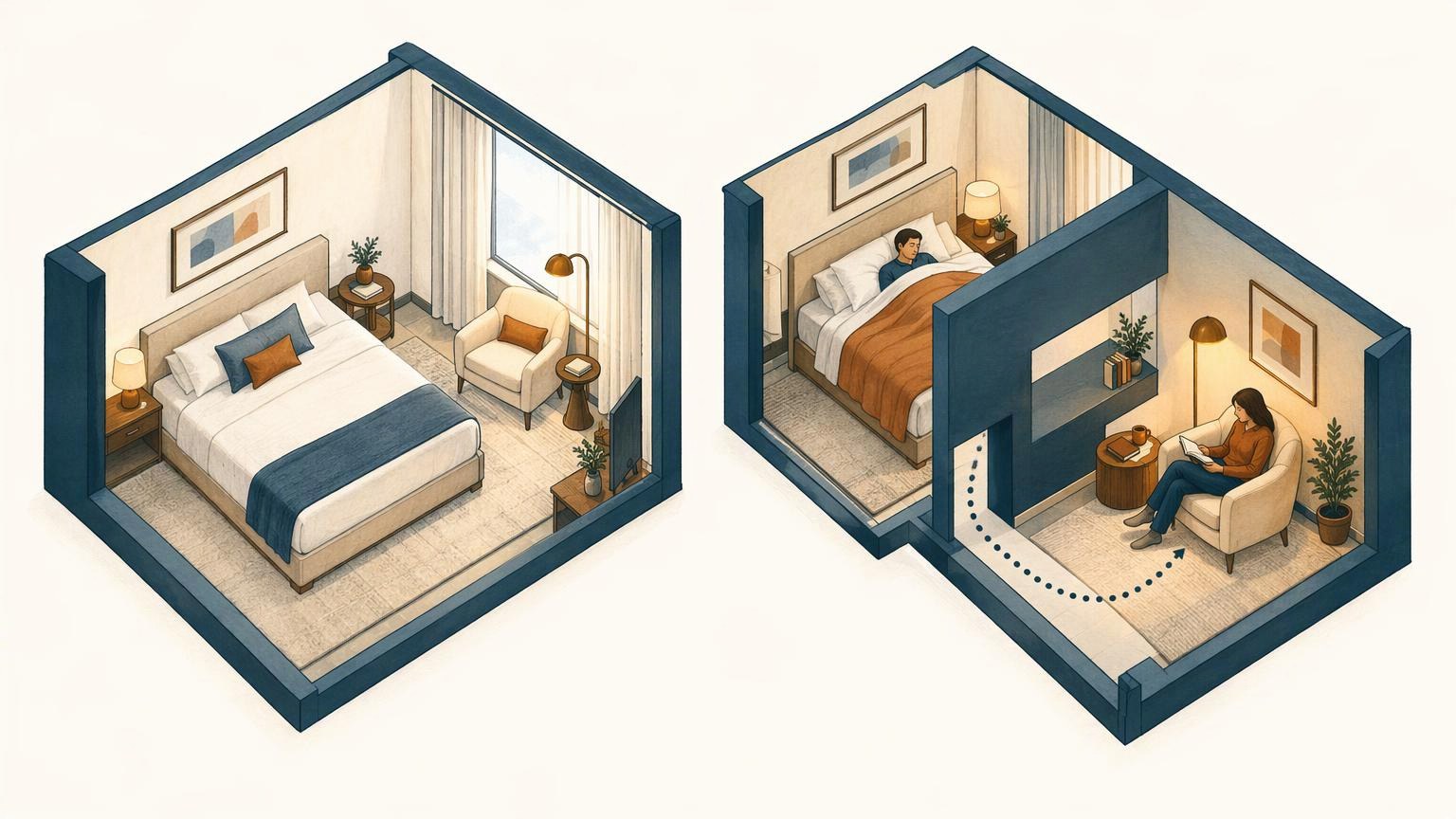
Conceptual illustration contrasting a shared bed-and-chair space with a partitioned sleeping area and reading nook. A dotted route marks access to the occupied nook.
I separate written inclusions into shared benefits and suite additions. Shared benefits belong to the cruise baseline and cannot also justify the upgrade. This prevents an attractive package description from overstating what the premium buys.
For each addition, I distinguish avoided spending from enjoyment. If you already planned to buy it, I use its current documented purchase cost in the comparison. I assign no cash saving to something you would otherwise skip, though enjoying it can still justify a preference.
I treat credits differently from fare reductions. Their value depends on eligible purchases, restrictions and your likely spending. I do not automatically subtract their face amount or count the same benefit twice.
For access or service benefits, I identify what the offer includes, who receives it and any usage conditions. I judge their practical effect without inventing a retail value.
I keep insurance separate unless the quote explicitly addresses it. My cruise travel insurance guide offers a starting point for considering protection. I would not interpret a suite inclusion as coverage for the money committed to your vacation without supporting written insurance terms.
I read terms beside the price because the premium alone does not reveal your flexibility. I compare deposits, payment deadlines, cancellation conditions and the consequences of changing the booking. These differences can outweigh an accommodation benefit when your plans remain uncertain.
I distinguish confirmed accommodation from an offer that leaves the exact assignment to the supplier. If location matters, I establish what the booking secures before valuing a particular deck-plan position. A category description and a confirmed room assignment are different information.
I keep benefits attached to the exact ship, sailing and fare quoted. A general suite collection description does not establish every inclusion in your reservation. I base the decision on the written offer rather than assume benefits transfer between categories.
For a cruise within a larger European vacation, I consider how changes affect surrounding arrangements. I do not assume cruise terms govern separately booked hotels or other components.
I may favor the lower category when its terms better suit uncertain plans. The suite commits more budget to accommodation; I weigh that commitment against flexibility and other priorities rather than let an attractive room decide.
Suppose you are planning an anniversary cruise with different sleep schedules. Entry-level accommodation meets your basic needs; the suite documents a separate living area. In this possible comparison, other inclusions and fare terms are identical.
I would judge the premium primarily as the price of separation. If you expect to use it regularly without sacrificing other priorities, the suite has a clear purpose. My romantic getaway planning connects accommodation preferences with the celebration, rather than treating a suite as essential.
If you instead expect most days ashore or in shared spaces, I would lean toward entry-level accommodation. The same extra room delivers less value when your intended use changes. I would preserve the difference for priorities you value more.
My Robin Holian advisor profile documents my cruise, family and group specialties and Accredited Cruise Counselor credential. I connect accommodation choices with your needs, not declare every upgrade worthwhile.
Superior Travel Consultants' Long Island travel planning provides a starting point for an advisor-led comparison. My explanation of why use a travel agent offers broader context; I would base this recommendation on current supplier-specific quotes and their documented differences.
Share the destination, dates and travel style you have in mind. A Superior Travel advisor will help turn the possibilities into one clear, personal plan.