
Start with the least flexible requirement
I would identify the feature you cannot reasonably replace, such as a required room arrangement. That requirement is more useful for setting the planning priority than a general preference for a luxury stay.

I would submit a planning request once you can describe dates, travelers and essential room needs, without assuming a universal booking window. Before committing, I would establish the current price, inclusions, payment schedule, cancellation terms and confirmation process in writing.
I would approach luxury hotels in stages: define the stay, compare accommodation, review terms and verify confirmation. For Long Island travelers, luxury hotels belong alongside itinerary planning because room arrangements and arrival dates can determine whether a trip works.
I am Izabela Melli, with our Long Island travel agency. My specialties include the Caribbean, Europe, Mexico and cruises. Here, I explain the booking timeline for luxury hotels: what to settle before payment and what can remain open.
I would identify the feature you cannot reasonably replace, such as a required room arrangement. That requirement is more useful for setting the planning priority than a general preference for a luxury stay.
I would mark which dates are settled and which can move. If your group is flexible, alternative travel windows give the accommodation discussion useful options without implying that everyone must provide them.
I would compare proposals using the same travelers, dates and essential room needs. A lower total does not answer your decision if it buys a room arrangement you cannot use.
I would attach a required action and recipient to each reminder. A payment reminder should not stand in for a cancellation deadline or a proposal-expiry reminder.
I would keep payment evidence and booking confirmation together, but read them separately. The confirmation needs to describe the stay you authorized, while the receipt records the payment.

Beachfront hotel buildings beside turquoise water and a wooden pier Client photo (media library)
I would begin when you can describe a real stay: an intended travel period, who is going and essential accommodation requirements. Activities can remain undecided, but dates and room needs give the planning request direction.
My timing test is flexibility, not a fixed number of months. If dates cannot move, a particular room arrangement is essential, or another reservation depends on the stay, I would address that dependency early. It identifies the decision that deserves attention first.
If you can change dates or accept several room categories, I would preserve those options during comparison. Starting a discussion does not authorize a reservation or justify accepting unclear payment and cancellation terms.
For a European vacation, I would place hotel nights within the route before committing. For a Caribbean all-inclusive vacation, I would define room requirements and intended inclusions at the outset. These choices establish what a suitable proposal must cover.
I would also identify decisions awaiting approval, such as time off. That separates planning you can begin now from commitments that must wait, without leaving the whole accommodation discussion until every trip detail is settled.
I would build the brief around the stay you need, rather than hotel photographs. List the destination, check-in and check-out dates, marking whether dates are settled or flexible.
My starting brief would include:
I would distinguish requirements from preferences. If connecting rooms are essential, a request is not written confirmation that the arrangement is secured. Describing why the configuration matters helps keep unsuitable options out of your comparison.
For family, group or cruise travel, I would identify room-sharing arrangements and decisions requiring everyone's agreement. Include alternative travel windows only if your group can use them; fixed dates remain a valid starting point.
I would finish with the experience you want and any existing decision deadline. Our customized travel planning connects accommodation choices with the wider itinerary, while this dated brief makes your priorities specific enough for a useful discussion.
I would distinguish a planning request from a reservation. Submitting preferences or seeing a hotel online does not confirm availability or create a booking. Final details, supplier terms, prices and cancellation conditions belong in the planning and booking process.
My comparison would use identical dates, travelers and essential room requirements. Otherwise, a lower total might describe a different stay rather than better value. I would read the quoted room category and occupancy before comparing the price.
I would then separate included services from separately payable amounts. Meals, transfers and other charges should not be assumed included simply because the property is described as luxurious. Dates, room configuration and proposal contents are meaningful cost drivers; I would use a current quote rather than an undated price.
For example, if two proposals meet your room needs but only one includes transfers, I would compare the complete arrangements. If their cancellation terms differ, I would weigh the financial exposure against how settled your plans are. The right choice combines usable accommodation, relevant inclusions and an acceptable commitment, not just the lowest accommodation figure on the page.
| Choice | Written details | Trade-off |
|---|---|---|
| Flexible rate | Refund conditions, deadline and charges | Does flexibility cover likely changes? |
| Stricter rate | Nonrefundable amounts and timing | Can you accept the exposure? |
| Package | Itemized inclusions and change terms | Compare the complete arrangement. |
For a honeymoon, I would weigh the room and relevant inclusions against the cancellation commitment. My romantic getaway planning discussion belongs alongside those choices, before payment narrows them.
I would define value by your priorities. An appealing description cannot compensate for an essential room requirement left uncertain, however attractive the quoted accommodation may otherwise seem.
| Choice | Written details | Trade-off |
|---|---|---|
| Flexible rate | Refund conditions, deadline and charges | Does flexibility cover likely changes? |
| Stricter rate | Nonrefundable amounts and timing | Can you accept the exposure? |
| Package | Itemized inclusions and change terms | Compare the complete arrangement. |
I would turn written booking terms into a calendar before authorizing payment. Each entry needs an action, a recipient and the consequence of missing it, not simply a date.
First, I would establish whether the proposal expires and whether accommodation is held. If a hold exists, I would request its end date, time and time zone, plus the action needed to proceed. A quote alone should not be treated as a room reservation.
Next, I would establish what the first payment secures, later payment and final-balance dates, and refundable amounts. For cancellation, I would identify the required recipient and method, the deadline and the financial consequences before and after it. I would record the applicable time and time zone to avoid ambiguity.
I would keep amendment terms separate: permission to cancel does not establish whether dates, travelers or stay length can change on the same terms.
For escorted tours and river cruises with hotel nights, I would compare each arrangement's commitments. One deadline need not cover the itinerary. I would settle any detail that determines whether the trip works before committing, rather than leave it on a reminder for later.
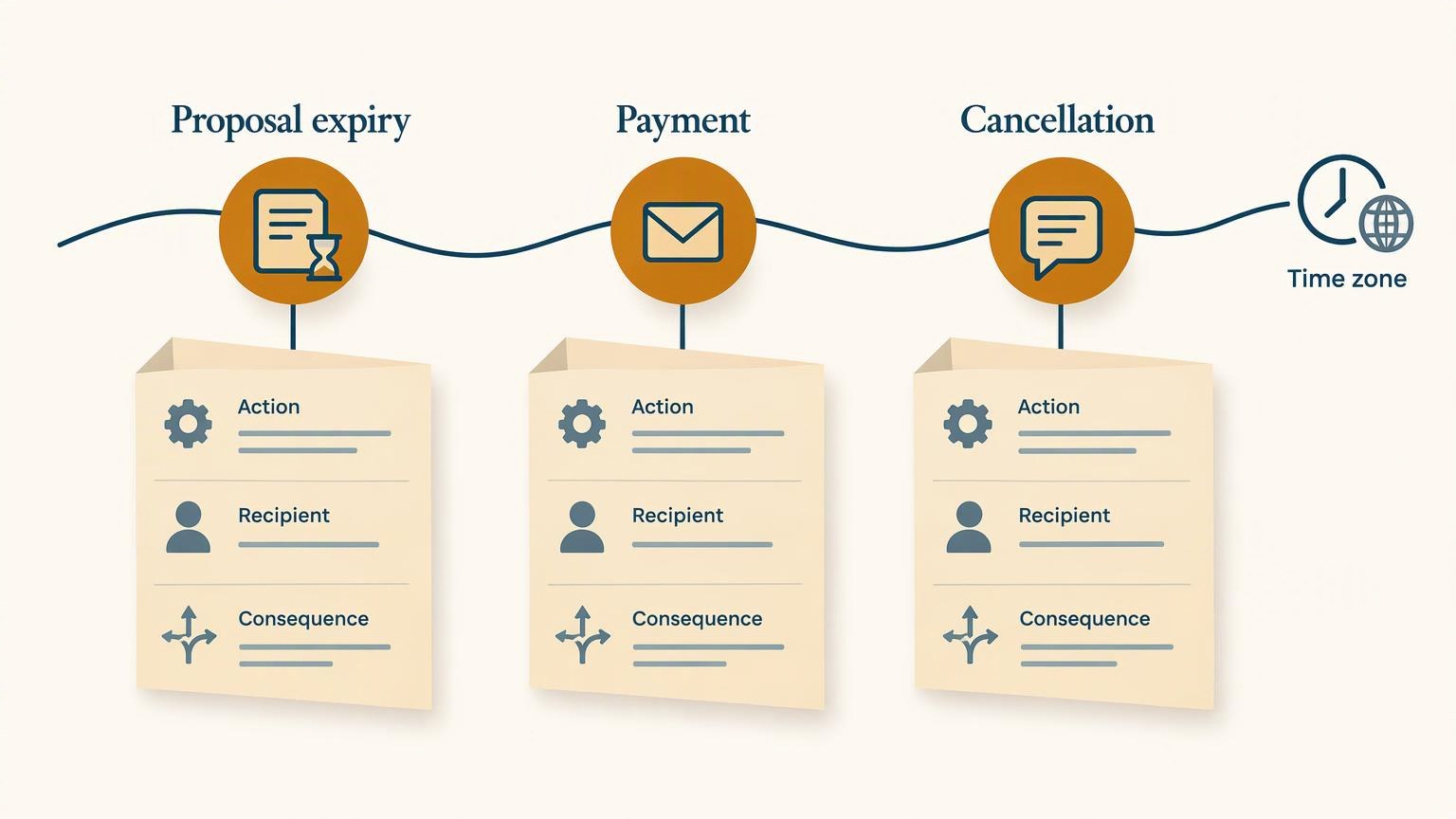
Illustration of three linked deadline milestones—Proposal expiry, Payment and Cancellation—with action, recipient and consequence cards, plus a separate Time zone symbol.
I would establish what written acknowledgment confirms the accommodation and how you will receive it. After authorization, I would match it to the approved proposal: dates, travelers, room category, occupancy and essential arrangements.
I would keep payment records alongside it, but a receipt alone does not establish every room detail. A mismatch needs attention before other purchases depend on the stay.
Consider a family choosing a hotel before a cruise, with connecting rooms essential. I would first define hotel dates around the sailing, then compare proposals addressing that requirement. The supplier's written acknowledgment needs to distinguish a secured arrangement from a recorded request.
If one proposal confirms connecting rooms and another only requests them, I would favor confirmation if the price and terms also fit. If neither establishes the arrangement, I would reconsider the room plan before payment rather than rely on arrival-day allocation.
For a couple with settled dates and no unusual room requirement, I would instead emphasize category, inclusions and cancellation exposure. The unanswered dependency determines the choice.
Finally, I would save accepted terms and confirmation together and match arrival and departure plans. When an advisor can help explains the wider coordination role.
Share the destination, dates and travel style you have in mind. A Superior Travel advisor will help turn the possibilities into one clear, personal plan.