
Set the room standard first
I would specify the bed setup, privacy and space you need before comparing extras. Otherwise, a package with more benefits can distract from a room that does not suit your stay.

I would request a package when confirmed inclusions replace purchases you intend to make and its terms fit your plans. I would favor room-only when extras go unused or restrict your choices. Compare equivalent rooms and complete stay costs before requesting a current quote.
I compare luxury hotel packages with room-only bookings by separating accommodation from extras. For Long Island travelers, luxury hotel packages merit consideration when their benefits support your vacation plans, not simply because the offer sounds generous.
When evaluating luxury hotel packages, I start with room requirements, useful inclusions and booking terms. Breakfast has little value if you plan to eat elsewhere; a preferred layout may matter daily.
I would specify the bed setup, privacy and space you need before comparing extras. Otherwise, a package with more benefits can distract from a room that does not suit your stay.
I would count a benefit only when you expect to use it. An included treatment or meal should not receive its advertised value if you would not otherwise purchase it.
I would distinguish a lower payable total from a credit for later spending. A restricted credit belongs beside its eligible uses, not directly subtracted as though it were cash.
I would decide how much uncertainty your dates carry before choosing a rate. Useful extras do not compensate for cancellation terms you cannot comfortably accept.
I use luxury as the beginning of an accommodation brief, not proof of value. Your definition might mean a separate sleeping area, a particular view, quiet surroundings or more time at the hotel. Those preferences establish what the room must deliver.
I would separate that room description from proposed package benefits. Breakfast, transfers, dining credits and treatments are possibilities to investigate, not inclusions I assume an offer contains. A longer benefits list does not necessarily create a better stay.
I also distinguish access from payment. A hotel having a spa does not establish that a treatment is included; a restaurant does not establish which meals the rate covers.
For Caribbean and all-inclusive vacations, I would read the exact inclusions rather than treat all-inclusive and hotel package as interchangeable. The proposed rate should explain its coverage.
For a European vacation spent exploring, I would give less weight to benefits requiring your return at particular times. A property-centered stay may make those benefits useful. I would use your daily plans to decide which extras deserve a place in the comparison, rather than assigning value to every advertised inclusion.
I compare complete stay costs, not advertised nightly rates. I would match dates, travelers, length of stay and room category. If a package includes a suite but room-only covers a standard room, I would separate the accommodation upgrade from the extras before judging value.
For room-only, I would add separately priced meals, transportation and other intended purchases to the accommodation cost. For the package, I would add requirements left outside the offer. Both totals need applicable mandatory charges, without counting amounts already included.
Imagine you want a comfortable room, hotel breakfast and arrival transportation, with days spent sightseeing. A proposed package includes breakfast, transportation and a spa credit. I would compare its premium with the separate cost of breakfast and transportation, assigning no savings to the credit if you would skip the spa. A credit is not cash and may have spending restrictions.
For family travel planning, I would use the actual travelers and room setup. If breakfast covers only adults, the children's breakfasts remain in the package budget. An inclusion replaces only the expense it covers, not the entire category of spending.
I would favor requesting a package quote when useful inclusions could justify its premium, or room-only when extras would go unused. Current prices and clear terms are necessary before calling either a saving. Until then, the comparison identifies which proposal deserves a quote, not a proven cheaper booking.
| Item | Package | Room-only | Decision test |
|---|---|---|---|
| Room | Exact category | Equivalent category | Suitable? |
| Breakfast | Eligible guests/service | Intended breakfasts | Usable with your schedule? |
| Transfers | Covered route | Required journey | Replaces your transport? |
| Dining/spa credit | Uses and restrictions | Intended purchases | Would you buy it? |
| Mandatory charges | Included/additional | Included/additional | Complete totals? |
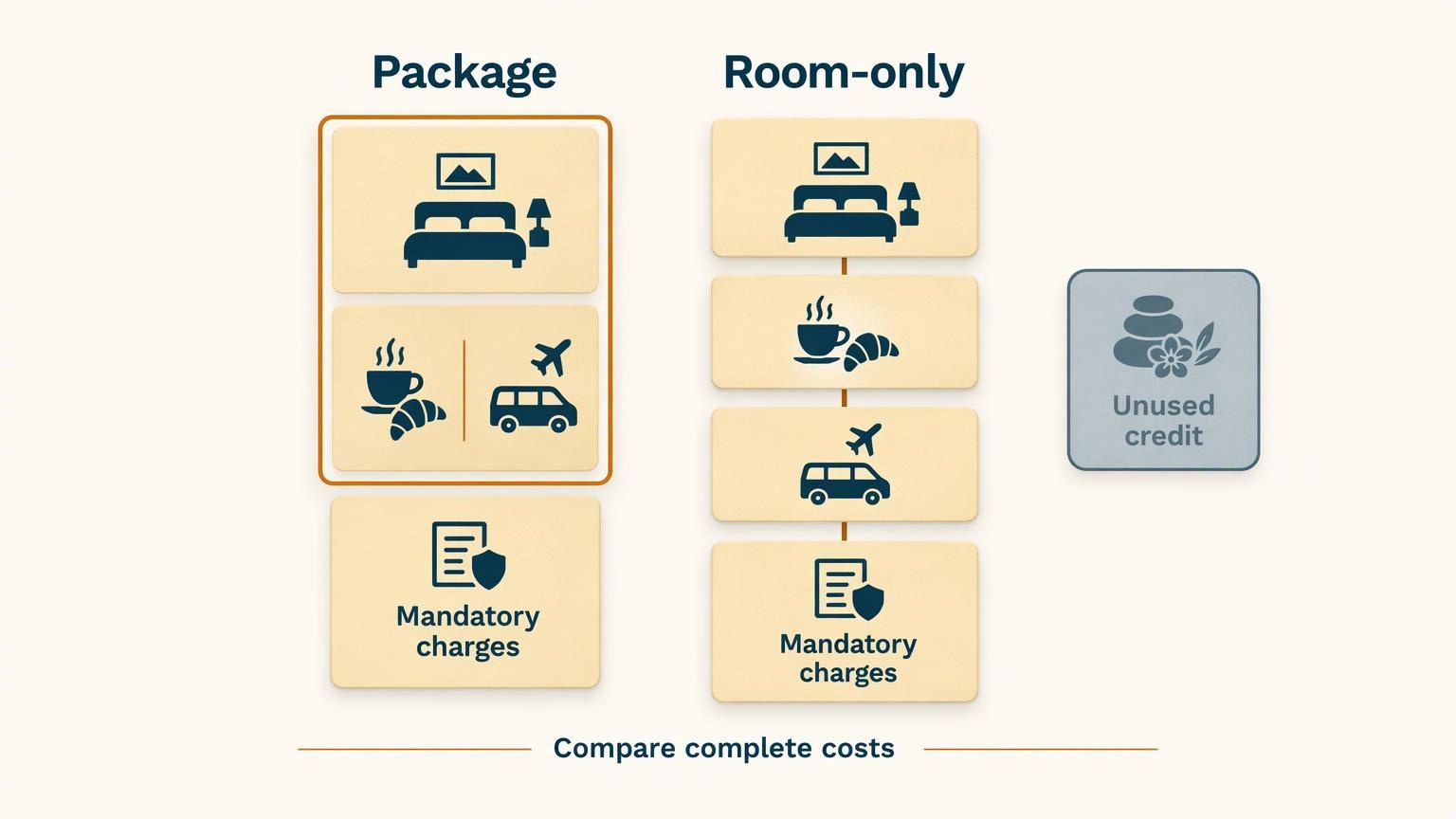
Illustration comparing bundled and separate room, breakfast and transfer tiles, with mandatory charges below and an unused spa-credit tile outside both stacks.
I assess cancellation and change terms separately from benefits. Neither package nor room-only establishes whether a rate is refundable, permits changes or requires payment before arrival. The label alone cannot tell you how much flexibility you retain.
I would record each rate's cancellation deadline, penalty and payment schedule. If dates depend on another commitment, those terms may outweigh an optional benefit. A lower total is not necessarily preferable when its payment conditions create an uncomfortable commitment.
I also separate confirmed inclusions from requests. An upgrade or arrival benefit described as subject to availability cannot replace something you require. I would judge the proposal using what it confirms, not its best possible outcome.
Separately arranged transfers or treatments may need changes under their own terms if the hotel stay changes. A bundle also needs clear wording about what happens to its components; inclusion does not by itself establish flexibility.
For a romantic getaway, a particular dinner may matter more than several optional benefits. I would favor clear coverage of that requirement, provided the booking terms fit. A useful bundle can still be unsuitable when its restrictions conflict with your plans.

Illustration of a planning desk with a branching paper route, labeled booking-term tabs and a magnifying glass over abstract lines, separated from breakfast and transport pictogram cards.
Imagine a honeymoon with a quiet room, hotel breakfast and an arrival transfer as priorities. You expect dinners away from the property and do not want a spa treatment. I would use those plans to compare useful coverage rather than the number of extras.
First, I would clarify the desired room location or category, separating a quiet-room request from anything the supplier can confirm. That accommodation standard should remain consistent across options so an upgrade does not get mistaken for package savings.
Next, you would identify the breakfasts and transfer arrangements you need. The proposed supplier would state package inclusions and terms; separately quoted services would need their own descriptions and costs.
I would compare the complete package cost with room-only plus those required services. The unwanted treatment contributes no useful value, and a dining credit does not offset dinners bought elsewhere.
If the package meets room requirements, replaces intended purchases and has acceptable terms, it merits consideration. If its premium mainly pays for unwanted extras, I would favor room-only. For honeymoon and luxury escape planning, this keeps your accommodation decision tied to the trip.
I am Fran Lozano; my specialties include the Caribbean, Hawaii, cruises and catamaran charters. My customized planning approach starts with your tastes and interests. Learn more about advisor-led planning on Long Island to understand the agency's role in shaping a personal trip.
For accommodation, I would separate required room details, inclusions you expect to use and optional extras. This gives the package question a purpose without assuming a particular offer is available. Your brief should describe the stay you want, not just a package label.
I would prioritize room suitability over collecting extras. Keep an existing offer's category, inclusions and terms together so its comparison remains accurate. Separate essential features from preferences that could change if suitable accommodation requires a trade-off.
In your planning inquiry, request Fran Lozano and ask whether package and room-only options can be considered for your dates and room standard.
Share the destination, dates and travel style you have in mind. A Superior Travel advisor will help turn the possibilities into one clear, personal plan.