
Choose your essential benefits
I would name the services that would change your choice before comparing offers. This keeps a long benefits list from distracting you from an arrival arrangement or meal you actually need.

Before booking luxury hotels, I would check six items in the exact quoted rate: breakfast, airport transfers, facility access, internet, taxes and property fees. For each, I would establish who is covered, any limits and what remains payable. I would choose by complete stay cost and usable benefits, not the hotel's category alone.
I would compare luxury hotels by what the quoted stay includes, rather than assume a premium category covers everyday costs. For Long Island travelers, luxury hotels deserve a practical review: a breakfast benefit you cannot use or transport that covers only arrival may not solve the problem you care about.
My focus here is luxury hotels as a booking decision. As an advisor with our Long Island travel agency, I would connect the rate details to your mornings, arrival plans and time at the property before weighing a more inclusive offer against a simpler one.
I would name the services that would change your choice before comparing offers. This keeps a long benefits list from distracting you from an arrival arrangement or meal you actually need.
I would test each inclusion against the days you plan to use it. Breakfast has less value on a morning when you intend to leave before the applicable service begins.
I would keep confirmed inclusions separate from requested extras or availability-dependent benefits. If a feature is essential, I would base the decision on written confirmation rather than a possible improvement.
I would add the necessary excluded services to each offer before deciding which is better value. I would also keep payment timing visible, since a quoted total and the amount payable before arrival answer different questions.
I would start with the rate description for your dates, room category and travelers. A hotel description tells you about the property; the rate terms need to establish what you are buying.
Forbes Travel Guide evaluates both service and facilities, with an emphasis on service. I would use that distinction to separate a quality assessment from a booking benefit: a rating is not the document I would use to establish breakfast coverage.
For the first inclusion, I would identify the covered guests, meal format and eligible venue. If the offer uses a breakfast credit, I would check the allowance and what spending falls outside it rather than treat it as an unrestricted meal.
When comparing luxury hotels for families, I would read the terms for children alongside those for adults. I would also establish whether room service is covered and whether service times fit your plans.
For a trip built around European vacation planning, I would weigh breakfast against your sightseeing schedule. I would favor a breakfast-inclusive rate only when its coverage and timing are useful; otherwise, a simpler rate could be the better purchase.
For the second inclusion, I would look for an actual transport commitment, not simply a mention of airport pickup. I would identify the pickup point, destination, covered travelers and whether the quoted service is private or shared.
I would then establish whether the benefit covers arrival, departure or both. An included arrival journey would not answer how you get back to the airport, and a transfer reservation would not by itself establish that its cost is included.
Our team can coordinate private transfers depending on the destination. If transport is excluded from your hotel rate, I would discuss arranging it separately and request its current cost. I would keep that amount outside the hotel's inclusions unless the proposal explicitly incorporates it.
I would also review luggage needs, any child-seat requirements and the instructions for finding the driver. Before choosing, I would establish the applicable arrangements for delays or changes rather than assume a general pickup promise settles them.
For honeymoon and luxury escape planning, I would weigh that arrival arrangement against your priorities. Private transport may merit a separate purchase if it gives you the journey you want; an included shared service may suit you if its arrangements fit.
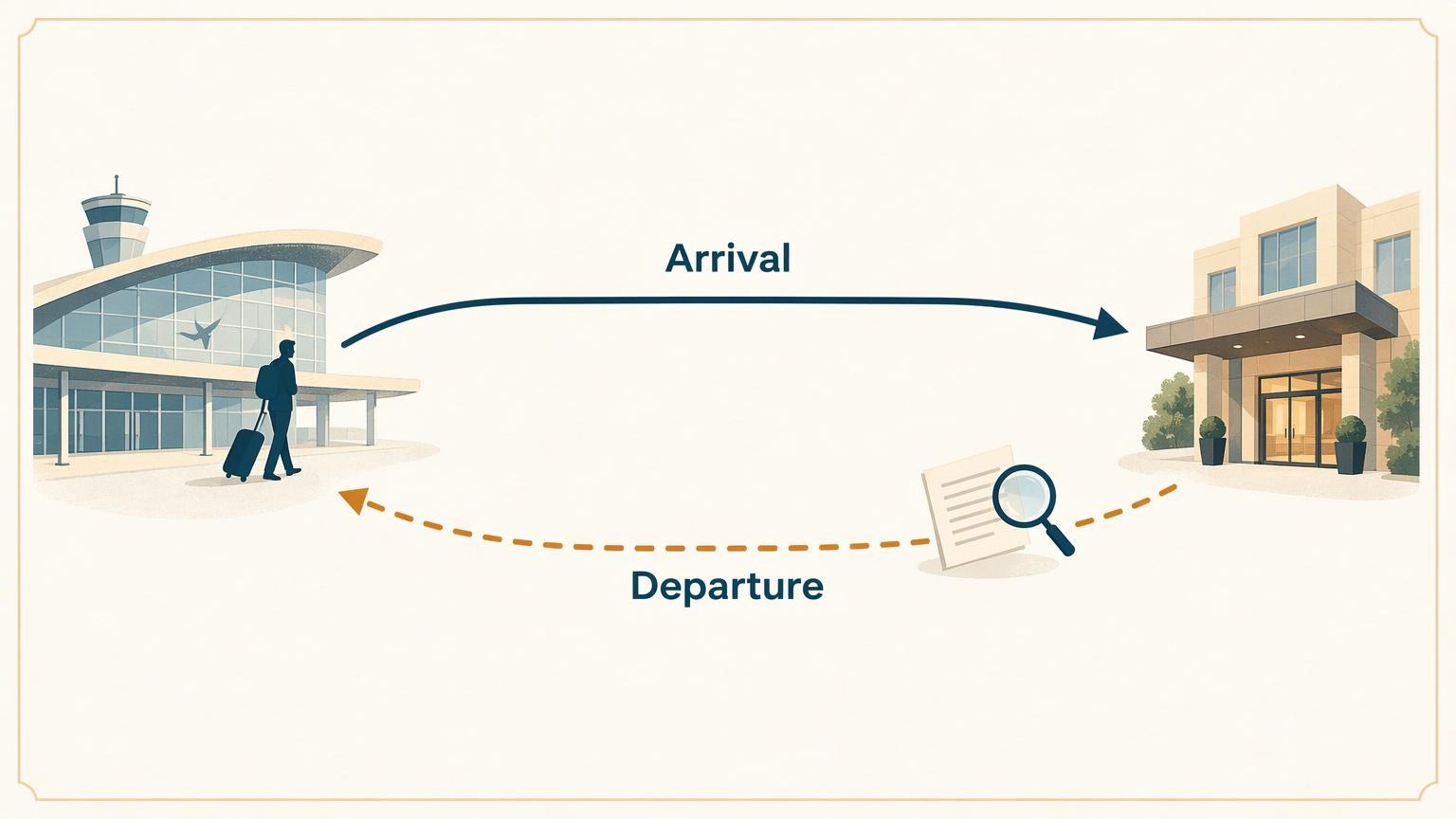
Illustration of separate arrival and departure routes between an airport and hotel, with a paper slip and magnifying glass beside the dashed departure route.
I would review the third and fourth inclusions separately because access to a place and access to a connection answer different questions. I would not treat an amenities list as confirmation that every use is covered.
For facilities, I would identify the spaces you want to use and what the quoted rate permits. If a spa is important, I would distinguish entry to its facilities from a treatment appointment; if pool time matters, I would distinguish ordinary access from any separately reserved seating or service.
I would also read age restrictions, reservation requirements and applicable operating information. For family and group vacation planning, access that excludes a member of your party would change the comparison even if the property itself appeals to everyone.
For internet, I would establish whether the quoted benefit applies in your room and in the spaces you intend to use. I would also check any device limits or distinction between connection tiers in the applicable terms.
If you need a work call, I would ask about suitability for that use rather than equate included internet with dependable performance. For a couples or anniversary getaway, I would give connectivity less weight if you intend to spend most of the stay offline.
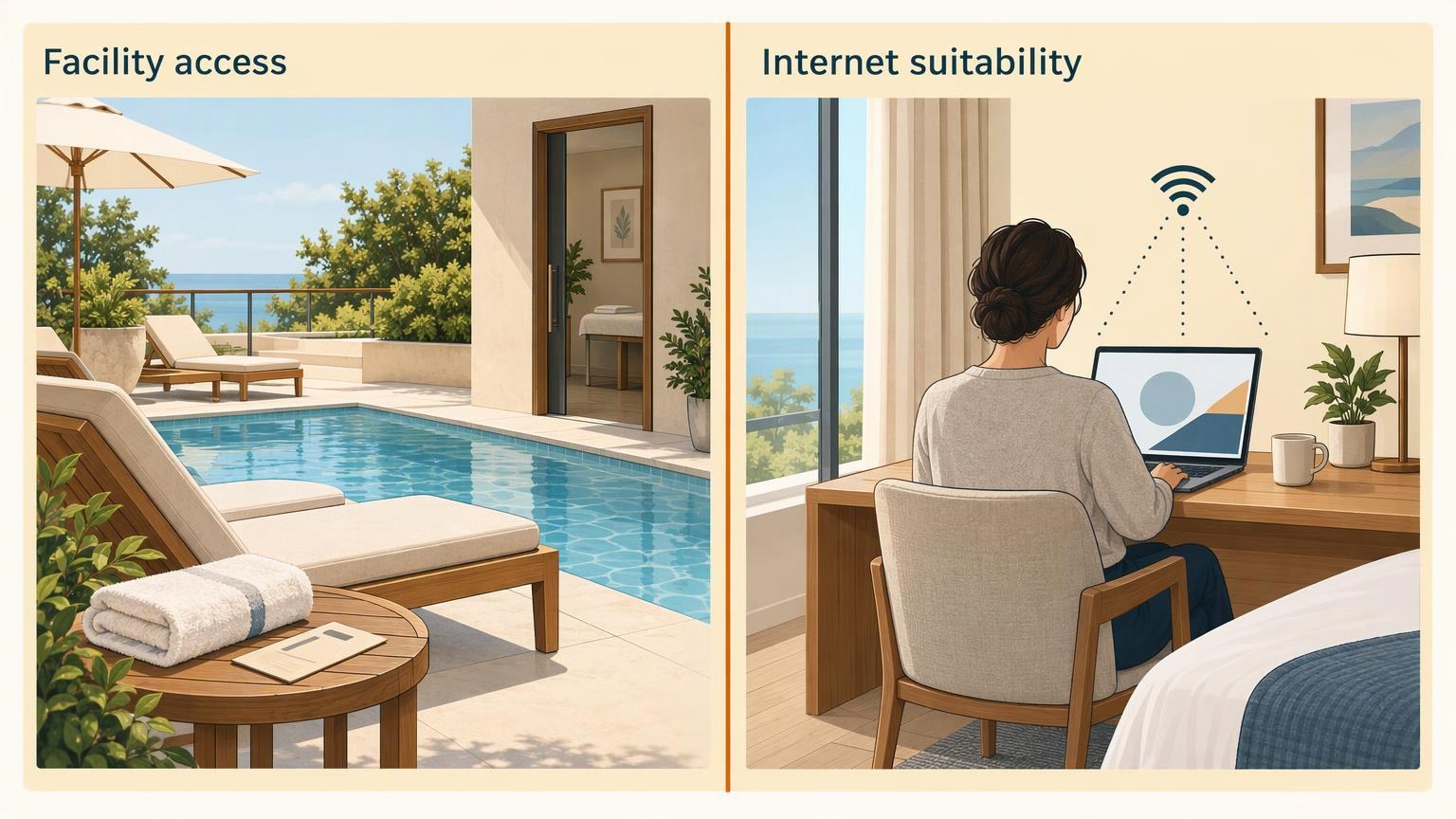
Illustration contrasting facility access and internet suitability: a pool terrace and doorway beside a guest-room desk with a traveler, laptop and wireless symbol.
I would treat taxes as the fifth check and property fees as the sixth. Before comparing offers, I would establish whether each quoted total includes the applicable taxes and whether mandatory property charges remain payable separately.
For every charge, I would want its name, calculation basis and payment timing. I would distinguish a charge assessed per room from one assessed per guest, and a charge applied each night from one applied once during the stay, using the actual quoted terms.
I would keep mandatory charges separate from optional purchases and any deposit or authorization described in the booking terms. That distinction helps you understand both the cost of the stay and the funds you may need available at arrival.
If a property fee describes bundled services, I would read what it covers without assuming it replaces every other charge. I would also check whether a service already described as included is being counted twice in my value comparison.
For Caribbean and all-inclusive vacation planning, I would apply the same test. I would use the applicable rate and package terms to establish coverage, then compare the full stay rather than rely on the package label or an attractive nightly figure.
Say you are comparing a room-only offer with a breakfast-inclusive offer and a broader package for a family stay. You plan to eat at the hotel most mornings, arrange transport and spend afternoons at the pool.
I would first match the dates, room category and travelers. Next, I would use the applicable terms to establish coverage, then add current quotes for necessary exclusions. You would decide how much convenience matters relative to the resulting cost.
If breakfast excludes part of your family, I would price those meals before giving that offer an advantage. If the broader package covers services you do not want, I would not count their advertised value as money you save.
I would also include your loyalty memberships and preferred-brand benefits in the comparison. Our team can account for those preferences when comparing options, but I would establish booking-specific eligibility before counting any benefit.
My specialties include families, honeymooners and milestone anniversaries, so I would frame the choice around the reason for your trip. The trade-off is straightforward: a broader package can simplify planning, while a simpler rate can avoid paying for services you will not use.
| Offer to investigate | Potential reason to choose it | What must be established |
|---|---|---|
| Room-only offer | Flexibility to buy only the services you need | Complete room cost plus necessary separate purchases |
| Breakfast-inclusive offer | Useful coverage for mornings at the hotel | Eligible guests, meal format, venue and timing |
| Broader package | Convenience when several covered services fit your plans | Exact inclusions, limits, mandatory charges and unused benefits |
| Rate structure | Potential value | Verify first |
|---|---|---|
| Room-only offer | Buy only the services you need | Room cost plus necessary extras |
| Breakfast-inclusive offer | Coverage for mornings at the hotel | Eligible guests, venue, format and timing |
| Broader package | Convenience when covered services fit | Inclusions, limits and mandatory charges |
Share the destination, dates and travel style you have in mind. A Superior Travel advisor will help turn the possibilities into one clear, personal plan.