
Name the likely change
I would identify whether your uncertainty concerns dates or who travels. A policy that permits a departure change may not answer whether a different person can take the reservation.

I would reserve a tour before dates are settled only if you can accept its written amendment and cancellation terms. A date change, passenger substitution and cancellation are different decisions. Compare any applicable charge, replacement price and treatment of money already paid before deciding whether booking now is worth the risk.
I approach tour booking change fees by identifying your likely change. For Long Island travelers considering Europe, a tour booking decision may depend on leave approval, family participation or a special occasion, not simply the starting price.
My approach to tour booking separates permission to amend from its financial consequences. Written terms matter more than a label such as flexible.
I would identify whether your uncertainty concerns dates or who travels. A policy that permits a departure change may not answer whether a different person can take the reservation.
I would compare the complete revised purchase with the original, rather than isolate an amendment charge. Include how previous payments are treated and whether the replacement retains the same inclusions.
I would weigh postponing the purchase when an essential date remains uncertain. Waiting leaves price and availability open, but reserving on unacceptable terms creates a different risk.
For a milestone occasion, I would distinguish a preferred departure from one that determines whether the trip works. An alternative date is useful only if you would genuinely take it.
I would save the quote and the terms you accept together. If you later request an amendment, that record gives you a clear basis for comparing the proposed replacement.
I separate moving your departure, replacing a traveler and canceling before deciding whether unsettled dates justify reserving. Each action needs its own written terms; permission for one does not establish permission for another.
For a date amendment, I distinguish any change charge from the replacement departure's price difference. I also check whether previous payments carry forward and whether accommodation, transportation and activities remain equivalent. The relevant cost is the complete revised purchase.
For passenger substitution, I distinguish replacing someone from correcting the same traveler's misspelled name. I would not assume a name-correction provision permits another person to travel. If participation is uncertain, substitution terms matter more than date flexibility.
For cancellation, I compare retained payments, refunds and credits, including restrictions. A credit is not equivalent to cash returned.
For escorted tours and river cruises, I use the proposed reservation's terms, not the category label. I would reserve only when the consequences of your likely change are clear and acceptable.
| Proposed action | Permission to establish | Financial treatment to establish |
|---|---|---|
| Move the departure | Whether the selected reservation can move to the proposed date | Any amendment charge, repricing and transfer of payments |
| Replace a traveler | Whether substitution is permitted for the relevant components | Any substitution charge and effect on the remaining party |
| Cancel the reservation | How and when cancellation takes effect | Any retained payment, refund or credit conditions |
I would establish whether the change is an amendment or requires cancellation and rebooking. A new purchase needs its own price and terms; different accommodation or inclusions may make it unsuitable.
I compare the total financial effect, not just a change fee. Even without an amendment charge, the replacement price and treatment of previous payments need to be clear.
My comparison shows the original total, revised total, separate charges and how deposits or other payments are applied. If money becomes a credit, I read its conditions before treating it as money returned.
I keep travelers, accommodation basis, duration and included services consistent wherever possible. A lower price may describe a different trip, not a saving on the original purchase. Changes to those inclusions belong beside the cost comparison.
I also review flights, accommodation outside the tour and transfers that depend on its dates. Permission to move the tour does not establish whether those reservations can change.
For family and group travel planning, I separate one person's cost from effects on others. If a substitution or cancellation changes room arrangements, I would seek a revised quote for the remaining travelers.
I distinguish money already paid from additional money due. A revised total alone does not show the cash needed to complete the change. If a credit is offered, I consider whether its permitted use and expiration fit a trip you would actually take.
My goal is to show what you would spend, retain or surrender under each choice before committing.
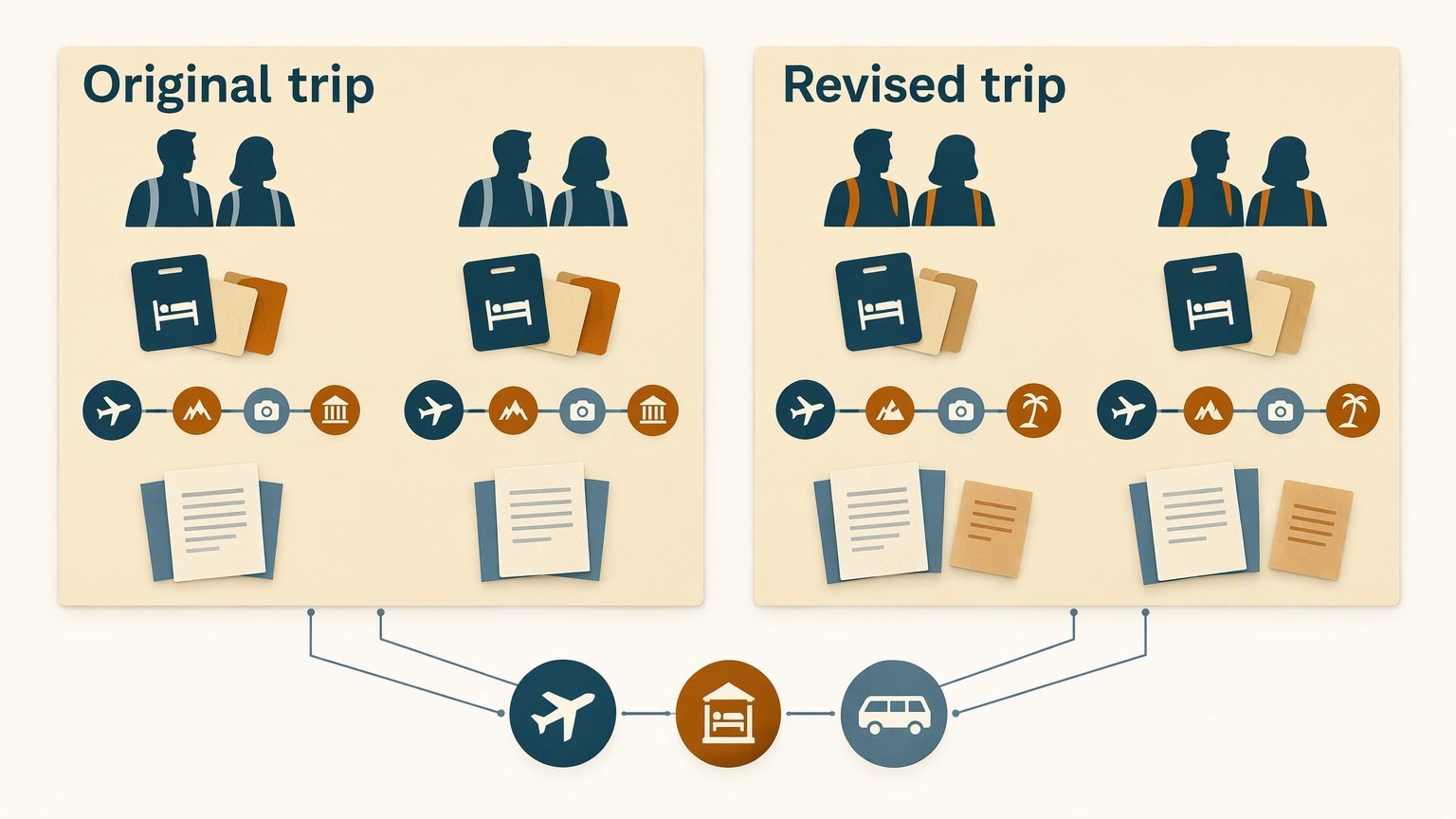
Illustration comparing original and revised trip panels, with offset papers and linked airplane, lodging and van pictograms beneath them.
I read amendment terms alongside deposit, final-payment and cancellation provisions before authorizing payment. Without the applicable deadline, a rule cannot tell you whether it fits your uncertainty.
I identify when a request must arrive, whether acceptance is required by that point and what terms apply afterward. Where a deadline specifies a time, I also establish its time zone. Sending a request and having it accepted are separate steps.
I check whether the deposit is refundable, transferable or conditional. The word deposit describes a payment stage, not evidence that money can be recovered.
If leave approval is pending, I compare its expected resolution with the written deadlines. An early reservation deserves caution when those dates do not align, even if the itinerary fits.
I would mark a personal decision date before the relevant contractual deadline, leaving room to review alternatives. That reminder does not extend your rights. If approval remains open then, I would decide using the consequences that apply, rather than assume an exception will be available.
For romantic getaways and anniversary travel, I consider whether a replacement preserves the occasion. Permission to move has limited value if the new date defeats the trip's purpose.
I retain the accepted terms with the quote and confirmation, rather than rely later on a general policy that may describe another offer.
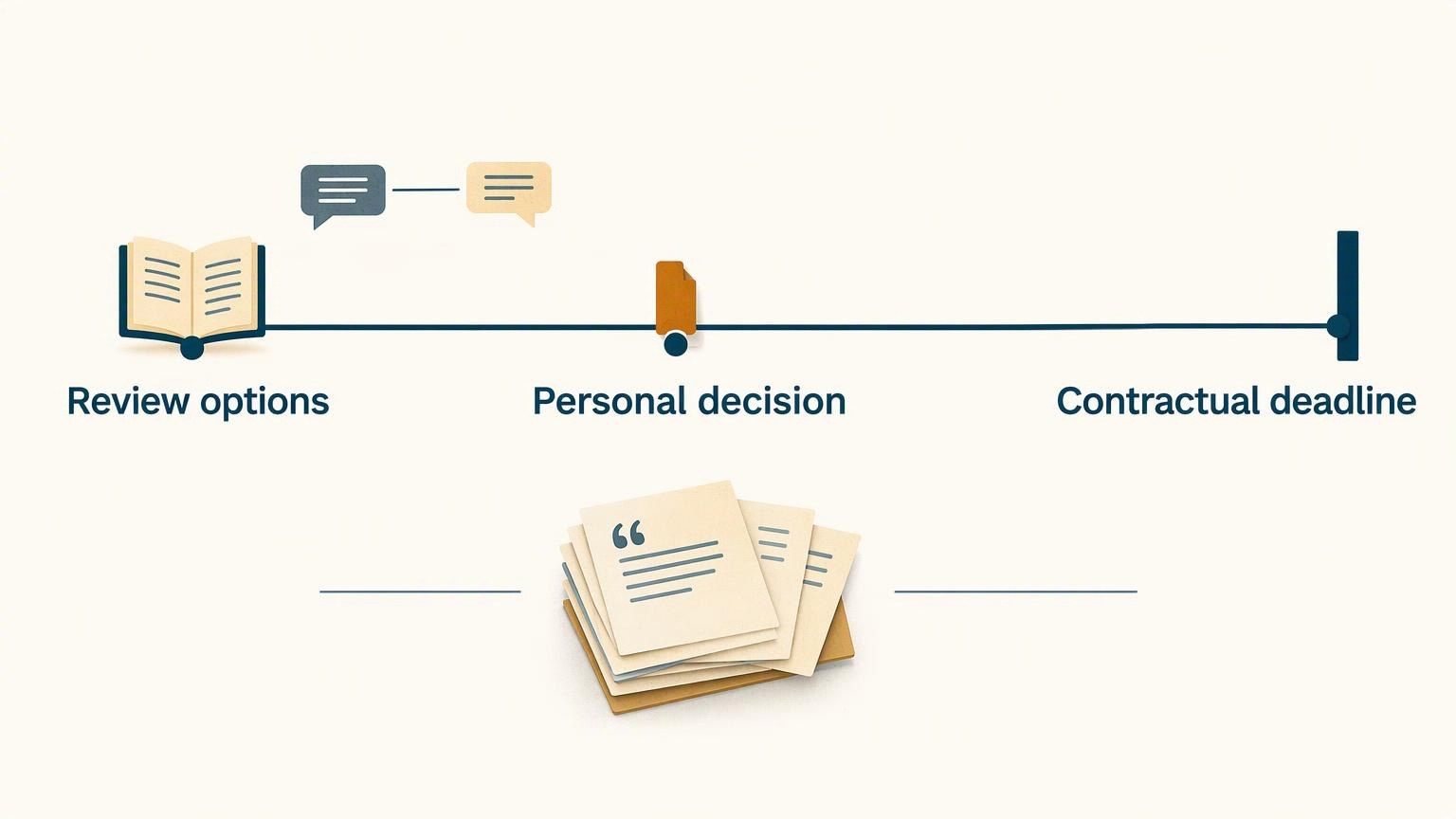
Illustration of a planning timeline with a personal decision before a contractual deadline, linked message bubbles above and stacked papers below.
Suppose you are considering an Italy anniversary tour, but leave approval is pending. Your partner can take either departure under consideration, so I would focus on date uncertainty.
I compare reserving now, waiting and choosing an offer with more suitable amendment terms. None is automatically cheapest.
I would reserve if the trip fits and you can accept the documented consequences of moving or canceling. Waiting is preferable when those consequences are unacceptable, although eventual price and availability remain open. I would not regard a desirable itinerary alone as a reason to accept financial risk you cannot carry.
I consider another offer when its terms address your likely change. Starting cost and trip content still matter: broader flexibility has little value if you would not take the alternative itinerary.
I would define your acceptable financial exposure before comparing offers. Consider both money you could lose and additional money you could afford for a replacement. If the written terms leave either consequence unclear, I would not treat that uncertainty as evidence that reserving is affordable.
If leave is approved but your partner's participation is uncertain, I shift to substitution and cancellation terms. Date flexibility does not solve that problem.
I weigh whether travel-agent guidance fits your decision when an unanswered question determines whether to commit. Clear, acceptable terms may make an independent purchase reasonable.
| Choice | When it fits | Watch for |
|---|---|---|
| Reserve now | Trip fits; change consequences acceptable | Written amendment and cancellation terms |
| Wait | Change consequences are unacceptable | Future price and availability remain open |
| Choose another offer | Terms address your likely change | Starting cost and a usable itinerary |
My specialties at Superior Travel Consultants include families, honeymooners, special occasions and milestone anniversaries. I consider those priorities when comparing changes: another departure is useful only if it preserves what makes your trip worthwhile.
Superior Travel Consultants provides advisor-led customized planning for Long Island travelers. Through European vacation planning, I would discuss your proposed tour dates and the amendment terms relevant to your decision.
I distinguish preferred dates from acceptable alternatives and settled participation from uncertainty. For a current quote, I consider the proposed arrangements alongside their applicable written terms, not a general promise of flexibility.
My comparison would connect those terms to your priorities. For a family trip, I would consider whether an alternative still fits everyone's commitments; for a milestone anniversary, whether it preserves the occasion. This keeps the decision centered on a usable trip, not amendment permission alone.
When weighing the benefits of travel-agent assistance, I focus on understanding your choices. I would not assume an advisor can waive charges or guarantee amendment permission.
Use the European Vacations Plan Your Trip page to submit proposed dates and request amendment terms, or send your dates and question here. Request Renata Boulos by name; identify the tour and your uncertainty.
Share the destination, dates and travel style you have in mind. A Superior Travel advisor will help turn the possibilities into one clear, personal plan.