
Match names to roles
I would record legal business names alongside their jobs in your booking. A familiar trading name alone does not identify the contracting entity.

I compare tour booking companies by identifying the operator, seller, and payment recipient before paying. These may be different businesses. I then use written terms to establish who administers changes, decides refunds, and receives complaints, rather than assume the seller controls every outcome.
I evaluate tour booking companies by responsibility, not only itinerary. For Long Island travelers, comparing tour booking companies means identifying who runs the trip and who administers the reservation.
My approach to tour booking companies separates those roles before weighing convenience or cost. I am Fran Lozano; my specialties include cruises, catamaran charters, Caribbean travel, and Hawaii. I would connect your proposal to written terms rather than let a sales page substitute for a clear agreement.
I would record legal business names alongside their jobs in your booking. A familiar trading name alone does not identify the contracting entity.
I would distinguish a preference passed to the operator from an accepted booking condition. That matters if the trip depends on a particular accommodation or activity arrangement.
I would connect the payment instruction to the invoice and reservation. An unexpected recipient deserves an explanation before you send funds.
I would value help that addresses an actual uncertainty in your trip. An extra booking contact adds little if its responsibilities are unclear.
I distinguish the business organizing the tour from the business selling the reservation. The operator's role concerns delivering the itinerary; the intermediary's role concerns arranging the purchase. Your agreement must establish each business's actual duties, including which party answers questions about the promised services.
I identify the payment recipient separately. Collecting money does not necessarily mean conducting the tour or deciding refunds. I would not infer responsibility from a logo, receipt, or the person answering an inquiry.
For a proposed trip from the escorted tours and river cruises category, I would map these roles before comparing departures. I would distinguish local service providers from the business named in your tour agreement.
CBI's example of a tour operator's contractual requirements for suppliers illustrates that operator-supplier relationships can have their own agreements. I would not treat that example as your traveler contract or a policy applying to every tour.
My aim is a readable chain of responsibility, with names matched to duties. Different business names are not automatically a problem; unexplained roles are a reason to pause before committing your money.
| Role | Establish | Do not assume |
|---|---|---|
| Tour operator | Who organizes and delivers the tour | Every guide is its employee |
| Booking intermediary | Who arranges the reservation | Authority to override operator terms |
| Payment recipient | Who collects payment and issues receipts | Refund authority |
I read the agreement alongside the dated proposal. The proposal describes the trip; the terms explain the commitments attached to buying it. If inclusions or responsibilities differ, I would seek written clarification rather than decide which document to trust.
I would locate the contracting business, the itinerary covered, and the process that confirms the reservation. A quote, payment acknowledgment, and booking confirmation are different documents. I would establish what each means for your purchase, including whether any arrangements remain pending.
I separate your cancellation, an operator cancellation, and an itinerary change. Each needs its own terms. I would identify who can approve changes and whether the seller merely forwards requests. That distinction matters when a proposed alternative would no longer suit you.
For European vacation planning, I would establish whether the tour and additional accommodation share an agreement. A shared itinerary does not establish a shared cancellation policy.
I would save the accepted terms with the proposal and confirmation. If a request determines whether you can take the trip, I would look for written acceptance from the responsible provider, not simply a note that it was sent.
I connect each payment instruction to a named business, invoice, and reservation. If the recipient differs from the seller or operator, I would establish why before paying. A mismatch needs an explanation, not an automatic accusation.
I distinguish the initial payment from the remaining balance: where each goes, who records receipt, and what confirmation follows. I would verify changed instructions through an established contact channel rather than rely solely on a new message.
My cost comparison uses matching dates, travelers, accommodation, and itineraries. I separate included transportation, meals, admission, and guiding from optional purchases. Room arrangements, private services, and added nights can change what two totals represent. A cheaper offer may simply cover less of the trip you want.
I distinguish supplier charges from any separately quoted advisor or booking fee. I would not assume either exists or disappears after cancellation; the applicable terms must explain that.
For family and group travel, I would establish whether payments are individual or tied to a shared agreement. For your trip's price, request a current quote from me, Fran Lozano, rather than rely on an undated advertised total.

Illustration of three abstract documents labeled Reservation, Invoice, and Recipient connected by an amber thread, with a magnifying glass over one connection and two travel pictogram strips alongside.
I separate immediate help from formal complaint handling. A guide may handle a missed pickup or room problem, while the booking terms name another business for written complaints. I would establish both routes before departure.
I would record the on-trip contact method, booking administration contact, and complaint requirements. I would not assume round-the-clock advisor assistance or a local supplier's authority to reimburse you. Those responsibilities must be specific to your booking, not inferred from a general promise of support.
If something goes wrong, I would prioritize appropriate assistance, then preserve confirmations, messages, receipts, and a factual account. That record helps explain how the service received differed from what was promised. I would include the relevant dates and any response already received rather than rely on a general description of disappointment.
I would submit the complaint to the designated party and retain a copy. A seller may help forward it without having authority to decide it.
For cruise-related tours, I treat cruise travel insurance separately. I would not equate insurance with the operator's complaint procedure or assume disappointment creates a covered claim. The agreement and policy answer different questions.
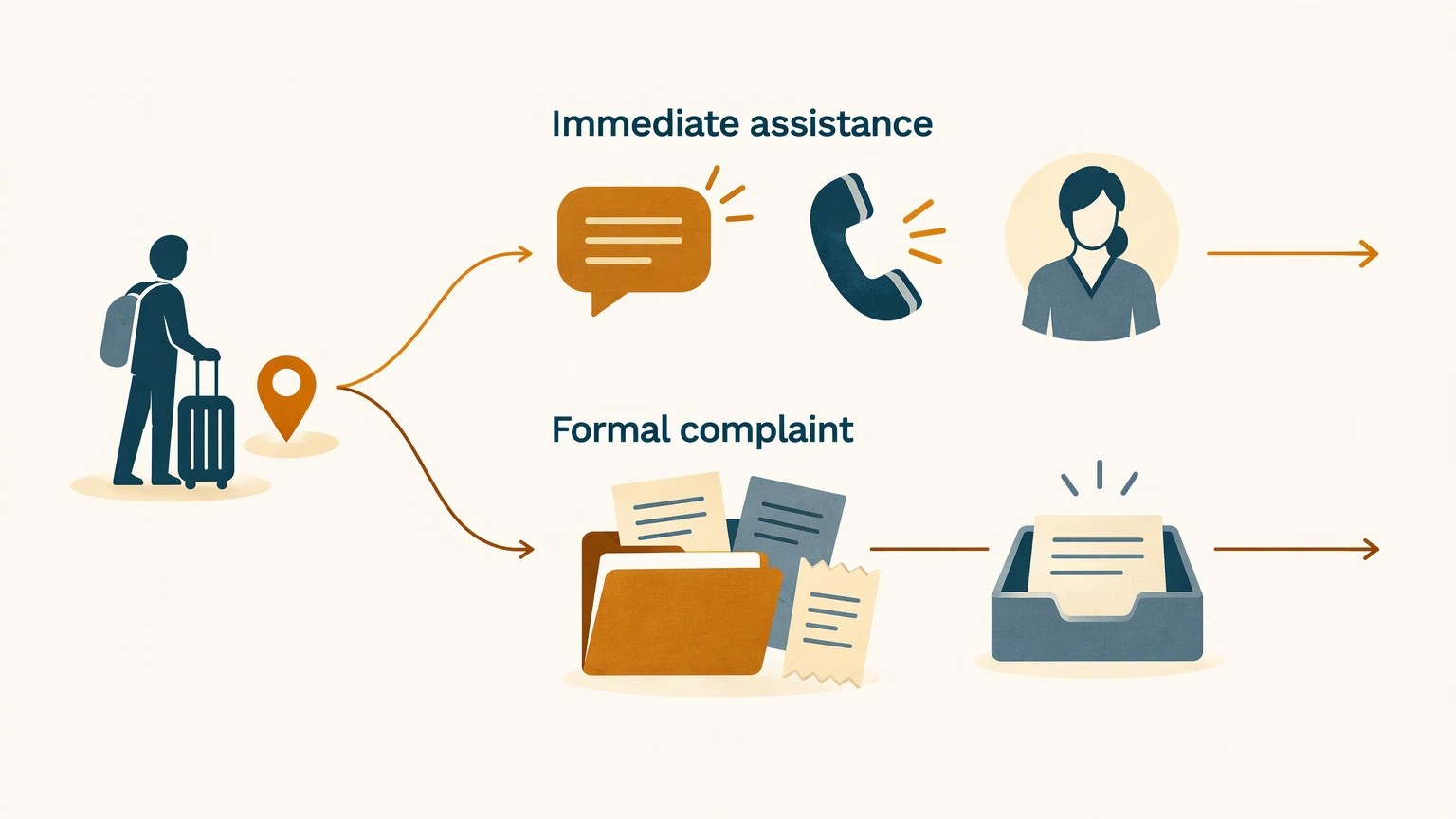
Illustration of separate Immediate assistance and Formal complaint routes, using communication icons above and a folder, papers and inbox tray below, with both routes ending in open arrows.
Suppose you compare a Caribbean cruise excursion sold directly by its operator with an advisor-arranged proposal. Your concern is whether the excursion's return arrangements fit your trip. I would compare timing commitments and responsibility for disruption, not count reservations.
If the direct offer answers that concern and you are comfortable administering it, I would not add an intermediary for its own sake. Advisor involvement can be useful when clarification across cruise and excursion arrangements falls within the advisor's agreed role.
I would keep the limit clear: comparison help does not guarantee changed operator terms or reimbursement. An extra communication step can be a disadvantage if its purpose is unclear. I would judge the channel by the uncertainty it resolves and the responsibilities it accepts, rather than assume direct booking or advisor involvement is always better.
My cruise and Caribbean specialties are relevant here. Superior Travel Consultants' Caribbean vacation planning is another starting point for resort-based trips. When choosing a travel agency on Long Island, I would evaluate specialties and the proposed role separately.
You can describe your proposed tour and request me, Fran Lozano. I would focus on who would operate, invoice, and administer it, not assume an agency-wide supplier relationship answers those questions.
| Decision factor | Direct booking | With an advisor |
|---|---|---|
| Useful when | The offer answers your timing concern | Clarification across arrangements helps |
| Administration | You are comfortable administering it | Clarification fits the advisor's role |
| Terms | Check timing and disruption commitments | No guarantee of changed operator terms |
| Communication | No intermediary added for its own sake | An extra step can be a disadvantage |
Share the destination, dates and travel style you have in mind. A Superior Travel advisor will help turn the possibilities into one clear, personal plan.