
Separate the roles
I would identify the seller, organizer and supplier where those roles differ. A helpful planning contact does not, by itself, establish who owes a refund or replacement.

I would choose tour packages when written terms clearly assign responsibility for dependent components. Separate bookings suit trips where individual terms and handoffs work better. A bundled price alone does not establish who must assist or pay after a disruption.
I compare tour packages by their booking terms, not whether sightseeing is guided. For Long Island travelers, tour packages deserve attention where an arrival, transfer or departure determines whether the next part of the trip can happen.
My approach to tour packages separates what you buy, who assists when plans change, and who bears the cost. My specialties are custom vacations, cruise planning and group travel. I use these distinctions to evaluate a European itinerary without assuming one booking structure always wins.
I would identify the seller, organizer and supplier where those roles differ. A helpful planning contact does not, by itself, establish who owes a refund or replacement.
I would flag the arrival that controls a tour departure or onward journey. That dependency matters more than how many reservations appear in the itinerary.
I would distinguish help finding another transfer from an obligation to pay for it. Both matter, but they answer different questions.
I would compare a likely date change or shortened stay under each proposal. General claims of flexibility are less useful than the terms for that actual change.
I start by drawing a boundary around the proposed package. Flights, hotels, transfers and activities belong either inside that arrangement or outside it. A single itinerary or total price does not establish which supplier has accepted responsibility for each component.
I separate sightseeing style from booking structure. Arranged lodging and transportation can accompany independent exploration, so traveling without a group does not necessarily mean booking separately. The distinction is what the agreement includes, what remains separately contracted and what happens when plans change.
I would compare a hotel-and-transfer package with those services purchased under separate agreements. After a delayed flight, do the transfer terms address late arrivals? Who arranges a replacement, and who pays? If the flight sits outside the package, I would not assume its supplier must absorb an airline disruption's consequences. Included components also need their change and cancellation provisions reviewed.
For European vacation planning, I would use the proposal and terms to identify each supplier, disruption contact and stated remedy or limitation. My planning role differs from a supplier's obligations.
I would favor a bundle when its documented arrangements address connections you want coordinated. Separate bookings may suit you when component-level choice matters more and you accept coordinating individual terms. For escorted tours and river cruises, I would include travel to the starting point, not just the tour, because that arrival can determine whether you use the booked journey.
| Structure | Best fit | Responsibility boundary |
|---|---|---|
| Bundled | Dependent components with documented coordination | Organizer's coverage and exclusions |
| Separate | Independent component choices | Individual obligations and gaps |
| Mixed | Packaged core, independent additions | Where package obligations end |
| Structure | Best fit | Boundary to check |
|---|---|---|
| Bundled | Dependencies with documented coordination | Organizer's coverage and exclusions |
| Separate | Independent component choices | Individual obligations and gaps |
| Mixed | Packaged core, independent additions | Where package obligations end |
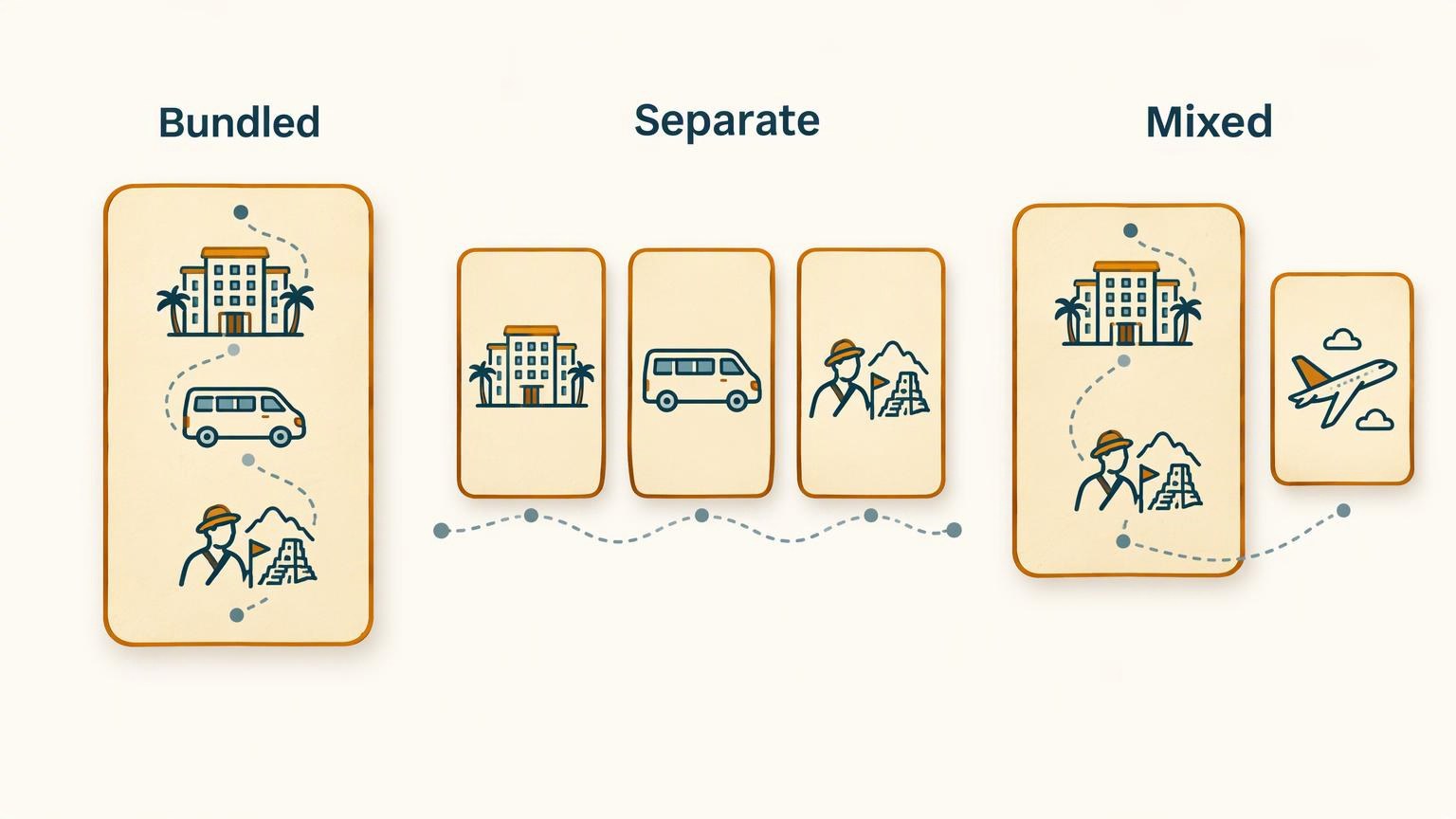
Illustration comparing booking boundaries: hotel, van and tour icons share one outline or occupy separate tiles; a mixed arrangement places hotel and tour icons together with an airplane tile outside.
I trace disruption forward, component by component. A delayed arrival creates an immediate transport problem, but unused hotels, transfers or tour places remain separate questions unless the applicable terms connect them.
I divide the response into assistance and expense. Who arranges and authorizes a replacement? Who pays initially, and what documented basis exists for reimbursement? An emergency contact number does not establish that replacement costs are covered.
For a bundle, I would locate the wording addressing the failed handoff. For separate bookings, I would assess each affected reservation. Neither structure earns my preference because its paperwork is shorter; I favor an understandable response to the disruption that matters.
My practical test is whether you could act without guessing whom to call. I would keep booking references, supplier contacts and spending-approval instructions accessible, particularly when the next service depends on arriving in time.
I distinguish insurance from supplier responsibility. For a cruise-related itinerary, considering travel insurance for a cruise is a separate decision, not a substitute for clear booking terms. If a proposal leaves that handoff unexplained, I would consider revising the timing or structure before accepting it.

Illustration of a travel route with an amber interruption, assistance and payment questions beside a phone and wallet, and a hand sketching planning marks.
I compare traveler-requested changes separately from supplier cancellations. Your decision to postpone and an operator's inability to deliver a service may fall under different terms; an answer for one event does not settle the other.
With separate bookings, I examine what remains usable after the first cancellation. A canceled activity does not determine what happens to an independently reserved hotel. With a package, I examine whether a change affects the whole arrangement or a defined component.
For family and group travel, I distinguish one household canceling from everyone canceling. I also examine whether the remaining travelers' accommodation or quoted arrangement changes, rather than assume their original terms stay untouched.
When comparing tours for couples and romantic getaways, I give a non-negotiable celebration date more weight than a general promise of customization. Useful flexibility addresses the change you may actually need, not simply the ability to choose activities.
My comparison records the refund basis, credit conditions and change-request procedure. I assess whether you could use a credit rather than equating it with money returned. I then compare the consequences across the entire itinerary before choosing.
I cannot judge whether a package is cheaper from its headline total. I first align dates, accommodation, transport and inclusions, then compare the cancellation and change terms attached to each price.
My comparison separates included items from exclusions and optional purchases. Transfers, meals, admissions, baggage and required charges deserve examination; I would not assume that every package includes them. An omitted necessity belongs in the total you compare.
The same distinction applies to all-inclusive vacation arrangements: I evaluate stated inclusions rather than let the label settle the comparison. A tour proposal deserves equally careful treatment, especially where separately purchased transport connects its components.
Destination, season, accommodation category, transport choices and private service are cost drivers I examine in a current quote. Equivalent arrangements provide a better basis for deciding whether a lower total represents value.
I also consider the change you fear. A cheaper booking may suit you if its terms are acceptable; paying more makes sense only for a useful difference. Request me, Heather Hamann, for a current quote rather than an estimated saving. I keep possible replacement expenses separate from the purchase price.
Suppose you want a European honeymoon with an independently booked flight followed by a tour. Time on your own matters, but reaching the tour departure is essential.
I would compare included arrival arrangements with a land-only package plus separate travel. If the first proposal's written terms meaningfully address the arrival-to-tour handoff, that could justify choosing it. I would still examine exclusions and your required response to disruption.
If both proposals leave that connection with you, I would not pay more merely because one looks bundled. I would consider revising the arrival plan, preserving useful time before departure and explicitly accepting separate booking responsibilities. The choice should improve the trip's vulnerable connection, not just simplify its presentation.
My custom-vacation specialty supports discussing these dependencies with you; proposed suppliers and their terms establish obligations. Superior Travel Consultants offers advisor-led customized planning for Long Island travelers, distinct from guaranteeing against disruption.
For family tours, I would apply this reasoning to each household's arrival. For honeymoon tours, I would prioritize the handoff most consequential to your plans. A mixed arrangement can suit that preference without making the independent portion part of the package.
Share the destination, dates and travel style you have in mind. A Superior Travel advisor will help turn the possibilities into one clear, personal plan.