
Name the decision you need help making
I would distinguish choosing the trip from arranging a trip you have already chosen. That difference helps you evaluate whether proposed research or booking work addresses your actual need.

I would not assume planning is free or that your trip carries a charge. Before proceeding, request any applicable amount, covered work, payment timing, and change or refund terms. Keep travel advisor fees separate from supplier deposits and payments for travel.
I would evaluate travel advisor fees by the work you need, not your vacation's price alone. For Long Island travelers comparing travel advisor fees, choosing a vacation style and arranging an already selected trip call for different planning scopes.
I am Robin Holian, and my specialties include groups, family travel, cruises, and honeymoons throughout Europe. When comparing travel advisor fees, I would identify the decision you need help making, then evaluate the proposed scope and payment terms before authorizing work or purchasing travel.
I would distinguish choosing the trip from arranging a trip you have already chosen. That difference helps you evaluate whether proposed research or booking work addresses your actual need.
I would label each payment as advisor work, travel purchased, or a possible later charge. A deposit toward accommodation is not automatically payment for itinerary development.
I would value a comparison that resolves your room choice more than a long itinerary containing decisions you have already made. The deliverable should help you act.
I would compare cancellation and amendment terms alongside the initial total. A lower purchase price may be less useful if you expect to change your dates.
I would not add broad planning work to a familiar trip without a reason. If only one decision needs help, explore whether the proposed service can focus on it.
I would read a planning charge as payment for defined advisor work, not for the vacation itself. Travel advisor fees, if applicable, should specify the deliverable: an options assessment, itinerary development, booking assistance, or another agreed task. The amount alone does not establish value.
I would compare deliverables first. For a cruise, you might need help choosing an itinerary and cabin rather than arranging flights, hotels, and transfers. For a trip with several stops, you might need a route and transportation options. Both could be labeled a “service fee” despite covering different work.
I also distinguish a completed plan from confirmed reservations. Revisions and assistance after booking are separate scope questions; a charge does not automatically include unlimited changes, ongoing support, or a vacation credit.
I keep advisor work, supplier payments, and possible later charges separate. A supplier deposit is not automatically a planning fee, and canceling travel does not determine whether completed planning work is refundable.
Superior Travel Consultants offers customized planning, so I would connect any charge to your itinerary, not a universal price. My guide to when using a travel agent makes sense helps you choose what to delegate.
| Category | Purpose | Terms to establish |
|---|---|---|
| Advisor charge | Agreed planning work | Scope, timing, refunds |
| Supplier payment | Purchased travel | Reservations, purchase terms |
| Possible amendment charge | Later changes | Who charges, when applicable |
| Supplier compensation to advisor | Advisor payment arrangement | Whether traveler charges also apply |
I would assess planning work through open decisions and the arrangements that depend on them. Reservation count is a poor shortcut: several familiar bookings may be straightforward, while one accommodation choice may require careful comparison if your family's needs remain uncertain.
For European vacation planning, your preferred pace can change the itinerary. Selecting stays independently differs from deciding whether hotel changes leave enough time for the experiences you want. I would resolve that question before treating individual bookings as the whole task.
Comparing escorted tours and river cruises also involves more than finding a departure. I would distinguish choosing a specific program from deciding between a shared schedule and more independent time.
These differences explain scope, not a particular fee. I would evaluate the proposed work rather than assume destination, group size, or trip label determines the charge.
I would also separate initial research from revisions. Exploring vacation styles is broader than adjusting an agreed itinerary. If your preferences are developing, a defined comparison stage may be more useful than detailed booking work. That distinction helps you assess what the proposal actually covers.

Illustration contrasting a prominent branching travel decision with luggage and bed tokens along a single simple route.
I would compare equivalent travel purchases: matching dates, accommodation or cabin category, inclusions, and change terms. Then I would add any separately quoted planning charge to the advisor-led option. Comparing a complete proposal with an accommodation-only price can mislead you.
For Caribbean and all-inclusive vacations, I would identify actual inclusions rather than assume the label covers every arrangement you want. A headline price alone cannot establish an equivalent purchase; omitted arrangements still belong in your comparison.
Suppose you have selected a family cruise but remain unsure which cabin arrangement fits. You could resolve that independently and book directly, or evaluate a defined advisor proposal covering the cabin decision and booking work. I would compare those options against the same sailing and cabin requirements.
I would favor independent booking if you can confidently resolve the fit and understand the terms. Otherwise, I would assess whether the proposed assistance justifies any charge. A family cruise is not automatically complex.
I would not promise that a planning fee pays for itself through savings. Lower cost and useful assistance are separate benefits; each needs support in the proposal.
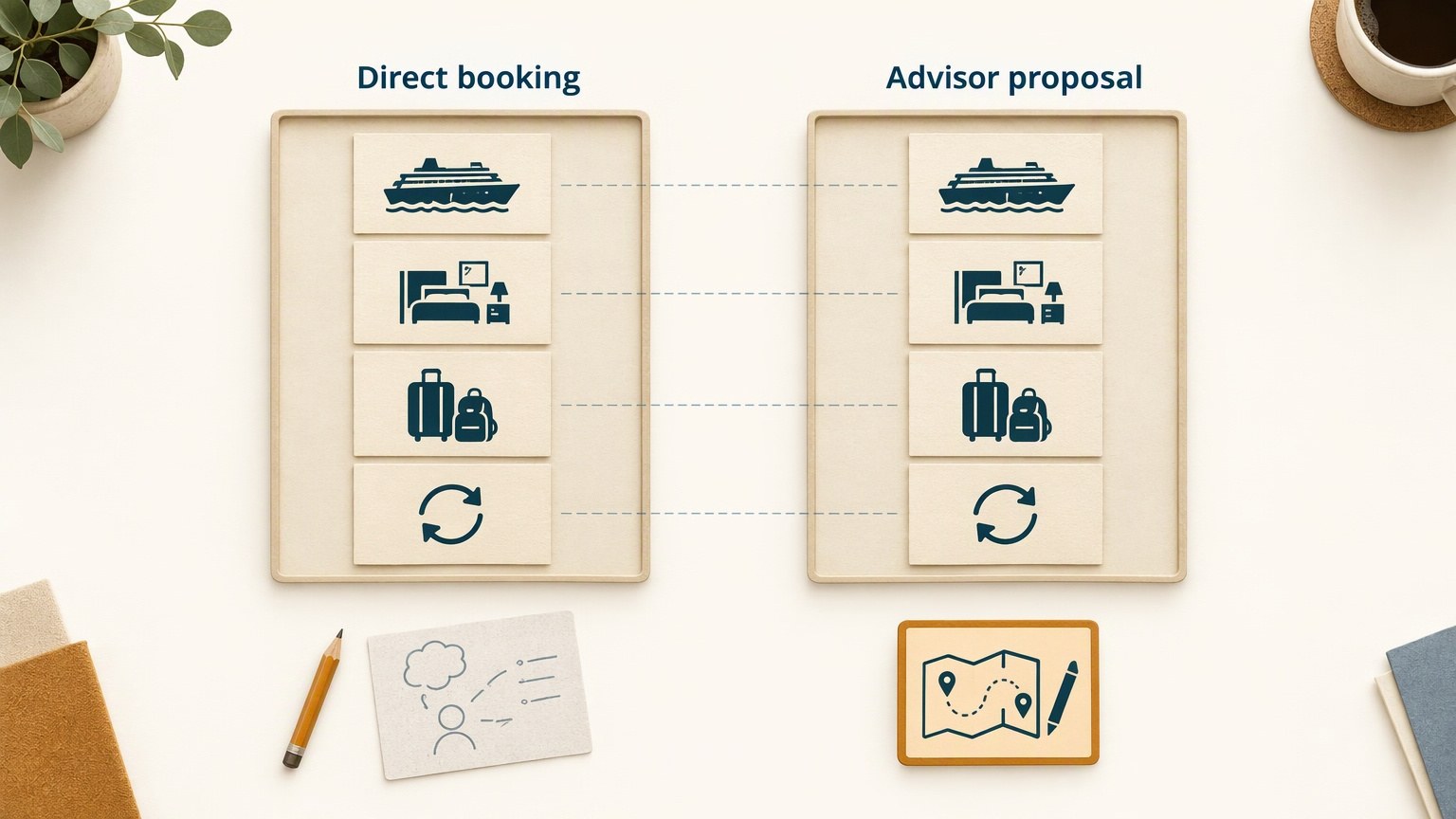
Illustration of matching travel pictograms in Direct booking and Advisor proposal trays, linked by dashed guides. A pencil and unfinished sketch sit below the left tray; a separate route-and-pencil tile sits below the right.
I would separate a revision before booking from an amendment after purchasing travel. Revising a proposal concerns planning scope; changing a reservation also involves purchase terms. One request can involve both, without making them the same charge.
For a date change, I would distinguish any advisor charge, supplier charge, and difference in travel price. The replacement may cost more or less even without a separate amendment fee. Comparing only the fee could obscure the actual cost of your decision.
For family, group, and cruise planning, I would consider whose arrangements change. One traveler withdrawing and the entire group changing dates require different reviews of affected purchases and planning work.
I would read cancellation terms separately. A refundable travel purchase does not establish that a planning charge is refundable, and canceling does not automatically reverse payment for completed work. Written terms should distinguish those outcomes.
I would retain scope and payment terms with booking documents. For work outside the agreement, establish the new scope and costs before authorizing it. You can then weigh the revised total against keeping the existing plan rather than deciding from one charge alone.
My specialties are groups, family travel, cruises, and honeymoons throughout Europe. They are useful starting points for coordinating travelers, choosing a cruise, or shaping a honeymoon, but do not determine fees or proposal inclusions.
My credentials include Accredited Cruise Counselor credentials for Royal Caribbean, Celebrity, Norwegian, and Princess Cruises, plus Certified Sandals & Beaches Specialist. I would weigh specialty fit alongside your needs and the proposed work, rather than treat credentials alone as the reason to purchase planning.
Superior Travel Consultants provides advisor-led customized planning for Long Island travelers. When considering a travel agency on Long Island, I would connect that role to your specific decision, not assume every trip needs extensive assistance.
For a European honeymoon, I would distinguish help choosing a route from help arranging stays along a route you have settled. For a group, I would distinguish comparing shared travel options from handling individual preferences. A useful proposal makes those boundaries clear, so you can judge whether any planning charge covers the work you want to delegate.
In your Plan Your Trip inquiry, describe your itinerary, settled choices, and open decisions. I would evaluate the proposal by whether it addresses those needs, with any applicable charges understood before proceeding.
Share the destination, dates and travel style you have in mind. A Superior Travel advisor will help turn the possibilities into one clear, personal plan.