
Separate family from insured traveler
I look for the definition of an insured person before relying on a family relationship. A relative mentioned in cancellation wording is not necessarily insured for their own medical expenses.

I consider shared coverage when everyone qualifies and benefits fit each traveler. Separate policies deserve consideration when households, dates or needs differ. Neither automatically covers joint cancellation: insured-person definitions, covered reasons and individual or shared limits determine which losses qualify.
I compare travel insurance for families by starting with people, not product labels. For Long Island travelers, travel insurance for families should account for households, payments and whether everyone follows the same itinerary.
When choosing travel insurance for families, I separate eligibility from benefits: qualifying for a policy is different from having enough protection. Shared coverage may fit your arrangements; separate policies may suit adults living apart or traveling independently. I explain which structures deserve comparison before price becomes the deciding factor for your family's trip.
I look for the definition of an insured person before relying on a family relationship. A relative mentioned in cancellation wording is not necessarily insured for their own medical expenses.
I would identify which travelers share a home and which live elsewhere. That makes any residence or dependent requirements easier to apply without assuming a family label includes everyone.
I would record each traveler's departure and return dates, including extensions. The shared portion of the vacation is not necessarily the full trip each person needs protected.
I would distinguish individual tickets from shared accommodation costs. I would then establish how the proposed policy requires those expenses to be assigned, rather than counting the same payment repeatedly.
I would decide whose absence would cause you to cancel. Then I would compare that relationship and event against each policy's wording, rather than treating a joint decision as automatic coverage.
I establish who can be insured before comparing premiums. The policy's definitions of insured person, dependent child, spouse or partner, and residence requirements matter more than your everyday understanding of family.
For an adult child living elsewhere, I examine age, dependency and household conditions. For grandparents joining the trip, I establish whether the arrangement accepts them as insured travelers. Neither relationship alone answers that question.
I distinguish an insured traveler from a family member whose illness could trigger cancellation benefits. A relative mentioned in cancellation wording is not necessarily insured for their own medical expenses. Both definitions matter when deciding who needs coverage.
For family and group vacations, I would list ages, relationships, households and complete travel dates. This makes eligibility differences visible before choosing one shared application, particularly when adult children or grandparents have separate arrangements.
If a definition does not clearly fit, I would seek the provider's clarification before purchase. Separate coverage deserves consideration when someone cannot qualify for the shared option, but their eligibility for an individual policy still needs review. Splitting applications does not itself resolve an eligibility restriction.
I read the benefit schedule alongside the definitions. A shared document does not establish whether limits apply per person, per trip, per event or across everyone insured.
For cancellation, I compare each traveler's assigned nonrefundable expenses with their limit and any overall maximum. For medical coverage, I examine individual benefits and deductibles. Baggage requires a separate review of item restrictions.
AXA describes cancellation reimbursement for covered reasons and eligible medical expenses up to the plan's maximum benefit. I use those distinctions to organize comparisons, not to suggest every family policy offers identical protection.
I also distinguish emergency medical treatment from evacuation. One benefit cannot substitute for the other when assessing the protection each traveler needs.
For all-inclusive vacations, I separate package cancellation conditions from insurance reimbursement. For escorted tours and river cruises, I include separately arranged travel costs, not just the main booking.
My comparison shows amounts and conditions together. A larger headline limit is less useful if your expense or event falls outside the wording. I would also establish how shared accommodation payments must be allocated, without counting the same expense toward multiple travelers' claims.
I compare structures after identifying eligible travelers and their needs. Shared coverage deserves consideration when its terms accommodate everyone's households, complete travel dates and required benefits.
Separate policies may fit travelers who need different protection or cannot qualify together. Their trade-off is more documentation and a separate review of how each contract treats the same disruption.
A mixed arrangement may suit a qualifying household plus another traveler needing individual coverage. I would not assume splitting applications improves or weakens benefits without examining the terms. The useful distinction is who qualifies and what each contract protects.
For customized European vacations, extensions and different arrival dates make complete itineraries important. I apply the same reasoning to couples when one partner travels independently for part of the journey.
I do not equate one application with easier claims, or separate applications with permission for independent travel. Coverage must fit the people and trip first. If multiple structures meet those needs, administration can become a tie-breaker after coverage and price. I would compare cancellation dependencies across all contracts before accepting extra paperwork as the only difference between shared and separate options.
| Structure | Potential fit | Trade-off | Key terms |
|---|---|---|---|
| Shared | Everyone qualifies | Possible shared maximum | Eligibility; individual limits |
| Separate | Different needs or eligibility | Multiple contracts | Dates; covered reasons; companions |
| Mixed | Household plus other travelers | Coordinating coverage | Relationships; cost allocation; cancellation |
| Structure | Potential fit | Trade-off | Check terms |
|---|---|---|---|
| Shared | Everyone qualifies; benefits fit | Possible shared maximum | Eligibility; individual limits |
| Separate | Different needs or eligibility | Multiple contracts | Dates; covered reasons; companions |
| Mixed | Household plus other travelers | Coordinating coverage | Relationships; costs; cancellation |
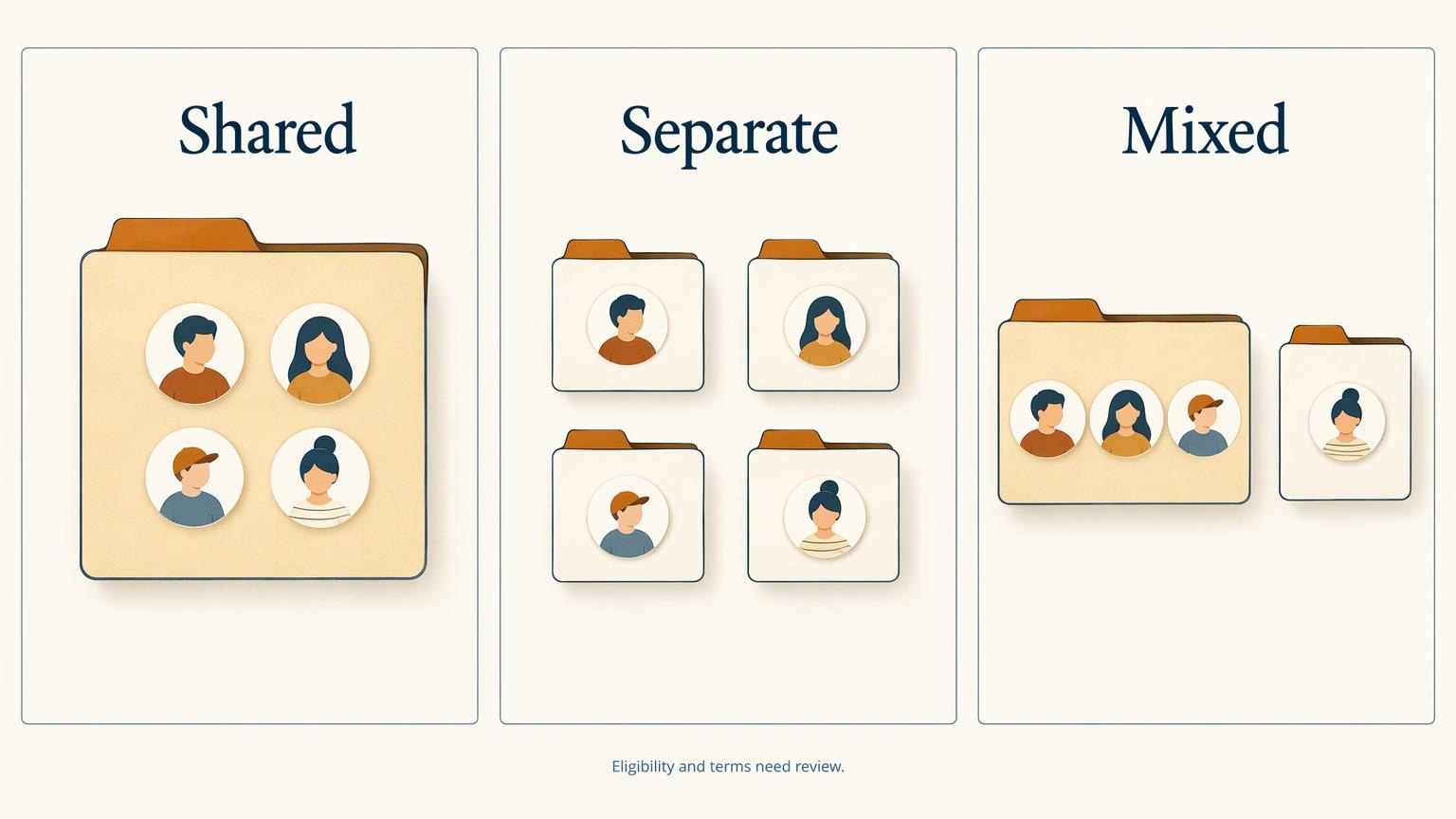
Illustration of shared, separate and mixed folder groupings using the same four traveler icons. A footer reads: Eligibility and terms need review.
Suppose parents, dependent children and grandparents living separately share a vacation, but the grandparents return earlier. You would cancel if a child became too ill to travel; the grandparents might still go.
I first test shared coverage against everyone's eligibility and complete dates. If the terms accept everyone and benefits fit, it remains a candidate. A different address alone is not my reason to reject it.
If the terms exclude the grandparents, I compare household coverage for parents and children with separate coverage for grandparents. Individual options also deserve consideration if they better match each traveler's needs.
I then examine cancellation separately: does the child's illness qualify as a covered reason for each affected traveler, under that policy's relationship definitions? Booking together does not establish that everyone can claim. The grandparents' decision to continue also makes each person's actual loss relevant to the comparison.
For a family trip to Asia, I use the same approach and consider each person's full itinerary, not only shared days. My preferred structure follows eligibility, benefits and cancellation dependencies, rather than the destination, number of reservations or the family's preference for one document.

An illustration of two households’ routes converging at “Shared vacation” and diverging toward “Earlier return” and “Later return,” with a folder and magnifying glass at lower right.
I compare current quotes using matching travelers, trip costs, dates and required benefits. Deductibles, exclusions and optional protection remain visible so a lower premium does not conceal different coverage.
Age, duration, destination and selected protection belong in the quote enquiry. I would not assume children are included without charge or shared coverage costs less. An eligible option must fit your priorities at an acceptable current price.
Timing matters too. AXA notes that a pre-existing medical condition waiver is available on some plans with eligibility conditions. I would review the proposed policy's purchase requirements promptly, not apply another plan's deadline.
My specialties include group travel, river cruises, ocean cruises, Europe, and Korea and Asia. My Lois Howes advisor profile provides background. I can place your insurance enquiry alongside trip details; the policy provider must establish eligibility and coverage.
For cruising families, I also suggest the cruise insurance guide for separate protection questions. Request me for a current quote enquiry once you have outlined the travelers and trip. My planning role supports the comparison without promising a product, benefit or policy outcome.
Share the destination, dates and travel style you have in mind. A Superior Travel advisor will help turn the possibilities into one clear, personal plan.