
Start with the actual document
I would use the current benefit guide for your exact card, not a general description of its travel perks. Match each promising headline to the eligibility language underneath it.

I would choose the best travel insurance by comparing your card's actual benefits with the risks of your planned trip. A separate policy is worth considering when eligible travelers, covered reasons, medical protection or reimbursement limits leave a meaningful gap. Neither a premium card nor a standalone policy automatically covers everything.
I start the best travel insurance comparison with your existing benefits. For Long Island travelers, the best travel insurance choice depends on who qualifies, eligible expenses and the risk you can accept.
When comparing the best travel insurance with credit card cover, I read the documents beside your itinerary. I am Lois Howes, specializing in river cruises, ocean cruises and group travel.
I would use the current benefit guide for your exact card, not a general description of its travel perks. Match each promising headline to the eligibility language underneath it.
I would distinguish a lost deposit from an unexpected medical bill. A benefit that addresses one does not establish protection for the other.
I would write down the reason you are most concerned about canceling. A generous reimbursement ceiling has little value if that reason does not qualify.
I would keep payment records, booking terms and receipts together. Ask the benefit administrator which documents a claim would require before relying on reimbursement.
I compare protection by benefit, not product label. Card benefits may address some risks adequately; a separate policy has restrictions too. Additional protection is useful when it addresses a meaningful shortfall.
I first match travelers and payments to each product's eligibility rules. Then I distinguish cancellation before departure from interruption afterward, comparing covered reasons, eligible nonrefundable expenses, limits and exclusions. For delays, I compare waiting periods as well as reimbursement limits: an earlier hotel stay or meal may not qualify.
For example, suppose you are booking flights, a hotel and a cruise. I would list each reservation's nonrefundable cost and compare the total eligible exposure with cancellation benefits. You gather booking amounts and the card guide; the card administrator and prospective insurer confirm their respective terms. Expenses above an applicable limit reveal a concrete gap.
I also separate refundable reservations from money you would actually lose. A large overall trip budget does not necessarily mean an equally large cancellation exposure, so I compare the applicable benefit with eligible losses rather than every planned expense.
I use the table to record answers, not declare a universal winner. Unknown coverage needs clarification. If existing benefits address your concerns, extra protection may add little; otherwise, compare policies against the specific shortfall.
| Concern | Card benefit review | Separate policy review |
|---|---|---|
| Canceling before departure | Eligible expenses, covered reasons and limits | Eligible prepaid costs, covered reasons and limits |
| Returning home early | Interruption benefit and qualifying events | Unused trip costs and eligible additional travel |
| Unexpected treatment | Medical payment benefit, if any | Medical benefit, exclusions and limits |
| Medical transportation | Assistance versus payment for evacuation | Evacuation eligibility and authorization requirements |
| Travel or baggage delay | Waiting period and eligible purchases | Waiting period, expense limits and exclusions |
| Concern | Card benefits | Separate policy |
|---|---|---|
| Cancellation | Eligible expenses, reasons and limits | Eligible prepaid costs, reasons and limits |
| Early return | Interruption and qualifying events | Unused costs and eligible extra travel |
| Medical care | Medical payment benefit, if any | Medical benefit, exclusions and limits |
| Evacuation | Assistance versus evacuation payment | Eligibility and authorization rules |
| Travel/bag delay | Waiting period and eligible purchases | Waiting period, limits and exclusions |
I review eligibility traveler by traveler. Paying for everyone with one card does not establish equal protection. I look for the definitions covering the cardholder, accompanying travelers and family members, then match each person to those definitions.
For families, I also match every traveler to the prospective policy's insured-person information. For couples, I do not assume that sharing a booking establishes both partners' coverage. A missing eligible traveler changes the decision even when the stated benefits look adequate.
Next, I trace payments: which card paid each expense, whether rewards were used and whether the deposit and balance used different methods. The benefit administrator confirms how those arrangements affect eligibility; another card's rules are not a substitute.
In family and group cruise planning, I keep household comparisons separate because payment arrangements may differ despite a shared itinerary.
For example, I would not carry a cardholder's eligibility answer over to a relative who booked independently. I would place that relative's expenses and payment method in a separate comparison, so one household's protection does not conceal another's gap.
Finally, I check whether limits apply per person, per trip or across a shared benefit. A family-friendly label matters less than whether the actual terms protect your travelers and eligible expenses without leaving a shortfall you cannot accept.
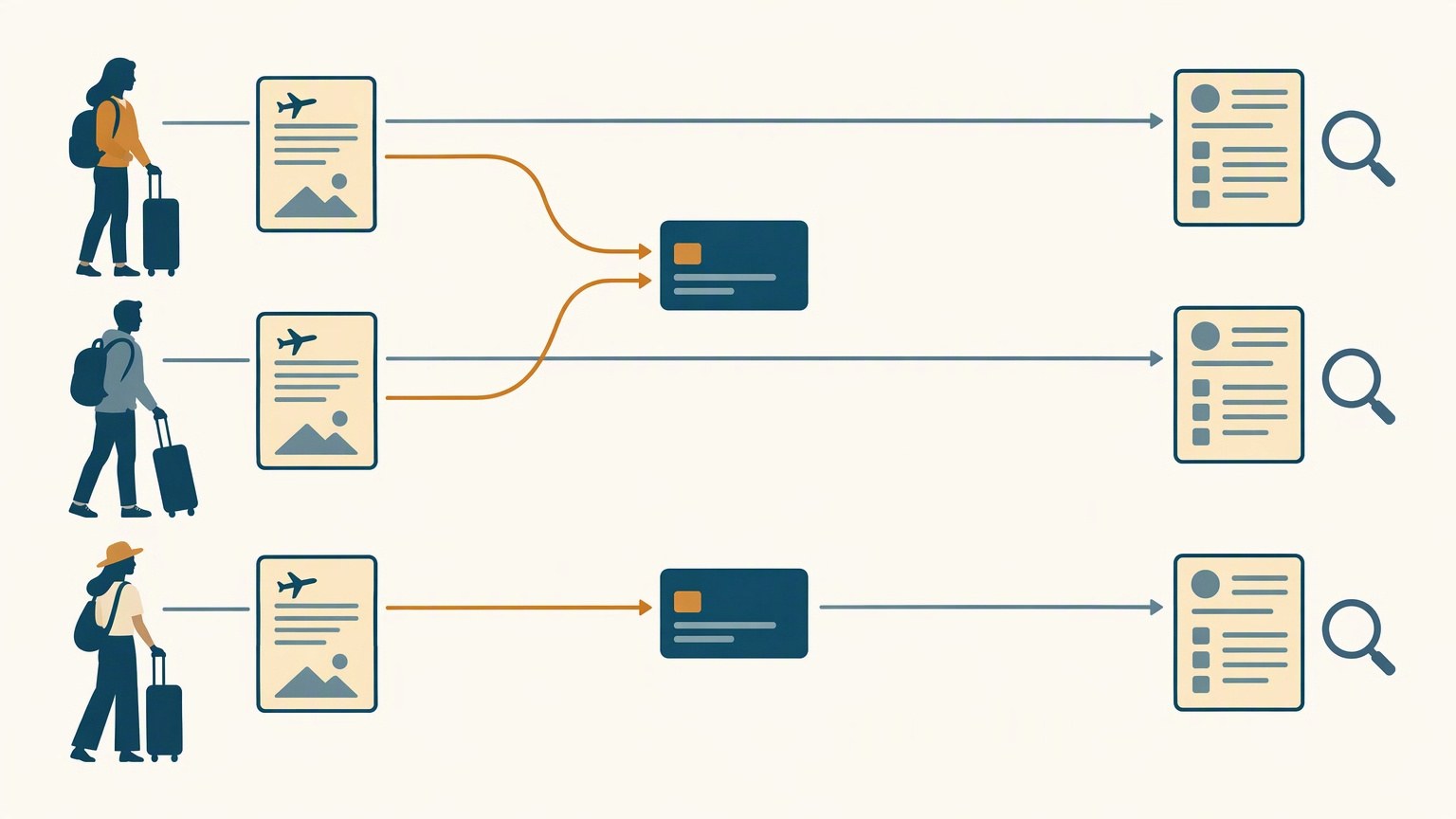
Illustration of three travelers, airplane slips, two payment cards and three documents with magnifying glasses; the top two slips connect to one shared card.
I evaluate treatment and evacuation separately from prepaid vacation costs. Assistance finding a doctor or coordinating transportation is not insurance that pays eligible bills. I look for payment benefits, limits and conditions before treating either risk as covered.
For treatment, I compare your health plan, card benefits and prospective travel policy at your destination. Doctor visits and hospital stays are useful categories, but exclusions can change the value of a reassuring limit. I would not assume every charge qualifies.
For evacuation, I establish who authorizes transportation, which circumstances qualify and the permitted destination. Transport to an appropriate facility is different from transport to your chosen hospital; the provider confirms the actual terms.
For a cruise, I ask whether your health plan covers care at sea and in foreign ports. My cruise travel insurance guide frames that comparison. If cancellation benefits suffice but medical protection remains uncertain, I focus on treatment and evacuation.
For an escorted tour or river cruise, accepting a lost deposit does not establish that medical costs are affordable. I discuss options and timing alongside planning; the provider confirms coverage and exclusions.

Illustration of a tabletop labeled Assistance, Medical payment, and Evacuation terms, with a phone, map, separate folders, magnifying glass, and open travel bag.
Suppose you are considering European vacation arrangements for your family. Your card lists cancellation and delay benefits, but traveler eligibility and medical protection remain uncertain.
I would first have you list travelers, payments and nonrefundable commitments. The card administrator confirms eligibility and payment requirements. Your health insurer answers medical questions; a prospective travel insurer explains its policy terms. Those answers turn benefit headlines into a comparison relevant to your itinerary.
If existing protection meets your concerns and the remaining exposure is acceptable, I would not add a comprehensive policy merely because you have several reservations.
If an uninsured traveler, inadequate limit or medical gap emerges, I focus the policy comparison on that need. A separate plan helps only when its terms address the shortfall.
In this example, I would keep adequate card cancellation benefits in the comparison while evaluating medical options. I would then compare the additional premium and relevant exclusions with the uncovered treatment risk, rather than assuming that every benefit needs replacing.
I apply the same logic to a couples getaway. The broadest package is not automatically the best choice. I weigh paying for additional protection against retaining a risk you understand and can afford, without treating uncertainty as coverage.
I discuss protection alongside booking, before commitments accumulate. Purchase deadlines and eligibility dates come from the provider; I would not apply a universal deadline to every policy. Timing can affect which options remain available for your circumstances.
My advisor role connects protection questions to the itinerary. My river cruise, ocean cruise and group travel specialties help identify relevant trip components. At our Long Island travel agency, we provide customized planning, with protection part of the conversation.
I bring the itinerary, payment history and identified gaps into that discussion. The card administrator confirms card terms, your health insurer confirms its benefits, and the travel policy provider confirms coverage and exclusions.
For quotes, I compare inclusions against the gap, not premium alone, using consistent travelers, trip details and desired benefits. A lower premium is not useful if the needed protection is absent.
I would keep a short decision record explaining which benefits you are relying on and which losses you are accepting yourself. If the itinerary or payment arrangement changes before booking is complete, that record shows which parts of the comparison need revisiting.
I also consider overlap. Trawick International explains that multiple forms of protection do not mean double reimbursement for the same expense. I would establish claim order and other-insurance provisions with each administrator before adding overlapping limits together.
Share the destination, dates and travel style you have in mind. A Superior Travel advisor will help turn the possibilities into one clear, personal plan.