
Find the starting payment
I would keep the earliest trip receipt available, even if it was only a deposit. The provider should identify which payment starts the applicable policy's timing calculation.

I recommend reviewing travel insurance at your first trip payment, not waiting for final payment or departure. Check the applicable policy's purchase deadline, time-sensitive eligibility and benefit start dates. Purchasing a plan does not establish that every benefit applies to your trip.
Deciding when to buy travel insurance starts with your payment history, not just your departure date. For Long Island travelers, I would connect the first booking receipt to the protection you want, keeping an early deposit visible as later arrangements take shape.
I am Robin Holian, with our Long Island travel agency. My approach to when to buy travel insurance separates purchase deadlines from effective dates. Understanding when to buy travel insurance means checking both against your payments, itinerary and the applicable policy.
I would keep the earliest trip receipt available, even if it was only a deposit. The provider should identify which payment starts the applicable policy's timing calculation.
I would distinguish cancellation flexibility from medical protection before comparing purchase dates. A plan available today may still have conditions attached to the particular benefit you want.
I would not treat a successful quote as proof that every optional provision is available. My comparison would include the written eligibility conditions alongside the premium.
I would record when each relevant benefit begins and ends. The departure date belongs beside those dates, rather than replacing them.
I would retain receipts for added arrangements and later payments. Before relying on existing protection, I would establish whether the policy requires an update and how to make it.
I would begin reviewing coverage alongside the first trip payment. That recommendation preserves an opportunity to compare choices; it does not establish a universal deadline or mean every traveler needs the same protection.
My starting documents would be the booking confirmation and payment receipt. I would distinguish the booking date, payment date and scheduled departure, because the provider may interpret each differently under the prospective policy. An early deposit belongs in that history even when later purchases are larger.
Next, I would identify what you want protected. For cancellation concerns, I would list amounts you could lose under supplier terms. For medical concerns, I would focus on the relevant benefit and eligibility conditions.
Final payment may feel convenient because more costs are settled. I would weigh that convenience against provisions tied to an earlier payment, rather than treat final payment as the default starting point.
My cruise insurance guide covers the broader protection decision for a sailing. Here, I would use the comparison below to keep purchase timing separate from the question of which benefits suit your trip and the risks you want addressed.
| Review point | Advantage | Policy question |
|---|---|---|
| First payment | Earlier comparison | Which payment starts deadlines? |
| Final payment | Clearer prepaid total | Does waiting affect benefit eligibility? |
| Near departure | More complete itinerary | Is purchase permitted, and when do benefits begin? |
| Added arrangements | Updated costs and dates | What coverage updates are required? |
| Review point | Advantage | Policy question |
|---|---|---|
| First payment | Earlier comparison | Which payment starts deadlines? |
| Final payment | Clearer prepaid total | Does waiting affect benefit eligibility? |
| Near departure | More complete itinerary | Can I buy, and when do benefits begin? |
| Added arrangements | Updated costs and dates | What coverage updates are required? |
I would examine any pre-existing-condition waiver and cancel-for-any-reason option separately from the ability to purchase the plan. A quote does not establish that either provision is included or that you qualify for it.
For a pre-existing-condition concern, I would have the provider explain the definition, waiver requirements and whose circumstances matter under the wording. Feeling well today does not answer those policy-specific questions, nor does a reassuring benefit name.
For cancellation flexibility, I would distinguish covered cancellation reasons from an optional cancel-for-any-reason provision. My comparison would include purchase conditions, cancellation requirements and whether payment takes the form of cash or credit, without assuming full reimbursement.
A useful timing answer identifies the exact plan, required action and event that starts its purchase window. I would connect those details to your receipt rather than rely on a general recommendation to buy early.
The choice then follows your concern. If protection for specified covered events is enough, an optional flexibility provision may not be a priority. If changing your mind matters, I would resolve that provision's requirements before relying on ordinary cancellation coverage to meet that particular need.
I would separate the purchase date from each benefit's effective dates. My review would identify protection before departure, protection during travel and when each relevant benefit ends. Those dates answer a different question from whether you can still buy the plan.
If losing prepaid costs before departure is your main concern, I would examine the cancellation benefit's start date. If medical care during travel matters most, I would examine that benefit's dates and conditions. The same purchase decision can involve both concerns.
I would also raise already-known circumstances before purchase. An announced disruption or newly developed symptoms require the provider's explanation of the applicable wording; buying now does not by itself settle whether those circumstances qualify for coverage.
For escorted tours and river cruises, I would compare the complete itinerary with the policy dates. Flights and hotel nights outside the main tour deserve review rather than an assumption that the tour dates cover the journey.
My practical test is whether the dates fit the risk. Early purchase may be useful, but I would still examine exclusions and eligibility before treating the calendar as proof of protection.
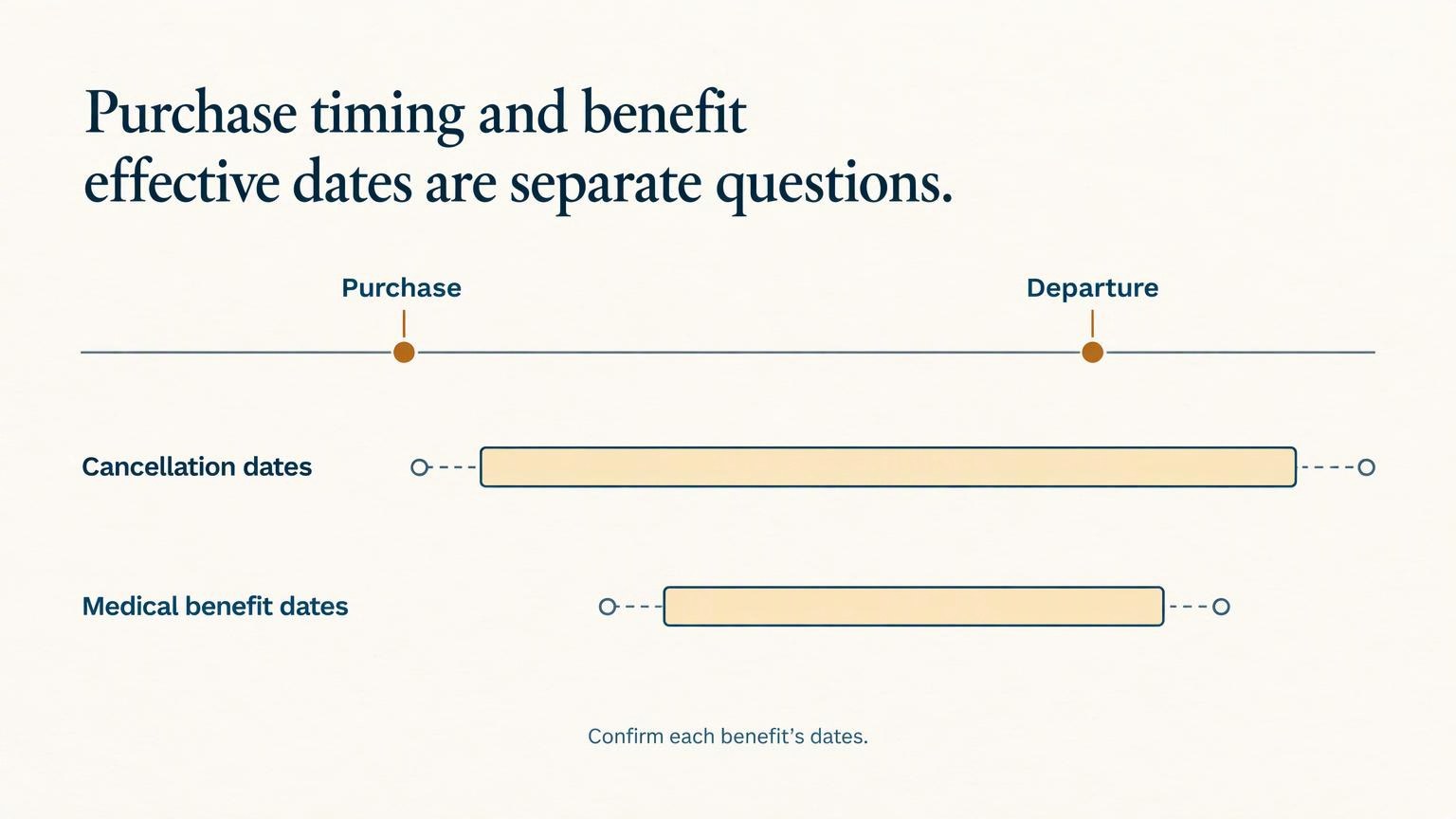
Illustration separating purchase and departure markers from cancellation and medical benefit date ranges, with dashed endpoints and a reminder to confirm each benefit’s dates.
Suppose you have paid a deposit for a European vacation, with airfare and a hotel stay undecided. I would compare reviewing coverage now with waiting for a complete itinerary, starting with the deposit receipt rather than the eventual total.
You would supply the payment history and intended dates. I would organize the trip details; the provider would explain the plan's first-payment definition, time-sensitive eligibility and requirements for handling later costs. Each role answers a different part of the decision.
If a provision you value is tied to that first payment, I would favor resolving its requirements now. Waiting for airfare may clarify the budget, but it does not answer whether an earlier purchase window affects that provision.
If the provision does not matter to you, I would compare the remaining benefits and dates without buying an unwanted option solely because it has an early deadline. Your protection needs guide the choice.
For family and group travel, I would separate each traveler's costs and payments. After purchase, you would retain new receipts and follow the provider's update instructions, not assume added arrangements are automatically included in existing coverage.

Illustration of an open folder and magnifying glass beside airplane and bed booking slips, linked by amber curves.
My specialties are groups, family travel, cruises and honeymoons throughout Europe. I connect travelers and arrangements to planning questions, while keeping policy eligibility decisions with the provider. An itinerary discussion and a coverage determination serve different purposes.
For cruise travelers, we can explain available options and timing, while the policy provider confirms exact coverage and exclusions. I would preserve that distinction whenever a deadline or eligibility condition changes your preferred option.
Payment history, intended departure and your main concern give the discussion a useful starting point. I would look for an answer tied to the applicable plan and wording, particularly when a time-sensitive provision affects your choice. A general summary cannot establish that provision's availability.
I would compare cost with needed benefits. Traveler age, prepaid cost, trip length, destination and selected coverage are relevant quote details. A lower premium cannot make up for a missing benefit you consider necessary.
My role helps connect an unsettled timing question to your trip arrangements. This is general planning information, not a recommendation of a particular policy; I would resolve material eligibility questions before purchase, rather than rely on reassurance.
Share the destination, dates and travel style you have in mind. A Superior Travel advisor will help turn the possibilities into one clear, personal plan.