
Choose access to answers
I would favor a route that makes the full policy available before purchase. A short benefits summary is useful for screening, but insufficient for a final decision.

You can buy travel insurance directly from an insurer, through a comparison service, or through a travel booking provider where available. I would choose the route that gives you complete policy wording, a current quote, insurer details and claims contacts before payment. An advisor conversation helps frame questions, but it does not establish coverage.
Deciding where to buy travel insurance means choosing more than a checkout page. I would start with your financial exposure and the policy information available before payment. For Long Island travelers, where to buy travel insurance should depend on whether the route makes coverage understandable, not simply convenient.
I am Robin Holian, a travel advisor with our Long Island travel agency. My approach to where to buy travel insurance separates trip-planning guidance from policy terms, so you can evaluate the actual offer rather than treat an enquiry as proof of protection.
I would favor a route that makes the full policy available before purchase. A short benefits summary is useful for screening, but insufficient for a final decision.
I would record the seller, insurer and claims administrator separately. If an organization handles several roles, have that relationship explained rather than inferred.
I would use the same travelers, dates and trip-cost information for competing quotes. Otherwise, a price difference may reflect different inputs rather than better value.
I would turn your biggest worry into a specific coverage question. Ask which clause applies and what conditions or exclusions could prevent payment.
I would save the final policy documents and written confirmation together. Keep assistance and claims contacts accessible while traveling, separately from the original sales conversation.
I would choose a buying route that lets you review the policy and identify who provides the insurance, not simply the easiest checkout. An insurer's website, a comparison service, a booking-provider offer and an advisor enquiry serve different purposes. None establishes suitable coverage by itself.
Buying directly may suit you when you already know which insurer and product you want to examine. I would look for full policy wording, a benefit schedule, applicable endorsements and claims contact details before deciding. The useful distinction is between knowing a brand and understanding the particular plan offered for your journey.
A comparison service can help you build a shortlist. I would use its summaries to narrow the choices, then compare the shortlisted policies individually. Matching labels such as cancellation or medical coverage are not enough: the covered reasons, limits and exclusions determine whether the benefits address your concerns.
A booking-provider offer puts insurance alongside your travel purchase. For an illustrative cruise comparison, I would start with your nonrefundable arrangements, then compare the cruise line's plan with a third-party policy for cancellation, medical and evacuation benefits. If a cancel-for-any-reason option matters, I would distinguish cash reimbursement from future cruise credit. That difference could change your choice even when the plan names sound similar.
An advisor enquiry connects those questions to your itinerary. My explanation of working with a travel advisor provides planning context. I would keep that conversation separate from purchasing coverage: general guidance is not a recommendation of a specific policy or an insurance contract. Before buying, I would establish the seller, underwriting insurer, current terms and claims contact rather than assume Superior Travel Consultants underwrites the policy.
| Route | Useful starting point | Trade-off to consider |
|---|---|---|
| Direct insurer | Examine a particular product | Compare alternatives separately |
| Comparison service | Screen several policy options | Verify each policy beyond summary labels |
| Booking-provider offer | Review protection alongside reservations | Check its scope against the whole journey |
| Travel advisor enquiry | Connect trip details to coverage questions | Establish who supplies and sells any actual policy |
| Route | Useful for | What to check |
|---|---|---|
| Direct insurer | Examine a particular product | Compare alternatives separately |
| Comparison service | Shortlist several policies | Read beyond summary labels |
| Booking-provider offer | Review cover alongside reservations | Check scope against the whole journey |
| Travel advisor enquiry | Connect itinerary to coverage questions | Identify the actual seller and insurer |
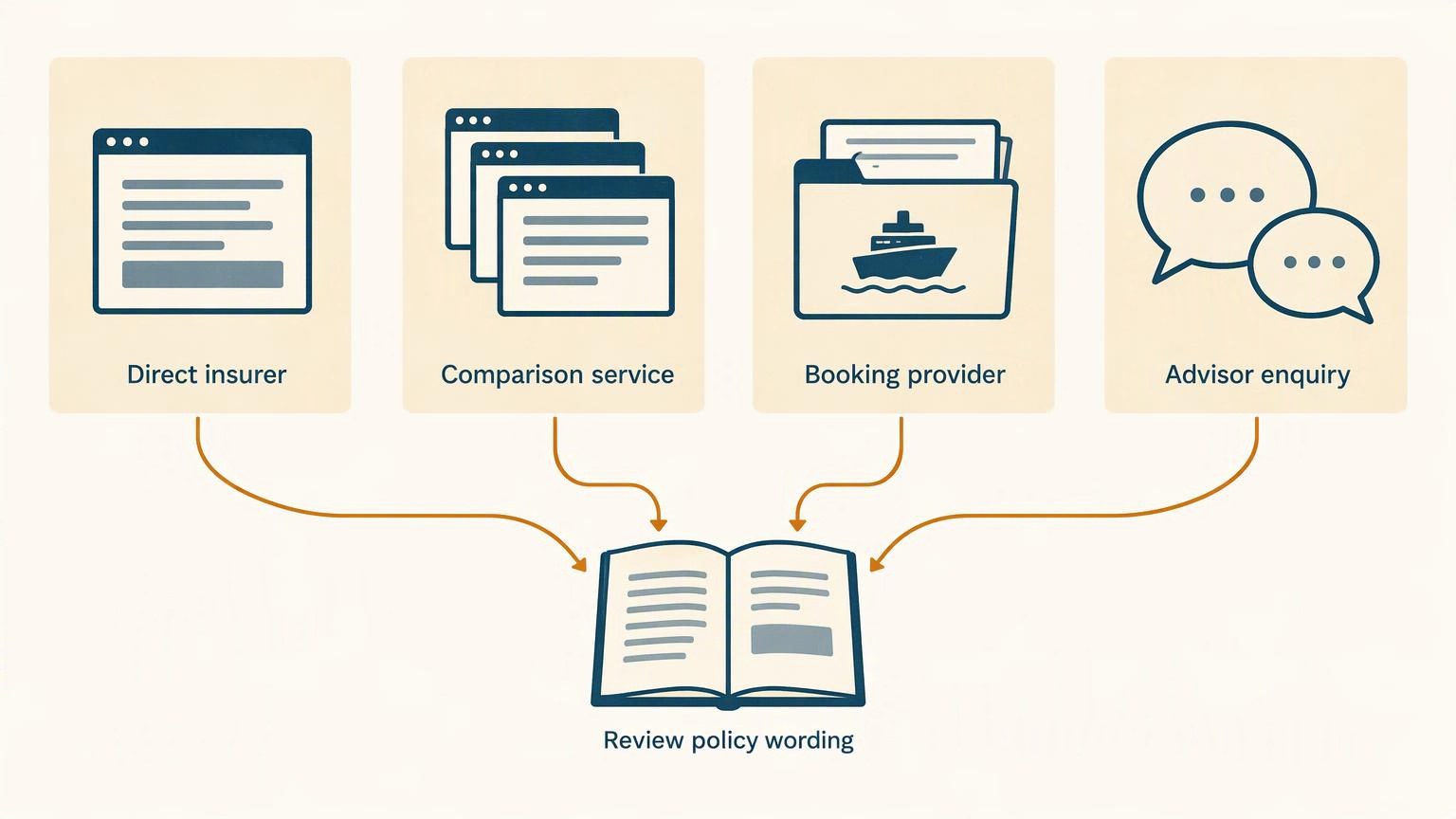
Illustration of Direct insurer, Comparison service, Booking provider and Advisor enquiry panels, equally displayed with arrows pointing to an open booklet labeled Review policy wording.
Before choosing a policy, I would request its full wording, benefit schedule and any endorsements that change the base terms. Ask for the version applicable to your residence and proposed journey, not a sample that may describe a different offer.
I would match the quote to the exact product name, travelers, dates and declared trip cost. A useful document set should let you trace a headline benefit to its limit, conditions and exclusions.
The distinction between marketing summaries and detailed policy wording matters here. I would use the summary to find a benefit, then read the clause that defines when it applies.
I would also ask who sells the policy, which insurer underwrites it and who administers claims. Request the seller's legal name and any applicable authorization details for your state; do not infer those roles from a travel company's name.
Finally, I would separate pre-purchase questions, emergency assistance and claims submission. Ask for the correct contact for each and the procedure for obtaining any required approval. A familiar planning contact is useful, but it should not replace the policy's assistance instructions.
For an illustration, imagine you have booked a cruise, purchased flights separately and reserved a hotel before embarkation. Your concern is losing those prepaid costs if illness prevents departure. I would first organize each reservation and its cancellation terms. You supply those trip details; the insurance seller explains how the proposed policy treats them. Next, I would compare the covered cancellation reasons and eligible expenses in each offer. If one quote includes only the cruise arrangements, it is not an equivalent comparison with a quote based on the entire journey. That scope difference matters before comparing premiums.
I would then read each important limit with its unit attached. Does the quoted amount apply per traveler, per trip, per item or across the policy period? For baggage, I would look for any separate item limits rather than assume the headline amount applies to every possession. For medical care and evacuation, I would examine the benefits separately and locate any approval requirements. A larger advertised limit does not resolve an exclusion or an unmet condition. The better fit is the policy whose terms address your concern, not necessarily the one with the largest headline benefit.
Before payment, I would resolve any mismatch between the seller's explanation and the documents by requesting the applicable clause or endorsement. After purchase, I would check the issued documents against the quote, including traveler names, dates and selected options. Save the policy identifier with the assistance and claims contacts. This gives you a usable reference if a problem arises, without relying on memory or assuming the original enquiry activated protection for your trip.

Illustration of a document-review desk with travel pictogram slips, abstract document lines, a magnifying glass and four separately labeled contact dividers.
Share the destination, dates and travel style you have in mind. A Superior Travel advisor will help turn the possibilities into one clear, personal plan.