
Keep a destination-date record
I would record the destination-local landing date and expected arrival at the property separately. That keeps the flight date from silently becoming the wrong reservation start date.

I would choose destination-local reservation dates, then address room access separately. Midnight or early-morning arrivals may require the preceding night for immediate access, with written late-arrival acceptance. I would also plan for any gap between hotel checkout and leaving the property.
I would compare your hotel booking with your flight itinerary. A hotel booking can have the right landing date but leave you waiting for a room.
I am Lynne Kaplan, with our Long Island travel agency. I would connect your hotel booking to local dates, overnight arrivals and room access throughout the journey.
I would record the destination-local landing date and expected arrival at the property separately. That keeps the flight date from silently becoming the wrong reservation start date.
I would use the complete itinerary rather than count nights spent in transit. A connection or date-line change needs its own calendar check before I choose accommodation dates.
I would state whether you need a bed immediately or can wait until the confirmed check-in time. Those are different purchases, even when the flight is identical.
I would save the property's written explanation of how it will handle your arrival after midnight. Paying for a night and arranging late arrival are separate steps.
I would decide what you need after checkout before adding another night. Luggage storage, a place to shower and continued use of your own room are different needs.
I would begin with the destination's calendar date, not the date you leave home. The flight itinerary's time-zone labels and date annotations establish whether departure and arrival fall on different days. Counting from your home calendar can put the reservation on the wrong night.
Next, I would distinguish landing from reaching the hotel. Arrival procedures and transportation come between those events. Your room-access need begins when you expect to reach the property, not necessarily at the flight's printed arrival time.
For a European vacation, I would write the sequence plainly: departure from home, destination-local landing, expected hotel arrival and first overnight stay. That makes a calendar mismatch visible before choosing a rate or paying for the stay.
I would then compare the reservation's start date with its check-in time. The correct date alone does not establish immediate access. If the room becomes available later, that waiting period needs its own plan.
On a multi-stop journey, I would repeat this review for each hotel. An overnight flight may replace a hotel night; copying dates forward can conceal an unintended accommodation gap.
I would not choose hotel dates by counting how many nights the journey feels like it takes. Time-zone differences and an international date-line crossing can change the destination calendar date. The dated flight information is the starting point, not elapsed travel time.
I would follow the segments in order, reading each connection's departure and arrival dates as labeled. Only after identifying the final destination-local arrival would I open the accommodation calendar. That prevents an intermediate airport's date from becoming the hotel's start date.
For an Asia vacation, I would repeat the process on the return. I would not assume the calendar pattern simply reverses, or choose checkout from the date you arrive home.
My room-night record would identify where you intend to sleep, which nights are spent in transit and when each accommodation begins. I would compare it with the flights rather than expect travel days and hotel nights to match.
A transit night without a hotel can be intentional. A destination night without accommodation is a different issue. I would resolve that gap before committing, while avoiding an unnecessary reservation for a night spent flying.
I would separate the clock date from the overnight stay you need. Arriving just after midnight does not mean a reservation starting that new calendar day provides immediate access. Its check-in terms may leave you waiting until later.
If you need to sleep immediately, I would investigate the preceding hotel night. The property must explain how it will retain the room, handle check-in and apply any no-show deadline. Payment alone does not settle the late-arrival arrangement.
For illustration, imagine arriving after midnight and staying several more nights. I would identify the local arrival date, connect immediate access to the preceding overnight reservation, then obtain the property's written acceptance of your actual arrival. That acceptance is what makes the arrangement usable, rather than simply adding a night to the calendar.
If you can wait until normal check-in, I would consider starting the reservation on the arrival date instead. The choice turns on your need for sleep, privacy or rest.
For family and group travel, I would map different flights separately. Shared travel plans do not automatically require every room to start on the same date.
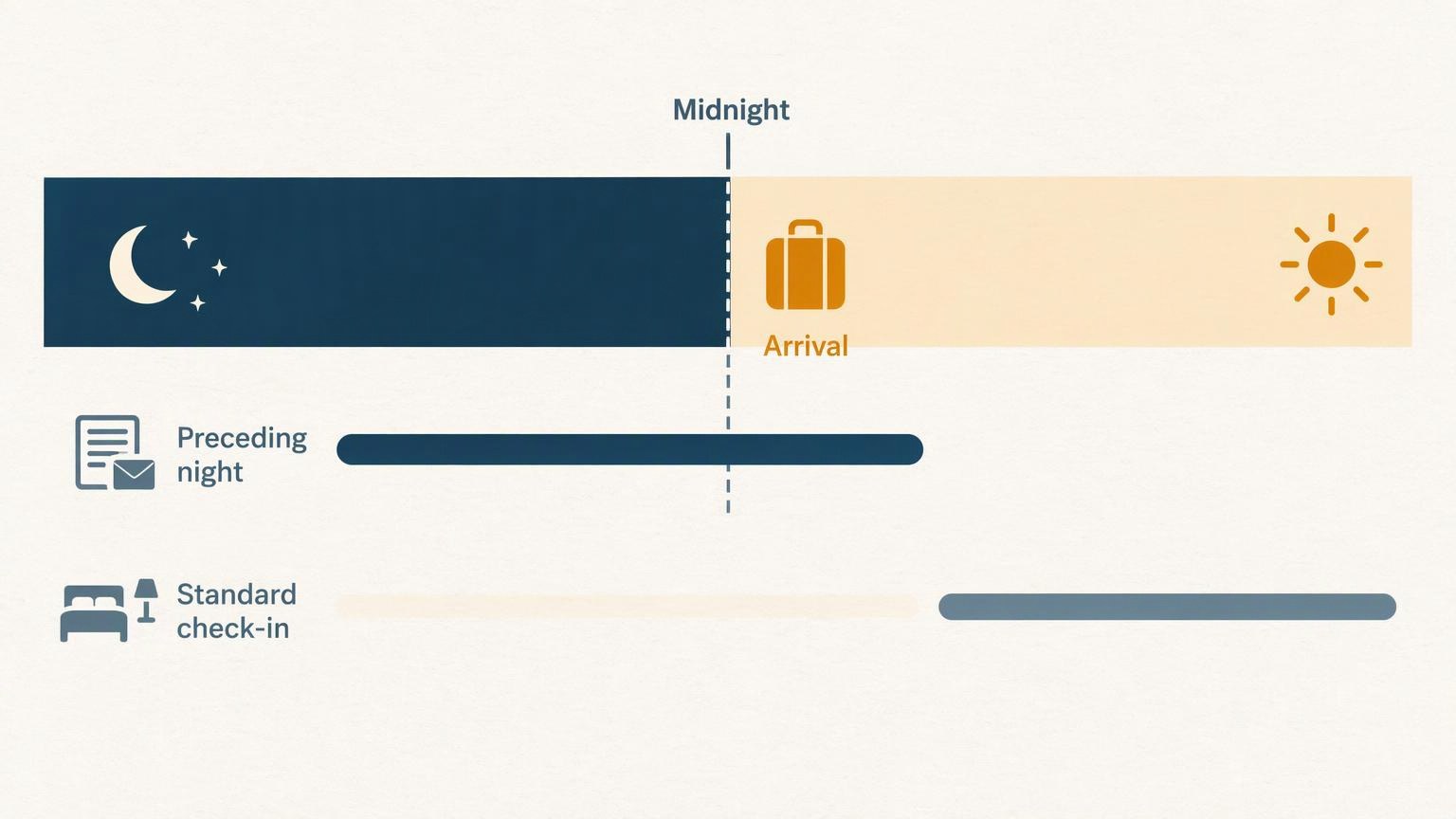
Illustration comparing two timing tracks: a preceding-night bar crosses midnight and arrival, while the standard check-in bar begins later, leaving a gap after arrival.
I would treat an early check-in request as a preference, not guaranteed access. If a bed, shower and privacy are essential on arrival, the reservation needs to cover that requirement explicitly.
Imagine reaching the hotel in the morning after an overnight flight, with an evening activity planned. I would estimate hotel arrival after formalities and the transfer, then compare it with the property's stated check-in time. That reveals the waiting period.
If immediate rest is optional, I would keep normal dates and leave the morning unscheduled. If access is essential, I would compare any confirmed earlier-access option with the preceding night. Neither should be assumed available. The preceding night also requires accepted late-arrival arrangements, so the property does not mistake you for a missed arrival.
I would compare the full quoted cost, included access period and cancellation terms. An extra night may cover more time than you need; earlier access only works if its terms cover your arrival. Ask me, Lynne Kaplan, for a current quote.
For a honeymoon or safari itinerary, I would weigh that expense against the first day's pace. I connect accommodation with the trip; the property confirms access.
| Option | Best fit | Required details |
|---|---|---|
| Standard check-in | You can wait | Check-in time and waiting plan |
| Confirmed early access | Earlier access matters | Written access time and charge |
| Preceding night | Immediate overnight access | Start date and accepted late arrival |
| Option | Best fit | Confirm |
|---|---|---|
| Standard check-in | You can wait | Check-in time and waiting plan |
| Confirmed early access | Earlier access matters | Written access time and charge |
| Preceding night | Immediate overnight access | Start date and accepted late arrival |
I would work backward from when you must leave the property, rather than copy the flight date into checkout. A late departure can leave a room-access gap. A flight shortly after midnight may mean leaving the hotel on the preceding evening.
I would decide what you need during that gap. Luggage storage is different from a private bathroom, bed or continued use of your room. A waiting plan works only if it meets your actual needs.
For escorted tours and river cruises, I would connect hotel departure to the onward transfer or joining time. The next itinerary event, rather than the airport alone, determines when the stay ends.
I would compare late checkout, a day room or another night only where offered. The full charge and included access matter more than the option's name; the shortest-sounding arrangement is not necessarily cheapest.
I would also review cancellation conditions and additional charges, not just the nightly rate. Keeping dates, access agreements and applicable terms together lets me assess whether the reservation covers the intended journey, including the final afternoon, without buying room time you do not need.
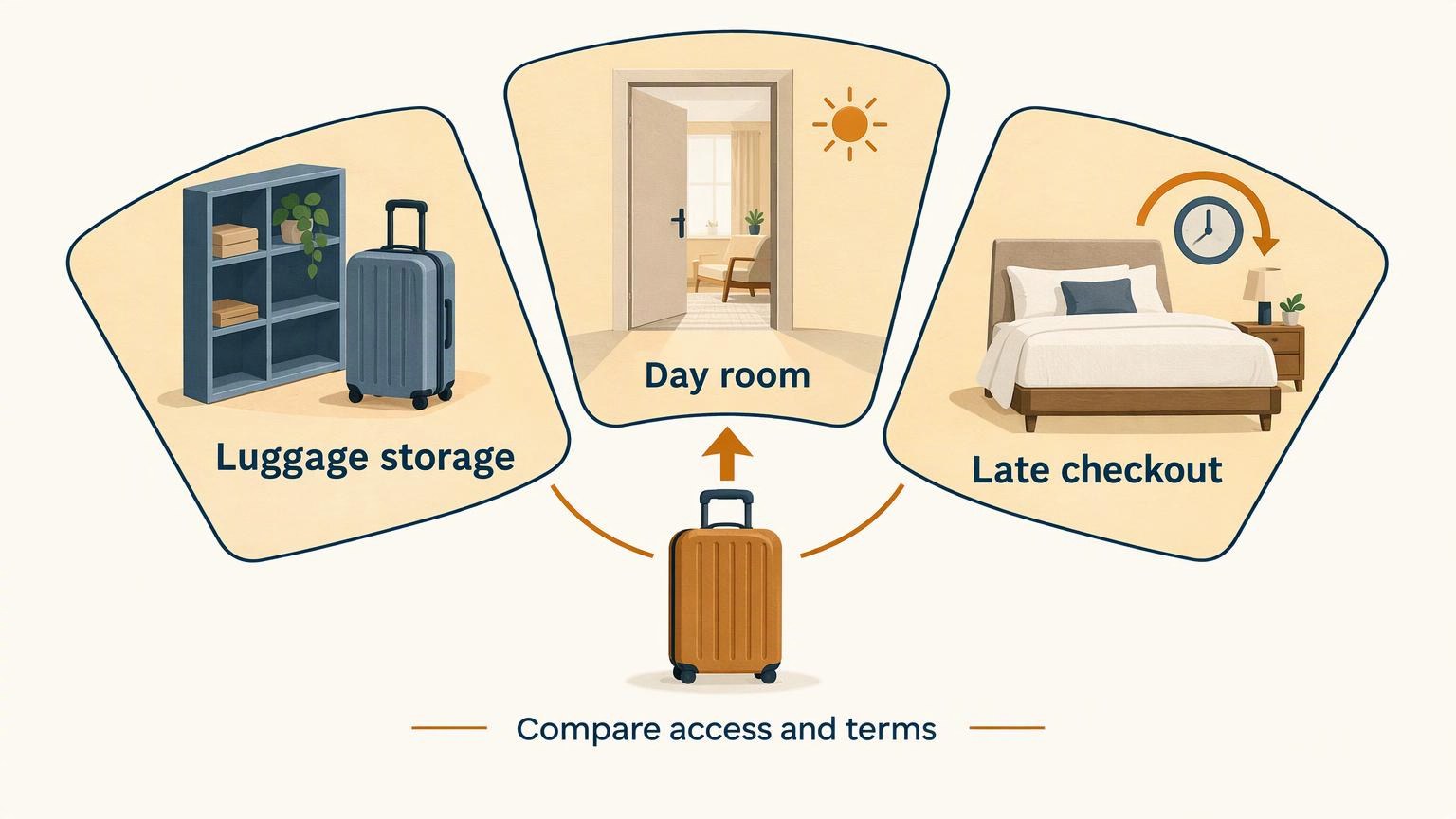
Illustration comparing luggage storage, day room and late checkout, with a suitcase beneath three option tiles and the reminder ‘Compare access and terms’.
Share the destination, dates and travel style you have in mind. A Superior Travel advisor will help turn the possibilities into one clear, personal plan.